Few places in Egypt bring visitors as close to the world of the pharaohs as the Valley of the Kings in Luxor. Hidden among the rugged cliffs of the West Bank of the Nile, this ancient necropolis contains more than sixty known tombs, including the famous tomb of Tutankhamun. Walking through its narrow valley and entering the decorated underground chambers offers a remarkable opportunity to explore how ancient Egyptians imagined death, rebirth, and eternal life.
The Valley of the Kings was not simply a cemetery. It was part of a carefully planned religious landscape connected with the ancient city of Thebes, one of the most important centers of ancient Egyptian civilization. The temples, tombs, settlements, workshops, and sacred landscapes of Thebes together form one of Egypt’s greatest archaeological areas and have been recognized as a UNESCO World Heritage Site since 1979.
For travelers staying in Hurghada, visiting the Valley of the Kings can turn a beach holiday into a journey through thousands of years of history. A well-planned Luxor excursion allows visitors to combine the necropolis with other major monuments on the West and East Banks of the Nile.
Whether you are fascinated by ancient history, archaeology, architecture, mythology, or photography, the Valley of the Kings deserves a place on your Egypt itinerary.
Where Is the Valley of the Kings?
The Valley of the Kings is located on the West Bank of the Nile in Luxor, the modern city that developed around the ancient Egyptian capital of Thebes.
The Nile divides modern Luxor into two main areas. The East Bank contains important monuments such as Karnak Temple and Luxor Temple, while the West Bank is dominated by ancient funerary landscapes, temples, tombs, and archaeological sites.
UNESCO describes the West Bank as part of the vast Theban Necropolis, where archaeologists have discovered thousands of tombs as well as temples, settlements, workshops, shrines, and other remains.
The Valley of the Kings occupies a naturally isolated desert valley surrounded by limestone cliffs. Its dramatic setting immediately distinguishes it from the monumental temples located closer to the Nile.
The landscape itself was an important part of the ancient Egyptians’ religious thinking.
Why Was the Valley of the Kings Created?
The Valley of the Kings was developed during Egypt’s New Kingdom, roughly from 1550 to 1069 BC. During this period, many rulers of the Eighteenth, Nineteenth, and Twentieth Dynasties were buried in the valley.
But why did Egyptian kings abandon the enormous pyramid tombs associated with earlier periods?
One major reason was security.
The great pyramids were impressive monuments, but their enormous size also made them visible from a great distance. Tomb robbers knew where royal burials were located, and many earlier royal tombs had been looted.
New Kingdom rulers therefore adopted a different strategy. Instead of constructing enormous pyramids as their burial places, they created hidden underground tombs in a remote desert valley.
The Ministry of Tourism and Antiquities explains that the isolated location of the Valley of the Kings was deliberately chosen partly because the Egyptians were aware of the danger of tomb robbery. The valley also carried deep religious significance because of its location on the western side of the Nile.
Why Is the West Bank Important?
The choice of the western side of the Nile was not accidental.
Ancient Egyptians associated the setting sun in the west with death, while the rising sun in the east symbolized rebirth.
As the sun appeared to disappear every evening and return each morning, it provided a powerful religious image for the cycle of death and regeneration.
For this reason, many funerary monuments were built on the West Bank of the Nile.
The Valley of the Kings was therefore not an isolated cemetery disconnected from the rest of Thebes. It formed part of a larger sacred landscape that included mortuary temples, worker settlements, private tombs, and religious monuments.
The Natural Pyramid of the Valley
One of the most fascinating features of the Valley of the Kings is the pyramid-shaped peak known as el-Qurn.
The mountain rises dramatically above the surrounding landscape and resembles a natural pyramid.
For the ancient Egyptians, this shape had symbolic importance. The pyramid was strongly associated with rebirth and eternal life, so the presence of a natural pyramid above the valley may have reinforced the area’s religious significance. The Ministry of Tourism and Antiquities also connects the valley’s sacred landscape with Hathor in her funerary aspect as the “Mistress of the West.”
This combination of natural landscape and religious symbolism helps explain why the valley was considered such an appropriate place for royal burials.
How Many Tombs Are in the Valley of the Kings?
The Valley of the Kings contains more than sixty tombs, along with around twenty additional unfinished tombs or excavations that are little more than pits.
The tombs are traditionally identified by numbers beginning with the abbreviation KV, meaning “King’s Valley.”
For example:
- KV9 – Tomb of Ramesses V and Ramesses VI
- KV17 – Tomb of Seti I
- KV62 – Tomb of Tutankhamun
Not every tomb belonged to a pharaoh. Members of the royal family and some exceptionally high-ranking non-royal individuals were also buried in the Valley.
The East Valley is by far the better-known section and contains most of the famous tombs visited by tourists. The West Valley contains fewer tombs but remains archaeologically important.
What Does an Egyptian Royal Tomb Look Like?
Unlike the pyramids of Giza, the royal tombs in the Valley of the Kings are largely hidden underground.
A typical tomb may contain a sequence of corridors, stairways, chambers, halls, and a burial chamber.
The exact design changed over time.
Some tombs follow relatively straight axes, while others contain changes in direction, descending passages, pillared halls, side chambers, and increasingly elaborate decorative programs.
The deeper a visitor walks into some tombs, the more clearly it becomes possible to understand the ancient concept of a journey through the underworld.
The tomb was not simply a room where the body was placed.
It was a symbolic pathway.
Tomb Paintings and the Journey to the Afterlife
One of the greatest attractions of the Valley of the Kings is its extraordinary wall decoration.
Ancient Egyptian artists covered many tomb walls with scenes, hieroglyphs, religious texts, gods, rituals, astronomical imagery, and representations of the afterlife.
These decorations were not created merely for artistic beauty.
They were part of a religious program intended to help the deceased king navigate the dangers of the afterlife and achieve eternal existence.
Among the important funerary compositions found in the Valley are texts such as:
- The Amduat
- The Book of Gates
- The Book of Caverns
- The Book of the Earth
- The Litany of Re
- Books of the Heavens
- The Book of the Dead
Different tombs contain different combinations of texts and images.
The Amduat and the Night Journey
The Amduat describes the journey of the sun god through the underworld during the twelve hours of night.
The sun’s journey was more than an astronomical concept. It was also a powerful metaphor for transformation.
The sun disappeared into darkness but emerged again at dawn.
The deceased king was symbolically connected with this process of death, regeneration, and rebirth.
Visitors can see this religious idea represented in several Valley of the Kings tombs.
The Ministry of Tourism and Antiquities explains that the funerary texts in tombs such as Ramesses VI’s describe the underworld and the sun god’s nocturnal journey, helping connect the deceased ruler with the promise of rebirth at dawn.
The Tomb of Ramesses VI
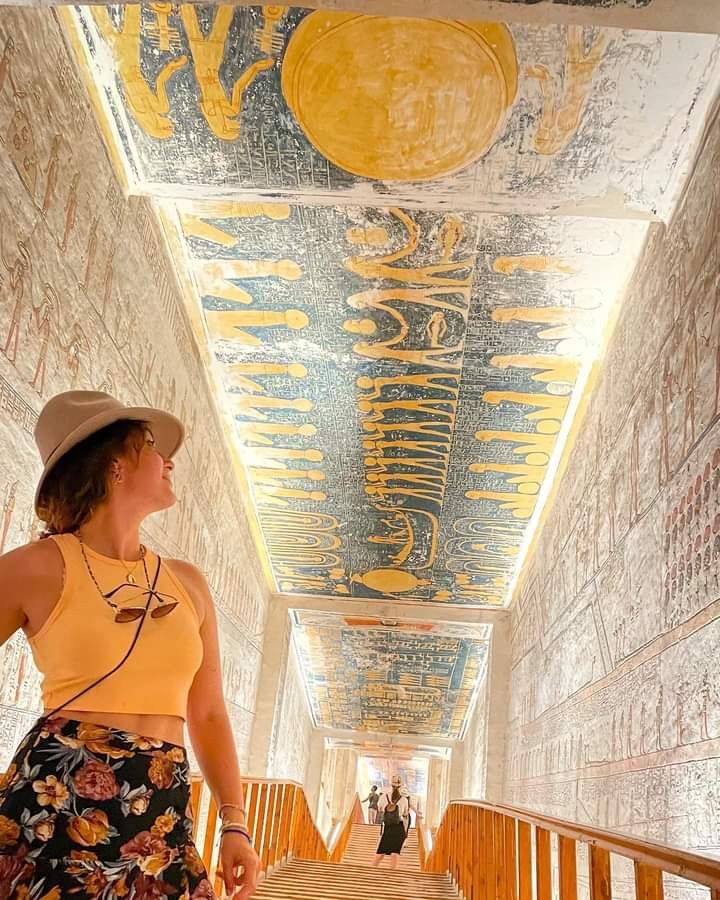
The tomb of Ramesses VI, known as KV9, is one of the visually impressive tombs in the Valley of the Kings.
The tomb was originally begun by Ramesses V, but his successor Ramesses VI enlarged it and used it for his own burial.
Its design consists largely of descending corridors leading toward the burial chamber.
The walls are decorated with a variety of funerary books, while astronomical scenes appear on the ceilings.
Among the texts represented are the Book of Gates, Book of Caverns, Amduat, Book of the Dead, and Book of the Earth.
For visitors, one of the most striking features is the combination of deep underground architecture and colorful religious decoration.
Walking through the corridors can feel like entering a giant illustrated religious manuscript carved into stone.
The Tomb of Seti I
Another extraordinary tomb is KV17, the tomb of Seti I.
Seti I was the second ruler of Egypt’s Nineteenth Dynasty and the father of Ramesses II.
The Egyptian Ministry describes his tomb as one of the longest, deepest, and most beautifully decorated tombs in the Valley of the Kings. It was also the first tomb in the valley to be entirely decorated.
The tomb contains scenes from several important funerary texts, including the Litany of Re, Amduat, and Book of Gates.
Its burial chamber also features astronomical decoration.
The tomb has a particularly interesting architectural feature: its passages continue deep into the rock, creating a powerful symbolic connection with the regenerative world of the underworld.
Giovanni Belzoni and the discovery of KV17
The tomb became famous in modern times after its discovery by Giovanni Battista Belzoni in 1817.
Belzoni later created painted reproductions of several rooms and displayed them in London in 1821.
This helped introduce European audiences to the extraordinary decorated tombs of ancient Egypt.
Today, the tomb remains an important example of the artistic and architectural ambitions of New Kingdom royal burial places.
Tutankhamun – The Tomb That Changed Archaeology
No discussion of the Valley of the Kings would be complete without Tutankhamun.
His tomb, KV62, became one of the most famous archaeological discoveries in history after it was found by Howard Carter in 1922.
The discovery attracted worldwide attention because the tomb contained an extraordinary collection of objects, including the famous golden burial equipment associated with the young king.
The Egyptian Ministry of Tourism and Antiquities describes Tutankhamun’s tomb as the only royal tomb in the Valley of the Kings discovered relatively intact.
Yet there is an interesting surprise.
The tomb itself is actually quite modest compared with several other royal tombs in the valley.
Its importance comes not from its enormous size but from the remarkable quantity and quality of objects discovered inside.
Why Was Tutankhamun’s Tomb So Important?
The discovery of Tutankhamun transformed public interest in ancient Egypt.
Although Tutankhamun was not one of the most powerful or longest-reigning pharaohs, his burial treasure made him one of the most recognizable names in Egyptian history.
The discovery also offered archaeologists an unusually rich collection of evidence about royal burial practices, craftsmanship, religious beliefs, clothing, furniture, weapons, jewelry, and other aspects of elite life.
The contrast between the relatively small tomb and its extraordinary contents raises an intriguing question:
What must the tombs of the most powerful New Kingdom kings have contained before ancient tomb robbers emptied them?
That question remains one of the enduring mysteries of the Valley of the Kings.
Archaeological Discoveries Beyond Tutankhamun
Tutankhamun is only one chapter in the archaeological story of the valley.
Explorers and archaeologists have spent centuries documenting tombs, inscriptions, objects, architectural details, and evidence of ancient burial practices.
The Valley continues to contribute to our understanding of New Kingdom religion and royal culture.
Every tomb offers a slightly different combination of architecture and decoration.
Some contain beautifully preserved paintings. Others are unfinished. Some were reused or modified. Others reveal traces of later activity.
This makes the Valley of the Kings more than a collection of famous tourist sites.
It is an enormous archaeological archive.
What Can the Tomb Paintings Tell Us?
The paintings inside the tombs provide valuable information about ancient Egyptian beliefs.
They show gods, divine beings, rituals, celestial imagery, offerings, symbolic landscapes, and scenes connected with the afterlife.
But the tomb decorations also tell us about artistic conventions.
Artists used carefully selected colors and repeated visual symbols. Figures were represented according to established conventions, while hieroglyphic inscriptions added religious and explanatory information.
The result is a combination of writing, art, architecture, and religion.
Visitors who take time to look closely may notice that the walls are not simply covered with random images.
They tell a story.
The Valley as a Religious Landscape
It is easy to think of the Valley of the Kings as a collection of individual tombs.
In reality, the valley formed part of a much larger religious landscape.
Royal tombs were connected with mortuary temples, where the cult of deceased kings could be maintained.
The Ministry of Tourism and Antiquities explains that royal mortuary temples were complementary to tombs and served as places where the cults of deceased kings could continue.
This is why a visit to the Valley becomes even more meaningful when combined with monuments such as the Temple of Hatshepsut, the Colossi of Memnon, Karnak Temple, and Luxor Temple.
Together, these sites reveal different parts of the ancient Egyptian understanding of kingship and the afterlife.
The Valley of the Kings and Ancient Thebes
Ancient Thebes was one of Egypt’s most important cities during the Middle and New Kingdoms.
The city was strongly associated with the god Amun and became a major political and religious center.
UNESCO’s World Heritage description emphasizes that the monuments of Thebes provide evidence of Egyptian civilization at its height, including temples, tombs, royal palaces, inscriptions, artistic representations, and settlements connected with the people who created and maintained these monuments.
The Valley of the Kings was therefore part of a much larger civilization.
The tombs cannot be fully understood without considering the temples, priests, artisans, workers, religious traditions, and political power that surrounded them.
Deir el-Medina – The Village Behind the Tombs
One of the most fascinating sites near the Valley is Deir el-Medina, the settlement associated with the craftsmen who created many of the royal tombs.
The existence of such a community helps us understand that the Valley was not created by anonymous workers alone.
Highly skilled artists, architects, stoneworkers, painters, scribes, and other specialists were involved in the construction and decoration of royal tombs.
Their work survives today in the corridors and chambers visited by travelers.
The Theban World Heritage property includes the town and tombs of the workers of the royal tombs at Deir el-Medina.
This connection adds another layer to a visit.
When you look at a beautifully painted royal tomb, you are also looking at the work of the craftsmen who transformed a dark underground space into a carefully planned religious environment.
Valley of the Kings From Hurghada
For travelers staying in Hurghada, a trip to Luxor offers a completely different side of Egypt.
Instead of beaches and the Red Sea, the journey leads toward the Nile Valley, ancient temples, royal tombs, and desert landscapes.
A typical full-day Luxor excursion may combine several West Bank highlights with monuments on the East Bank.
Depending on the itinerary, travelers may visit:
- Valley of the Kings
- Temple of Hatshepsut
- Colossi of Memnon
- Karnak Temple
- Luxor Temple
The exact itinerary depends on the tour operator and the selected package.
For travelers looking to organize a trip from Hurghada, Best Tours Hurghada can be a useful option to explore when planning a Luxor excursion and comparing available itineraries.
A good itinerary should leave enough time to appreciate the Valley rather than rushing through several monuments without understanding their historical connections.
How Long Should You Spend in the Valley?
The ideal amount of time depends on how many tombs are open during your visit and how interested you are in archaeology.
A short visit can provide an impressive introduction.
However, travelers who enjoy history and ancient art may want more time to examine the decoration, architecture, and inscriptions.
The valley can also become physically demanding because visitors may walk on uneven ground and enter underground tombs with stairs and sloping corridors.
Comfortable footwear is therefore a good idea.
Valley of the Kings Opening Hours
According to the current information published by Egypt’s Ministry of Tourism and Antiquities, the Valley of the Kings is listed as open daily from 6:00 AM to 5:00 PM. The same official page currently lists a general foreign visitor admission price of EGP 750 for adults and EGP 375 for students.
However, opening hours, ticket prices, included tombs, and special-access fees can change.
Some individual tombs have separate admission requirements or prices. For example, the official Ministry page currently lists different ticket information for the tombs of Seti I and other special tombs.
Therefore, it is sensible to check the official information shortly before your visit.
What Should You Wear?
Luxor can be very hot, especially during the warmer months.
Light, comfortable clothing is practical, while comfortable walking shoes are particularly important.
A hat, sunglasses, sunscreen, and drinking water can also make a major difference.
Inside some tombs, the temperature and atmosphere can feel different from outside, but the walk between tombs takes place in an exposed desert environment.
Planning for both conditions is therefore useful.
Is Photography Allowed?
Photography rules can vary between monuments and can change over time.
Some tombs may allow photography under specific conditions or require an additional photography ticket, while other areas may restrict it.
Visitors should always follow the current instructions at the site.
Even when photography is allowed, flash photography can be restricted because of conservation concerns.
Most importantly, visitors should avoid touching walls or painted surfaces.
The paintings have survived for thousands of years, but they remain part of a fragile archaeological environment.
Why Should You Avoid Touching the Walls?
The decorated walls may look solid and durable.
However, ancient pigments, plaster, reliefs, and surfaces can be extremely sensitive to human contact.
Hands can transfer oils and moisture to ancient surfaces, while repeated physical contact can contribute to deterioration.
The best way to appreciate a tomb is therefore to observe the decoration without touching it.
Respecting conservation rules helps ensure that future generations can experience the same extraordinary paintings.
The Valley of the Kings for Families
A visit to the Valley can also be fascinating for older children and teenagers.
Instead of simply looking at ruins, families can turn the visit into a historical mystery.
Who was buried here?
Why were the tombs hidden?
What do the hieroglyphs mean?
Why did Egyptians associate the west with death?
How did archaeologists discover the tombs?
Why was Tutankhamun’s tomb so famous?
Questions like these can make the experience much more engaging.
Younger children may find the heat and walking challenging, so families should consider the time of day, hydration, breaks, and the number of monuments included in the itinerary.
Valley of the Kings for History Lovers
For anyone interested in ancient Egypt, the Valley is one of the most rewarding places to visit.
The experience combines several subjects at once:
History: Learn about New Kingdom rulers and royal burial traditions.
Archaeology: Explore excavated tombs and the history of their discoveries.
Religion: Understand ancient Egyptian ideas about death and rebirth.
Art: Examine paintings, reliefs, colors, and hieroglyphs.
Architecture: Observe how tomb designs developed over time.
Geography: See how the Nile, desert, cliffs, and sacred landscapes shaped the location of monuments.
This combination is what makes the Valley so powerful.
The Valley of the Kings Is More Than Tutankhamun
For many first-time visitors, Tutankhamun is the main reason they know about the Valley.
But the site is much larger than one famous tomb.
Seti I’s tomb reveals extraordinary artistic ambition.
Ramesses VI’s tomb demonstrates the complexity of funerary texts.
Other tombs provide evidence of different periods, rulers, architectural ideas, and religious traditions.
Once you understand this, the Valley becomes less about finding one famous name and more about discovering how an entire civilization imagined eternity.
A Journey Through the Footsteps of the Pharaohs
Standing at the entrance to an ancient tomb, it is easy to imagine the people who worked here thousands of years ago.
Stonecutters shaped the corridors.
Artists painted gods and kings.
Scribes carefully carved hieroglyphs.
Priests performed rituals.
Workers transported materials into the desert.
The royal burial eventually disappeared behind sealed doors.
Centuries later, archaeologists returned to the valley and began uncovering its secrets.
Today, travelers walk through those same passages.
The experience creates a remarkable connection between the ancient world and the present.
Frequently Asked Questions
What is the Valley of the Kings?
The Valley of the Kings is an ancient royal necropolis on the West Bank of the Nile in Luxor. It contains more than sixty known tombs and was primarily used for royal burials during Egypt’s New Kingdom.
Why were pharaohs buried in the Valley of the Kings?
The valley offered a secluded location that helped hide royal burials from tomb robbers. Its position on the West Bank and its sacred landscape also connected it with ancient Egyptian beliefs about death, the setting sun, and rebirth.
How many tombs are in the Valley of the Kings?
The official Egyptian Ministry of Tourism and Antiquities currently describes more than sixty tombs, along with around twenty unfinished tombs or pits.
Can I visit Tutankhamun’s tomb?
Yes, Tutankhamun’s tomb is a major attraction within the Valley of the Kings. However, access and ticket arrangements can be subject to the current rules of the archaeological site, so visitors should check official information before traveling.
Is the Valley of the Kings a UNESCO World Heritage Site?
The Valley of the Kings forms part of Ancient Thebes with its Necropolis, which was inscribed on the UNESCO World Heritage List in 1979.
How long does a visit to the Valley of the Kings take?
A visit can take several hours depending on the number of tombs you enter and how much time you spend studying the paintings and architecture. A full Luxor day trip usually combines the Valley with several other monuments.
What is the best time to visit the Valley of the Kings?
Early morning is generally a comfortable choice because the desert environment can become very hot later in the day. Starting early can also make it easier to explore the site before the strongest heat.
Is the Valley of the Kings suitable for children?
Yes, particularly for children who are interested in history and archaeology. However, families should consider the heat, walking distances, stairs, and underground passages when planning the visit.
What should I bring to the Valley of the Kings?
Comfortable walking shoes, water, sun protection, sunglasses, and a hat are useful. A camera can also be useful if photography is permitted under the current site rules.
Final Thoughts
The Valley of the Kings is one of the places where ancient Egyptian history feels remarkably close.
Behind every decorated wall is a story. Behind every corridor is an ancient religious idea. Behind every tomb is the ambition of a ruler who hoped to continue his existence beyond death.
The valley was created during one of the most powerful periods in Egyptian history, when the pharaohs of the New Kingdom ruled a prosperous and influential civilization.
Today, the tombs allow visitors to explore that world through architecture, paintings, hieroglyphs, mythology, and archaeology.
From the extraordinary tomb of Seti I to the famous burial place of Tutankhamun and the richly decorated tomb of Ramesses VI, each site offers a different perspective on ancient Egypt.
For travelers staying in Hurghada, a Luxor excursion with Best Tours Hurghada can provide an opportunity to move beyond the Red Sea and discover the monuments of the Nile Valley.
Ultimately, the Valley of the Kings is not simply a place where pharaohs were buried.
It is a place where history, religion, art, archaeology, and the ancient Egyptian idea of eternal life come together.
And as you walk through the silent corridors beneath the cliffs of Luxor, you are not simply visiting an archaeological site.
You are following the footsteps of the pharaohs.