
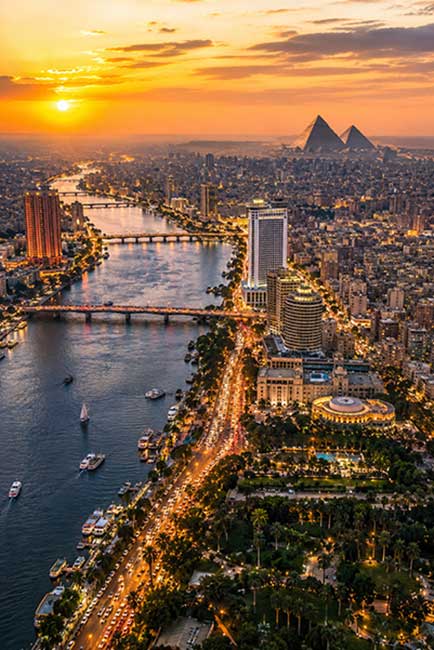
Egypt is a country of remarkable contrasts. In one direction, the Red Sea opens into clear blue water filled with colorful coral reefs. In another, vast deserts stretch toward distant mountains and rocky valleys. Between these landscapes, the Nile creates a green ribbon of fertile land, while ancient temples, tombs, pyramids, and historic cities reveal thousands of years of human history.
For many travelers, Egypt is immediately associated with the Pyramids of Giza. They are undoubtedly among the country’s most famous landmarks, but they represent only one part of what makes Egypt beautiful. The country offers a much wider variety of landscapes and experiences.
You can watch the sunrise over the desert, sail along the Nile, explore ancient temples in Luxor, swim in the Red Sea, walk through historic neighborhoods in Cairo, or discover peaceful oases far from the major cities. Each destination presents a different side of Egypt.
This diversity also makes Egypt suitable for different types of travelers. Beach lovers can focus on the Red Sea, history enthusiasts can explore ancient monuments, photographers can search for dramatic landscapes, and adventure travelers can head into the desert.
If you are planning an Egypt vacation from Hurghada, Best Tours Hurghada can also be useful when organizing excursions that combine coastal experiences with cultural and historical destinations.
Why Egypt Has So Many Beautiful Places
Egypt’s landscapes are shaped by several very different environments. The Nile Valley supports agriculture and settlements, while much of the country consists of desert. The Red Sea coast adds mountains, coral reefs, islands, and beaches.
This geographical variety means that two days in Egypt can feel completely different.
You might begin the morning surrounded by ancient stone monuments and finish the afternoon beside turquoise water. Another day could take you from a busy city to a quiet desert landscape within a few hours.
The beauty of Egypt therefore does not come from a single type of scenery. It comes from the contrast between different environments.
The Red Sea – A World of Blue and Coral
The Red Sea coast is one of Egypt’s most spectacular natural areas. Its clear water, coral reefs, colorful fish, islands, and desert mountains create a landscape that looks completely different from the Nile Valley.
Hurghada – Beaches, Islands and Marine Life
Hurghada is one of the best-known destinations on Egypt’s Red Sea coast. The city combines beaches, hotels, restaurants, marinas, boat excursions, and easy access to the sea.
One of the biggest attractions is the marine environment. Depending on the location and conditions, visitors can discover coral reefs and observe numerous species of tropical fish.
You do not necessarily have to be a diver to appreciate this environment. Snorkeling, glass-bottom boat trips, and organized cruises provide different ways to experience the Red Sea.
The contrast between the dry desert behind Hurghada and the intense blue of the sea makes the area especially attractive for photographers.
Giftun Islands
The Giftun Islands are another popular destination near Hurghada. Their beaches, clear water, and surrounding marine environment make them suitable for a relaxing day away from the city.
A typical island excursion may combine a boat ride, swimming, snorkeling, and time on the beach.
The scenery changes throughout the day. Morning light creates bright turquoise colors, while later sunlight produces deeper shades of blue.
For travelers who want to experience the Red Sea without spending an entire day underwater, an island excursion can provide a good balance between relaxation and exploration.
Marsa Alam – A Quieter Side of the Red Sea
Further south, Marsa Alam offers a different atmosphere. The region is known for its natural coastline, coral reefs, desert surroundings, and opportunities to observe marine life.
Places such as Abu Dabbab and Marsa Mubarak are associated with marine wildlife encounters. Depending on natural conditions, travelers may have opportunities to see sea turtles and other species.
However, wildlife sightings can never be guaranteed. Responsible travelers should observe animals from a respectful distance and avoid touching, feeding, or chasing them.
The combination of sea, desert, and relatively open landscapes makes Marsa Alam particularly interesting for nature lovers.
The Egyptian Desert – Beauty in Silence
Egypt’s deserts cover enormous areas, and they are far more diverse than a simple image of endless sand dunes might suggest.
There are rocky plateaus, mountains, valleys, salt formations, unusual rock structures, oases, and wide open spaces where the horizon seems endless.
The White Desert
The White Desert is one of Egypt’s most unusual landscapes. Located in the Western Desert, it is famous for its pale rock formations shaped over time by wind and erosion.
Some formations resemble giant mushrooms, animals, or abstract sculptures.
The landscape becomes especially dramatic around sunrise and sunset. Warm light changes the appearance of the white rocks, creating shadows and textures that are difficult to appreciate in photographs alone.
The White Desert is particularly appealing to photographers because its appearance changes throughout the day.
The Black Desert
The Black Desert offers a completely different visual experience.
Dark volcanic-looking hills and rocks contrast with the surrounding golden and sandy landscape. Instead of bright white formations, visitors encounter darker tones and rugged terrain.
The journey between desert landscapes demonstrates how varied Egypt’s Western Desert can be.
Siwa Oasis
Siwa Oasis is one of Egypt’s most distinctive destinations. Located far in the Western Desert, it combines palm groves, salt lakes, natural springs, desert landscapes, and traditional architecture.
The oasis has a slower rhythm than Egypt’s major tourist cities. Palm trees surround agricultural areas, while salt lakes create bright blue and white contrasts against the dry desert.
Siwa is also known for its local culture and distinctive architecture.
One of the most memorable experiences is watching the sunset from a high point overlooking the oasis and surrounding desert.
The view becomes especially beautiful as the sunlight gradually changes the colors of the landscape.
The Nile – Egypt’s Green Heart
The Nile is central to Egypt’s geography and history. Without the river, the country’s landscape would be dramatically different.
Along its banks, fertile agricultural land creates a striking contrast with the surrounding desert.
This contrast is one of the most beautiful features of the Nile Valley.
Nile Landscapes Around Luxor
Luxor provides some of the best opportunities to see the relationship between the river, agriculture, villages, and ancient monuments.
Green fields extend along parts of the Nile Valley, while dry desert hills rise beyond them.
A short distance away, travelers can visit ancient temples and tombs.
This combination makes Luxor particularly impressive. Ancient history is not separated from the landscape. Instead, temples, villages, fields, riverbanks, and desert exist within the same geographical setting.
A Nile Cruise
A Nile cruise offers another perspective.
Instead of simply visiting individual monuments, travelers move through the landscape itself. Along the way, they can see agricultural fields, villages, palm trees, boats, and changing scenery.
The pace of a river journey is also different from a road trip. The landscape passes gradually, giving travelers more time to observe details.
For photographers, early morning and late afternoon can be especially rewarding. Soft light highlights the contrast between the river, fields, and desert.
Luxor – Where Ancient Monuments Meet the Landscape
Luxor is one of the most important destinations for travelers interested in ancient Egypt.
The modern city stands near the remains of ancient Thebes, a major center of political and religious life.
Today, visitors can explore monuments on both sides of the Nile.
Karnak Temple
The Karnak Temple complex is one of Luxor’s most impressive attractions.
Its enormous columns, courtyards, pylons, statues, and inscriptions demonstrate the scale of ancient Egyptian architecture.
The Great Hypostyle Hall is particularly famous for its massive columns.
Walking through the complex allows visitors to appreciate how architecture, religion, symbolism, and political power were connected.
Luxor Temple
Luxor Temple has a different atmosphere.
It stands close to the modern city and was associated with important religious ceremonies.
The temple becomes particularly atmospheric in the evening when artificial lighting emphasizes its columns and monumental structures.
Its location also demonstrates how ancient and modern Luxor exist side by side.
Valley of the Kings
On the western bank of the Nile, the Valley of the Kings offers a completely different landscape.
Instead of enormous open courtyards, visitors enter rock-cut tombs built into the surrounding hills.
The valley was used as a burial place for numerous rulers of ancient Egypt.
The tombs contain corridors, chambers, painted scenes, and inscriptions that provide insight into ancient Egyptian beliefs about death and the afterlife.
The surrounding desert landscape adds to the atmosphere.
Temple of Hatshepsut
The Temple of Hatshepsut stands dramatically against the cliffs of Deir el-Bahari.
Its terraces and straight architectural lines contrast with the natural rock formations behind it.
The location itself is one of the reasons the monument is so photogenic.
Visitors can appreciate the architecture while also observing how ancient builders incorporated the natural landscape into the design.
Abu Simbel – Monumental Architecture in the Desert
Abu Simbel is located in southern Egypt, near Lake Nasser.
The site is famous for its enormous rock-cut temples and colossal statues.
The scale of the monuments is impressive, but their location also contributes to their beauty. The temples rise from an otherwise vast and dry landscape.
The journey to Abu Simbel requires more planning than many attractions around Luxor or Cairo. However, for travelers interested in ancient architecture, it can become one of the most memorable parts of a longer Egypt itinerary.
Cairo – A Historic City Full of Contrasts
Cairo offers a very different type of beauty.
Instead of natural silence or isolated monuments, the capital is full of movement, architecture, markets, mosques, museums, streets, and everyday life.
The city can feel intense, but that energy is part of its character.
The Pyramids of Giza
The Pyramids of Giza remain Egypt’s most recognizable landmarks.
The Great Pyramid of Khufu, the Pyramid of Khafre, and the Pyramid of Menkaure dominate the Giza Plateau.
The surrounding desert provides a dramatic setting, while modern Cairo is visible in the wider area.
The pyramids are especially impressive when viewed from different positions across the plateau. Their relationship with the surrounding landscape helps explain why they have remained such powerful symbols of ancient Egypt.
The Great Sphinx
The Great Sphinx stands near the pyramids and combines a human head with the body of a lion.
Its exact historical interpretation has been debated, but its monumental presence is undeniable.
The Sphinx also demonstrates how ancient Egyptian monuments were often designed as part of larger architectural landscapes rather than isolated objects.
Historic Cairo
Beyond the pyramids, Cairo has an extensive historic core.
Visitors can explore traditional streets, mosques, old buildings, markets, and architectural details that reveal different periods of Egyptian history.
Islamic Cairo is particularly interesting for travelers who want to understand the city beyond its ancient monuments.
Khan el-Khalili
Khan el-Khalili is one of Cairo’s best-known historic market areas.
Its narrow streets are filled with shops selling souvenirs, jewelry, crafts, spices, textiles, and other goods.
The area can be busy, but it offers a completely different experience from the quiet spaces around the pyramids.
Visitors should take time to look beyond the shops. Architectural details, old doorways, decorative elements, and traditional cafés provide plenty of photographic opportunities.
Aswan – Nile Beauty and Southern Landscapes
Aswan is often described as one of the most scenic cities along the Nile.
The river becomes especially beautiful here, with islands, granite rocks, palm trees, and warm-colored landscapes creating a distinctive atmosphere.
Philae Temple
Philae Temple is located on an island and is reached by boat.
The journey across the water adds to the experience. Instead of approaching the temple from a road, visitors gradually see the ancient structures appearing among the river landscape.
The combination of water, stone, and surrounding islands creates one of the most picturesque settings for an ancient Egyptian monument.
Felucca Sailing
A traditional felucca ride offers another way to experience Aswan.
These simple sailing boats move quietly along the Nile when conditions allow.
From the water, travelers can observe palm trees, islands, rocks, and riverbank landscapes without the noise of a busy road.
A late-afternoon sailing trip can be particularly atmospheric as the sun moves lower over the river.
Dendera – A Temple Filled With Detail
The Temple of Hathor at Dendera is another fascinating historical destination.
Unlike the vast open spaces of some major temple complexes, Dendera is especially interesting for its detailed reliefs, columns, inscriptions, and astronomical representations.
The temple provides an opportunity to look closely at ancient Egyptian decorative art.
For travelers who enjoy photography and architecture, the combination of carved stone surfaces, columns, shadows, and ancient inscriptions creates many interesting compositions.
Fayyum – Lakes, Desert and Rural Landscapes
The Fayyum region offers another example of Egypt’s geographical diversity.
Here, agricultural land, lakes, desert, and rural communities exist relatively close to one another.
Lake Qarun is one of the region’s most recognizable natural features.
Wadi El Rayan adds waterfalls and desert lakes to the landscape, creating a surprising contrast with the surrounding arid environment.
Nearby Wadi El Hitan, the Valley of the Whales, is particularly significant for its fossil discoveries and natural setting.
Fayyum is an excellent choice for travelers who want to explore a side of Egypt that is different from the traditional Cairo-Luxor-Red Sea route.
The Sinai Peninsula – Mountains, Coast and Desert
The Sinai Peninsula contains another striking combination of landscapes.
The region includes mountains, desert valleys, and coastal areas.
The landscape around Sharm El-Sheikh and the southern Sinai coast combines dry mountains with the clear waters of the Red Sea.
For travelers interested in nature and dramatic scenery, the contrast between rugged mountains and blue water can be particularly impressive.
However, visitors should always check current travel conditions and local guidance before planning excursions in any desert or remote area.
The Beauty of Egypt’s Historic Cities
Egypt’s beauty is not limited to natural landscapes and famous monuments.
Its cities also reveal layers of history.
Cairo shows Islamic, Coptic, modern, and contemporary influences. Luxor connects ancient monuments with everyday life along the Nile. Aswan offers a slower river atmosphere with distinctive Nubian influences.
Alexandria, on the Mediterranean coast, provides yet another perspective.
Its seaside location and long history make it different from the destinations along the Nile and Red Sea.
Exploring Egypt’s cities allows travelers to see more than monumental architecture. Markets, cafés, streets, food, local crafts, and daily life are all part of the country’s cultural landscape.
The Best Places in Egypt for Photography
Egypt offers extraordinary opportunities for photography because of its combination of scale, color, texture, and contrast.
Some particularly interesting subjects include:
- Red Sea beaches and coral reefs
- Boats and islands around Hurghada
- Desert landscapes
- White Desert rock formations
- Siwa’s salt lakes and palm groves
- Nile fields and riverboats
- Karnak’s columns
- Luxor’s temples
- Valley of the Kings
- Giza’s pyramids
- Historic Cairo
- Philae Temple
- Aswan’s river islands
- Dendera’s reliefs
Early morning and late afternoon often provide softer natural light.
At ancient sites, photographers should also respect site rules and avoid touching monuments or entering restricted areas.
How to Combine Egypt’s Most Beautiful Places
One of the biggest challenges is deciding which destinations to include.
Egypt is too large to experience everything in a short vacation.
If you are staying in Hurghada, the Red Sea can become the natural starting point. From there, you can add a historical excursion to Luxor or combine your beach holiday with a desert adventure.
A longer trip can include Cairo, Giza, Luxor, Aswan, and one or more natural destinations.
For example, a traveler with a week might choose:
Days 1–2: Relax in Hurghada and explore the Red Sea.
Day 3: Take a boat or island excursion.
Day 4: Explore Luxor and its ancient monuments.
Day 5: Enjoy a desert or cultural experience.
Days 6–7: Continue to another destination or return to the coast for relaxation.
A longer vacation allows more ambitious combinations, such as Cairo, Luxor, Aswan, and the Red Sea.
The most important point is to leave enough time between major excursions. Trying to visit every famous site can turn an exciting holiday into an exhausting schedule.
When Is the Best Time to Visit Egypt’s Beautiful Places?
Egypt can be visited throughout much of the year, but different seasons affect different activities.
For sightseeing, cooler months are generally more comfortable, especially when exploring large outdoor archaeological sites.
The Red Sea can be attractive throughout the year, although water and air temperatures vary.
Desert excursions require particular attention to heat, sun exposure, and the timing of activities.
Travelers should also consider the destination itself. A comfortable day on the coast may feel very different from several hours walking around an exposed archaeological site.
Planning activities around the conditions can make the experience much more enjoyable.
Responsible Travel in Egypt
Beautiful destinations remain beautiful only when visitors treat them with care.
At archaeological sites, avoid touching walls, reliefs, statues, or ancient surfaces.
In the desert, do not leave plastic, food packaging, or other waste behind.
At the Red Sea, never stand on coral or remove marine life. Do not feed fish or chase animals for photographs.
During wildlife encounters, keep a respectful distance and follow the instructions of guides and boat crews.
Responsible travel is not only about protecting nature. It also means respecting local communities, traditions, photography rules, and historic places.
Final Thoughts: Egypt Is More Than One Famous Landmark
The most beautiful places in Egypt cannot be reduced to a single list of monuments.
The country’s real attraction lies in its extraordinary variety.
The Red Sea offers clear water, coral reefs, islands, and marine life. The deserts create dramatic spaces filled with mountains, rocks, dunes, and silence. The Nile brings greenery and life through an otherwise arid landscape.
Then there are the ancient monuments.
The pyramids of Giza, temples of Luxor, Valley of the Kings, Abu Simbel, Philae, and Dendera reveal different chapters of Egypt’s long history.
Historic Cairo adds another dimension, while Aswan, Fayyum, Siwa, Marsa Alam, and the Sinai landscapes show that there is much more to discover beyond the most famous tourist attractions.
For travelers based in Hurghada, this variety makes it possible to build an itinerary around personal interests. You can spend one day exploring the Red Sea, another discovering the ancient world of Luxor, and another experiencing the desert.
With thoughtful planning, Egypt becomes more than a collection of famous sights. It becomes a journey through water, desert, river, architecture, culture, and history.
And that is perhaps what makes the country so memorable: within one destination, travelers can experience landscapes that seem to belong to completely different worlds.