
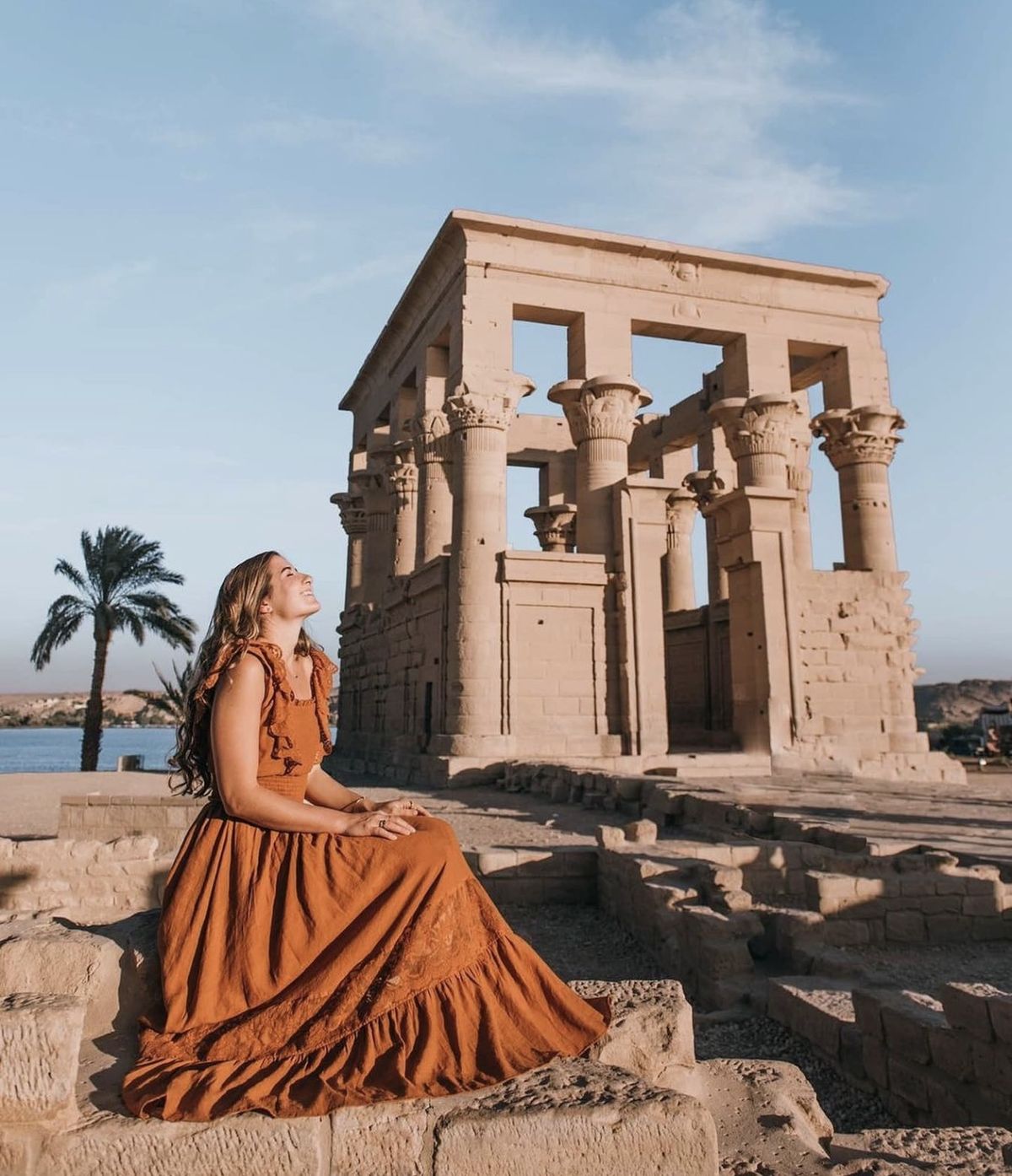
Philae Temple is one of the most fascinating ancient monuments in Egypt, not only because of its beautiful architecture, but also because of the extraordinary story behind its survival. Located near Aswan, the temple stands on Agilkia Island and appears to rise naturally from the waters of the Nile. Its columns, pylons, reliefs, and sanctuaries create a remarkable scene that attracts travelers from around the world.
Yet the temple you see today is not standing on its original island.
For centuries, Philae was located on a nearby island that carried the same name. The island was considered sacred and became one of the most important centers for the worship of Isis, one of the most powerful goddesses in ancient Egyptian religion. Over time, however, modern engineering projects changed the level of the Nile and placed the ancient sanctuary in serious danger.
The construction of the Aswan High Dam created an enormous reservoir. As the water rose, Philae was threatened with permanent flooding. Rather than allowing this important monument to disappear, archaeologists, engineers, and international organizations worked together on an ambitious rescue project. The temple complex was carefully dismantled, moved, and reconstructed on Agilkia Island.
Today, visitors can explore Philae and discover both stories: the ancient history of the sanctuary and the modern effort that saved it.
For anyone planning an Egypt itinerary, Philae offers much more than beautiful ruins. It provides an opportunity to understand ancient Egyptian religion, Ptolemaic architecture, Nubian history, the importance of the Nile, and one of the most impressive monument-preservation projects of the modern era.
Where Is Philae Temple?
Philae Temple is located near Aswan in southern Egypt, a region known for its dramatic Nile scenery, granite islands, palm trees, and strong Nubian cultural traditions. The temple complex is now situated on Agilkia Island, which can be reached by boat from the mainland.
The journey across the water is an important part of the experience. As the boat approaches the island, the ancient structures gradually appear between the rocks and trees. The setting is peaceful, and the contrast between the ancient stone buildings and the blue waters of the Nile creates one of the most memorable views in Aswan.
However, it is important to remember that Agilkia Island is not the original home of the temple.
Philae originally stood on Philae Island, which was located nearby. The relocation of the complex was necessary because rising water threatened to submerge the ancient buildings.
This unusual history makes Philae different from many other Egyptian temples. When you visit, you are not only seeing an ancient monument. You are also seeing the result of a major modern conservation project.
Why Is Philae Temple Important?
Philae is important for several reasons, and each one adds another layer to the visitor experience.
First, the temple was one of the most important religious centers dedicated to Isis. The goddess played a central role in Egyptian mythology and was worshipped for centuries.
Second, the architecture reflects the later periods of ancient Egyptian history. Much of the surviving complex was constructed during the Ptolemaic and Roman periods. This makes Philae especially valuable for understanding how traditional Egyptian religious architecture continued to develop long after the construction of the great pyramids.
The temple also has a strong connection with Nubia. Its location in southern Egypt placed it within a region where Egyptian and Nubian cultures interacted for thousands of years through trade, religion, politics, and migration.
Finally, Philae is famous for its rescue. The international campaign to save the temple from the rising waters of the Aswan High Dam became an important milestone in the history of cultural heritage preservation.
Together, these elements make Philae one of the most distinctive historical attractions in Egypt.
The Sacred Island of Philae
The original Philae Island was more than a beautiful place in the Nile. Ancient Egyptians considered it a sacred landscape, particularly because of its connection with Isis and the mythology surrounding Osiris.
Temples were built on the island over many centuries, and different rulers contributed to the religious complex. As a result, Philae developed gradually rather than being created according to one single architectural plan.
This long history explains the variety of buildings found at the site. Monumental pylons stand beside courtyards, sanctuaries, chapels, and elegant colonnades. Later Roman additions exist alongside structures built in traditional Egyptian styles.
The island also had a reputation that extended beyond the immediate region. Pilgrims and worshippers came to honor Isis, and the sanctuary remained important even during the later periods of Egyptian history.
When you walk through the complex today, you are therefore following the footsteps of people who regarded this island as a sacred place for generations.
Philae Temple and the Goddess Isis
The history of Philae is closely connected with Isis, one of the best-known goddesses of ancient Egypt.
Isis was associated with motherhood, protection, healing, magic, and family. She was also an essential figure in the mythology of Osiris and Horus, a divine family whose story influenced Egyptian religious beliefs for thousands of years.
According to the myth, Osiris was murdered by his brother Seth. After the death of Osiris, Isis searched for his body and worked to restore him. Their son Horus later became a central figure in the struggle against Seth and was closely associated with Egyptian kingship.
Philae became an important center for the worship of Isis because of these connections.
The reliefs and inscriptions found throughout the complex reflect this religious tradition. Gods and rulers appear together in ceremonial scenes, while hieroglyphic texts describe religious ideas and royal offerings.
For modern visitors, these carvings provide a valuable opportunity to see how ancient Egyptians represented their beliefs in stone.
The Myth of Isis, Osiris, and Horus
The story of Isis, Osiris, and Horus was not simply a myth told for entertainment. It helped ancient Egyptians understand important ideas about life, death, family, kingship, and renewal.
Osiris became associated with the afterlife and regeneration. Isis represented protection and restoration, while Horus became a symbol of royal power and the continuation of life.
These ideas were particularly meaningful in a civilization shaped by the Nile.
Every year, the river supported agriculture and brought life to the surrounding land. The natural cycle of water, planting, growth, and harvest reinforced Egyptian ideas about renewal.
Philae stood within this religious and natural landscape. Its location beside the Nile was therefore significant both physically and symbolically.
When Was Philae Temple Built?
Philae was developed over a long period, although much of the surviving architecture dates from the Ptolemaic and Roman eras.
The Ptolemaic dynasty ruled Egypt after Alexander the Great’s conquest and remained in power for several centuries. Although the rulers were of Macedonian Greek origin, they adopted many Egyptian traditions and presented themselves as pharaohs.
They continued building temples according to traditional Egyptian principles.
Philae is a particularly good example of this cultural combination. Its reliefs and architecture follow established Egyptian conventions, while the historical context belongs to a much later period.
Roman rulers later added their own structures and inscriptions to the complex.
As a result, Philae provides a window into the final centuries of ancient Egyptian religious architecture.
The Architecture of Philae Temple
The architecture of Philae is one of the first things visitors notice.
The complex includes massive pylons, courtyards, columns, sanctuaries, chapels, and walls covered with reliefs. These structures were not arranged randomly. They created a gradual movement from more public spaces toward increasingly sacred areas.
The monumental entrance creates a strong first impression. Once inside, visitors encounter courtyards and additional buildings before reaching the more private parts of the sanctuary.
This type of architectural progression was common in ancient Egyptian temples.
At Philae, however, the island setting makes the experience especially dramatic. Water and sky surround the buildings, while the granite landscape creates a natural frame.
The First Pylon of Philae
The First Pylon is one of the most impressive features of the temple.
A pylon consists of two massive towers surrounding a central entrance. Ancient Egyptian architects used these monumental gateways to mark the transition into sacred space.
The towers at Philae are decorated with reliefs and inscriptions. They show rulers interacting with gods and participating in religious ceremonies.
Standing in front of the pylon today gives visitors an idea of the scale and visual power that ancient temples were designed to create.
It is also a perfect place to slow down and examine the details. Although the entire structure looks impressive from a distance, the reliefs become more interesting when viewed closely.
Reliefs and Hieroglyphs at Philae
The walls of Philae contain a wealth of carved images and inscriptions.
Many scenes show kings making offerings to the gods. Others depict religious rituals and mythological events. Hieroglyphic inscriptions accompany numerous scenes and help explain the religious significance of the temple.
These carvings were not simply decorative.
Ancient Egyptian temples were places where religion, politics, and royal authority came together. The king was often shown performing rituals before the gods, reinforcing the idea that he had an important role in maintaining order between the human and divine worlds.
For visitors, the reliefs are also an excellent reminder that ancient Egyptian history is not limited to pyramids and tombs. Temples preserve a different type of historical information, particularly about religion and royal ceremonies.
The Temple of Isis
The central sanctuary at Philae was dedicated to Isis.
Ancient Egyptian temples were often described as houses of the gods. Religious rituals were performed by priests, who presented offerings and carried out ceremonies according to established traditions.
The sanctuary itself was therefore considered a sacred environment rather than simply a public building.
The Temple of Isis reflects this idea through its sequence of gateways, courtyards, halls, and more private spaces.
The closer visitors move toward the sanctuary, the more restricted the ancient religious environment would have become.
Today, travelers can explore much of this architectural sequence and imagine how different the complex must have felt when priests were actively performing rituals there.
The Birth House at Philae
One of the most interesting structures within the complex is the birth house, also known as a mammisi.
The building is connected with the birth of Horus, the son of Isis and Osiris.
Its reliefs help explain the mythology surrounding the divine family and show how Egyptian temples could include separate buildings for different religious traditions.
The birth house may be smaller than the main temple, but it is important for understanding the religious ideas associated with Philae.
It also gives visitors another opportunity to examine ancient reliefs and architectural details without focusing only on the main sanctuary.
The Kiosk of Trajan
The Kiosk of Trajan is one of the most recognizable structures at Philae.
Its open design and tall columns create a lighter appearance than the massive pylons and temple walls.
The kiosk dates from the Roman period and is associated with Emperor Trajan. Its position near the water makes it particularly attractive for photography.
Many visitors find that the kiosk looks especially impressive when viewed from a boat.
The columns frame the surrounding landscape, while the Nile creates a natural background.
For photographers, it is one of the best places at Philae to combine architecture and scenery in the same image.
The Temple of Hathor
Philae was not dedicated exclusively to Isis.
The complex also contains structures associated with other Egyptian deities, including Hathor.
Hathor was a major goddess connected with motherhood, music, joy, love, and femininity.
Her presence at Philae reflects the complexity of Egyptian religious traditions.
Ancient temple complexes could contain several sanctuaries and chapels. Different gods could have different roles, while their stories could also be connected through mythology.
Exploring these smaller structures helps visitors understand that Philae was a complete religious landscape rather than a single temple building.
Philae and Nubian Heritage
The story of Philae is also closely connected with Nubia.
Nubia was the historic region along the Nile south of Egypt and into present-day Sudan. Over thousands of years, Nubian and Egyptian communities interacted through trade, diplomacy, warfare, religion, and cultural exchange.
The area around Aswan was an important meeting point between these worlds.
This history gives southern Egypt a distinctive character.
A visit to Philae can therefore be combined with other experiences that introduce travelers to Nubian culture, traditional villages, local crafts, food, and the unique landscape of the Nile south of Aswan.
Ancient monuments are only one part of the region’s identity.
The Nile and the Landscape Around Philae
The Nile is essential to understanding why Philae looks so different from many other Egyptian archaeological sites.
Around Aswan, the river passes through a landscape filled with granite formations and small islands. Palm trees grow along parts of the shoreline, while the surrounding desert creates a striking contrast.
The river has always been central to life in the region.
It provided transportation, water, food, and communication.
For ancient communities, the Nile was also deeply connected with religion and mythology.
At Philae, this relationship is especially visible because the temple itself is surrounded by water.
The landscape is therefore not simply a beautiful setting. It is part of the history of the monument.
How the Aswan Dam Threatened Philae
The modern history of Philae began to change when dams were constructed across the Nile near Aswan.
The first Aswan Dam changed water levels around the original island. As a result, the temple was periodically exposed to flooding.
This repeated contact with water created serious preservation problems.
When plans for the Aswan High Dam were developed, the danger became much greater.
The new dam would create a huge reservoir and significantly raise water levels.
Philae could have been permanently submerged.
The threat was not limited to one temple. Many archaeological sites throughout Nubia faced a similar problem.
A large-scale international response was therefore required.
The Aswan High Dam and Ancient Monuments
The Aswan High Dam brought major benefits to modern Egypt.
It helped control the Nile, store water, support agriculture, and generate electricity.
However, the project also transformed the landscape of Nubia.
Rising water threatened archaeological sites and forced communities to move from areas that would be covered by the new reservoir.
For archaeologists, the situation created an urgent question:
How could important ancient monuments be protected before the water rose?
This question led to one of the largest cultural heritage campaigns of the 20th century.
The International Campaign to Save Philae
Egypt worked with international partners to protect monuments threatened by the rising waters.
UNESCO played an important role in the wider campaign to save the cultural heritage of Nubia.
The work involved archaeologists, engineers, architects, conservation specialists, and other experts.
Different monuments required different solutions.
Some were relocated.
Others were carefully documented or excavated before being submerged.
Philae was one of the most ambitious rescue projects because the entire temple complex needed to be dismantled and reconstructed.
The success of the campaign became an important example of what international cooperation could achieve in the field of heritage preservation.
How Was Philae Temple Moved?
Moving an ancient temple sounds almost impossible.
Philae, however, was not moved as one giant structure.
Instead, the complex was carefully dismantled.
Individual stones and architectural elements were documented and numbered. This step was essential because every block had to return to the correct position during reconstruction.
After dismantling, the pieces were transported to Agilkia Island.
There, the temple complex was rebuilt according to its original architectural arrangement.
The work required extraordinary precision.
It was not simply a construction project. It was a conservation project in which the historical identity of the monument had to remain intact.
Why Was Agilkia Island Selected?
Choosing the new location was an important part of the rescue.
The objective was not merely to find dry land.
The new site needed to recreate the character of the original island as closely as possible.
Agilkia Island was therefore reshaped to accommodate the temple complex.
The landscape was modified, and the buildings were reconstructed in a carefully planned arrangement.
The result is what visitors experience today.
Although the temple is no longer on its original island, its relationship with the surrounding water and landscape has been preserved remarkably well.
Philae: A Temple Saved Stone by Stone
The relocation of Philae is often described as a monument being moved.
That description does not fully explain the scale of the work.
A large ancient temple complex consists of thousands of architectural elements. Each stone has a specific place within the structure.
Some pieces are enormous.
Others are small.
Many contain inscriptions or reliefs that had to be protected.
The rescue therefore required detailed records and careful handling.
The successful reconstruction is one of the most impressive achievements in the modern history of Egyptian archaeology.
Why the Rescue of Philae Still Matters
The story of Philae remains relevant because cultural heritage is still vulnerable today.
Ancient monuments can be damaged by water, environmental changes, pollution, development, natural erosion, and excessive tourism.
Philae demonstrates that preservation can succeed when governments, experts, and international organizations work together.
It also shows why archaeological documentation matters.
Without careful records, moving a monument of this complexity would have been far more difficult.
The temple’s survival is therefore a reminder that protecting history requires both knowledge and long-term commitment.
What Does Philae Temple Look Like Today?
Today, Philae appears almost magical.
Ancient columns stand beside the Nile.
Granite rocks surround the island.
Palm trees rise behind the temple.
The desert landscape stretches beyond the water.
The combination creates a peaceful atmosphere that is very different from the busy streets of Cairo or the enormous archaeological fields around Giza.
The island setting also changes the way visitors experience the temple.
Instead of approaching by road, you cross the water first.
That journey creates a sense of separation from the modern world.
The Boat Ride to Philae Temple
For many visitors, the boat ride is one of the highlights of the trip.
The journey is short, but it provides a different perspective on the monument.
As you approach the island, the buildings become larger.
The First Pylon becomes visible.
The columns of the Kiosk of Trajan stand against the sky.
The water surrounds the ancient structures.
It is easy to understand why the original island was considered sacred.
The boat journey also provides excellent opportunities for photographs before you even enter the temple.
Best Time to Visit Philae Temple
The climate should be considered when planning a visit to Philae.
Aswan can become very hot, especially during the summer months. For many travelers, the cooler season provides a more comfortable experience.
Morning visits are also popular because temperatures are generally more pleasant.
Early light can create soft shadows across the temple walls and columns.
Late afternoon can also be beautiful, particularly for photography.
Before visiting, always check current opening times and local arrangements, as schedules can change.
How Long Do You Need at Philae?
Most travelers should allow around one to two hours for the main visit.
This gives enough time to walk through the complex, see the major structures, examine the reliefs, and take photographs.
However, history enthusiasts may want longer.
Philae contains many details that are easy to overlook when following a rushed itinerary.
If you have a strong interest in ancient Egyptian religion or architecture, consider giving the site additional time.
A slower visit is often more rewarding than trying to see everything as quickly as possible.
What Should You Bring?
A few practical items can make your visit easier.
Comfortable walking shoes are important because the site includes stone surfaces and uneven areas.
You should also bring drinking water, sunscreen, sunglasses, and a hat.
Light clothing can be useful in warm weather.
A camera or smartphone is worth bringing because Philae offers excellent photography opportunities.
It is also sensible to carry some cash for small expenses during the excursion.
Photography Tips for Philae Temple
Philae is an excellent destination for photography because the temple and landscape work together.
Do not wait until you reach the island before taking photographs.
The approach by boat offers beautiful wide views of the complex.
Once inside, experiment with different perspectives.
Photograph the pylons from a distance before moving closer to the reliefs.
Use doorways and columns to frame smaller details.
Look for reflections in the water.
The Kiosk of Trajan is especially photogenic because of its open structure and position near the river.
Most importantly, respect the monument while taking photographs. Avoid touching carvings or entering restricted areas simply to get a better picture.
Philae Temple for Families
Families can enjoy Philae because the visit combines history with a boat journey.
For children, crossing the Nile and arriving at an island temple can make ancient history feel more real.
Parents can also use the reliefs to introduce stories about Egyptian gods and mythology.
However, the heat should be considered when traveling with young children.
Bring enough water and plan short breaks.
A guide can also make the experience more engaging by explaining the stories behind the monuments rather than presenting only dates and names.
Philae Temple for History Lovers
History enthusiasts will find plenty to explore.
The site provides evidence of religious traditions that continued into the Ptolemaic and Roman periods.
The inscriptions offer information about rulers and religious ceremonies.
The architecture demonstrates how ancient Egyptian traditions were maintained over long periods.
At the same time, the modern rescue story adds another historical layer.
Few archaeological sites allow visitors to move so naturally from ancient history into modern conservation.
Philae Temple and Abu Simbel
Philae and Abu Simbel are often included in the same southern Egypt itinerary.
Both monuments were threatened by the rising waters associated with the Aswan High Dam.
Both were saved through major preservation efforts.
However, their character is very different.
Philae is primarily associated with Isis and has a more intimate island setting.
Abu Simbel is famous for its enormous rock-cut temples and colossal statues of Ramesses II and Nefertari.
Visiting both provides a broader understanding of ancient Nubia and the international campaign to preserve its monuments.
Philae Temple and Luxor
Travelers who enjoy Philae often continue to Luxor.
The two destinations offer different views of ancient Egyptian history.
Luxor is home to enormous monuments such as Karnak Temple and Luxor Temple. The Valley of the Kings also provides a completely different experience through its decorated royal tombs.
Philae, by comparison, offers a smaller and more intimate temple complex.
Combining Aswan and Luxor can therefore create a balanced itinerary.
You can experience monumental temple architecture in both cities while discovering different historical periods and religious traditions.
Visiting Philae on a Nile Cruise
A Nile cruise is one of the most memorable ways to explore southern Egypt.
Instead of traveling between every archaeological site by road, the river becomes part of the journey.
Depending on the itinerary, a cruise may connect Aswan and Luxor and include several major temples.
Travelers may visit Philae, Kom Ombo, Edfu, Luxor Temple, and Karnak Temple.
The pace of a Nile cruise also allows visitors to experience the landscape between the archaeological sites.
Palm groves, villages, desert scenery, and riverbanks become part of the trip.
For travelers who want to understand how strongly the Nile shaped Egyptian civilization, this is an especially rewarding experience.
Can You Visit Philae Temple from Hurghada?
Yes, but the journey requires careful planning because Aswan is a considerable distance from Hurghada.
Philae is therefore better suited to a longer Egypt itinerary than a quick local excursion.
Travelers may choose a private trip, an organized multi-day tour, or a broader itinerary that combines Aswan with Luxor and other historical destinations.
If you are staying in Hurghada and want to explore more of Egypt, Best Tours Hurghada can be considered when comparing organized excursions and longer trips to major historical attractions.
Before booking, check the complete itinerary rather than focusing only on the headline destination. Transportation, travel time, entrance fees, meals, guides, accommodation, and the amount of time spent at each attraction can all affect the quality of the experience.
For long-distance excursions, a realistic schedule is particularly important.
Why Visit Philae with a Guide?
A guide is not essential, but it can make the experience much more meaningful.
Without historical context, a carved figure may simply look like another image on an ancient wall.
A guide can explain who the figure represents, why the scene was carved, and how it relates to Egyptian mythology.
The same is true of the architecture.
Understanding the purpose of the pylons, courtyards, sanctuaries, and birth house helps visitors appreciate why the temple was designed in this way.
A guide can also explain the modern rescue project, which is one of the most important parts of Philae’s story.
Responsible Tourism at Philae
Philae survived because people worked hard to protect it.
Visitors should continue that effort by treating the monument responsibly.
Do not climb on ancient structures or touch reliefs unnecessarily. Never scratch names into walls or remove stones and fragments.
Follow signs and barriers, especially in areas that are closed for conservation.
Photography should also respect local rules and other visitors.
Responsible behavior may seem simple, but it matters.
Every visitor contributes to the long-term preservation of archaeological sites.
Experiencing Nubian Culture Around Aswan
A visit to Philae can be combined with other experiences around Aswan.
The region has a strong Nubian identity, with distinctive traditions in architecture, food, crafts, music, and community life.
Travelers can learn more by visiting local areas, exploring markets, trying regional dishes, or meeting local guides.
When visiting communities, cultural respect is important.
Ask before photographing people.
Support local businesses where possible.
Take the time to listen and learn rather than treating local culture as simply another tourist attraction.
This creates a richer travel experience and helps connect the ancient history of the region with its modern communities.
Why Philae Is Different from Other Egyptian Temples
Egypt has no shortage of spectacular ancient temples.
Karnak is enormous.
Luxor Temple is famous for its location and history.
Edfu has an exceptionally well-preserved temple.
Abu Simbel is known for its colossal statues.
Philae, however, offers a combination that is difficult to find elsewhere.
It has the religious story of Isis, the beauty of an island setting, the history of Nubia, the architecture of the Ptolemaic and Roman periods, and the remarkable story of its modern rescue.
That combination gives Philae a very distinct identity.
A Suggested Philae Temple Visit
If this is your first visit, there is no need to rush.
Start with the boat ride and enjoy the approach to the island.
Once you arrive, spend some time at the First Pylon before entering the complex. Look at the reliefs and notice the scale of the towers.
Continue toward the Temple of Isis and learn about the goddess and her connection with Osiris and Horus.
Then explore the birth house and the other structures around the complex.
Finally, take time to see the Kiosk of Trajan and enjoy the views across the water.
Before leaving, look back at the temple from the island.
This final view can help you appreciate the unusual combination of ancient architecture and modern landscape engineering.
Frequently Asked Questions About Philae Temple
Where is Philae Temple?
Philae Temple is near Aswan in southern Egypt. The complex now stands on Agilkia Island in the Nile.
Is Philae Temple on its original island?
No. The temple originally stood on Philae Island. It was relocated to Agilkia Island to protect it from rising water.
Why was Philae Temple moved?
The construction of the Aswan High Dam created a reservoir that threatened to submerge the ancient temple. The complex was therefore dismantled and reconstructed on a safer island.
Who was Philae Temple dedicated to?
The main temple was dedicated to Isis, one of the most important goddesses in ancient Egyptian religion.
What is the connection between Philae and Isis?
Philae was an important center for the worship of Isis. The mythology of Isis, Osiris, and Horus played a major role in the religious importance of the island.
How was Philae Temple relocated?
The complex was dismantled into individual blocks and architectural elements. The pieces were documented, transported, and reconstructed on Agilkia Island.
Who helped save Philae Temple?
The rescue was part of the wider international campaign to protect Nubian monuments threatened by the Aswan High Dam. Egypt worked with international experts and organizations, including UNESCO.
Can you reach Philae Temple by boat?
Yes. Visitors normally travel by boat from the mainland to Agilkia Island.
How long should I spend at Philae Temple?
Around one to two hours is suitable for a standard visit, although history lovers and photographers may prefer additional time.
What are the main attractions at Philae?
The main highlights include the Temple of Isis, the First Pylon, the birth house, the Temple of Hathor, the Kiosk of Trajan, and numerous reliefs and inscriptions.
Is Philae Temple connected with Nubia?
Yes. Philae is located in the historic Nubian region and is part of the broader cultural and archaeological history of southern Egypt.
Can I visit Philae from Hurghada?
Yes. However, the distance between Hurghada and Aswan makes it more suitable for a longer organized excursion or multi-day Egypt itinerary.
Is Philae Temple worth visiting?
Yes. Philae combines ancient Egyptian religion, impressive architecture, Nubian landscapes, Nile scenery, and an extraordinary modern rescue story.
What is the best time to visit Philae?
The cooler months are generally more comfortable. Morning visits can also help travelers avoid the strongest heat.
Is Philae suitable for children?
Yes. The boat ride and temple setting can make the visit interesting for families. Parents should plan for the heat and bring sufficient water and sun protection.
Final Thoughts: Why Philae Temple Deserves a Place on Your Egypt Itinerary
Philae Temple tells two extraordinary stories.
The first story belongs to ancient Egypt.
It is the story of Isis, Osiris, and Horus. It is the story of priests, kings, temples, rituals, and religious beliefs that shaped Egyptian civilization for centuries.
The second story is much more recent.
It is the story of a monument threatened by modern engineering and saved through international cooperation.
When the waters of the Aswan High Dam threatened to cover the ancient sanctuary, the temple was not abandoned. Instead, experts developed a complex plan to preserve it.
The buildings were dismantled carefully.
The stones were documented.
The pieces were transported to Agilkia Island.
Then the temple was rebuilt.
That is why a visit to Philae feels different from visiting many other ancient sites.
You are not simply looking at a monument that survived thousands of years.
You are looking at a monument that was deliberately saved so future generations could continue to experience it.
The island setting makes the visit even more memorable. Traveling by boat across the Nile, seeing the temple appear in the distance, and then walking through its ancient courtyards creates a powerful sense of place.
Philae also provides an excellent opportunity to explore southern Egypt beyond the most famous pyramids.
Its story connects ancient religion with the Nile, Ptolemaic and Roman history with Nubian heritage, and archaeology with modern conservation.
If your Egypt journey includes Aswan, make time for Philae.
If you are traveling from Hurghada, consider adding Aswan to a longer itinerary rather than trying to rush the experience into a single busy day.
And if you choose an organized tour, compare the complete itinerary carefully so you know how much time will actually be available at each site.
Most importantly, take your time when you arrive.
Look closely at the reliefs.
Notice the columns.
Listen to the stories behind the gods.
Watch the water around the island.
Then remember that the temple standing before you was once in danger of disappearing beneath that same water.
Philae Temple is therefore more than an ancient monument. It is a symbol of Egyptian history, Nubian heritage, religious tradition, and the determination to protect the past for the future.
For travelers who want to understand Egypt beyond the pyramids, Philae is an experience that should not be missed.