
Luxor is one of the most fascinating destinations in Egypt for travelers who want to move beyond the beaches of the Red Sea and discover the country’s ancient past. For visitors staying in Hurghada, a day trip to Luxor offers the opportunity to experience monumental temples, royal tombs and archaeological sites that tell the story of one of the world’s most remarkable civilizations.
The journey from Hurghada to Luxor is long, and a typical day excursion can be intensive. However, for travelers interested in history, architecture and ancient Egyptian culture, the experience can be one of the highlights of an Egypt holiday.
Known in ancient times as Thebes, Luxor was one of the most important cities of ancient Egypt. The area became particularly significant during periods when Thebes served as a political and religious center. Today, visitors can explore the remains of this extraordinary civilization on both banks of the Nile.
Among the most important attractions are Karnak Temple, the Valley of the Kings, the Temple of Hatshepsut and the Colossi of Memnon.
This guide explains what makes Luxor special, what you can expect from a Luxor from Hurghada excursion, how to prepare for the journey and why the trip can be worthwhile despite the long day.
Why Visit Luxor from Hurghada?
Hurghada is primarily associated with the Red Sea.
Travelers come for:
- beaches,
- snorkeling,
- diving,
- boat trips,
- islands,
- water sports,
- sunshine,
- and relaxation.
Luxor provides a completely different experience.
Instead of spending the day on the coast, you travel inland toward the Nile Valley and discover monuments connected with thousands of years of Egyptian history.
This contrast makes the excursion particularly attractive.
A holiday in Hurghada can combine two very different sides of Egypt:
Red Sea relaxation + ancient Egyptian history.
You can spend one day snorkeling among coral reefs and another standing beneath enormous temple columns.
For travelers who want more than a traditional beach holiday, Luxor is therefore one of the most interesting excursions available from Hurghada.
Ancient Thebes – The Historical Importance of Luxor
To understand Luxor, it helps to understand its ancient name.
Luxor corresponds largely to the area of ancient Thebes, which became one of Egypt’s most important cities.
The city developed on the banks of the Nile and gained enormous religious and political importance.
Thebes was closely associated with the god Amun, whose cult became particularly powerful during the New Kingdom. The city’s temples, monuments and royal burial sites reflect the enormous importance of religion and kingship in ancient Egyptian society.
The New Kingdom, generally dated to approximately 1550–1070 BCE, is one of the periods most strongly represented in Luxor’s monuments.
During this era, Egypt experienced periods of considerable political power and cultural development.
Pharaohs built monumental temples and created elaborate burial places for kings and other important figures.
Many of the sites visitors explore today are connected with this extraordinary period.
The Nile and the Two Sides of Luxor
One of the most interesting aspects of Luxor is the division between the eastern and western banks of the Nile.
Traditionally, the eastern bank was associated more strongly with life, temples and the living city.
The western bank became associated with the setting sun and the world of the dead.
This symbolic division helps explain why many royal tombs and funerary monuments are located on the west bank.
Today, visitors can experience this contrast during a single excursion.
On the east bank, enormous temple complexes such as Karnak demonstrate the religious power of ancient Thebes.
On the west bank, the Valley of the Kings and other funerary monuments reveal how ancient Egyptians approached death and the afterlife.
Karnak Temple – A Monumental Religious Complex
Karnak is one of Luxor’s most famous attractions.
It is important to understand that Karnak is not simply one temple building.
It is a vast temple complex that developed over many centuries.
Different rulers contributed to its construction, expansion and decoration.
The complex was closely associated with the Theban religious tradition and especially with the god Amun.
For modern visitors, one of the most impressive features is the sheer scale of the site.
The Great Hypostyle Hall
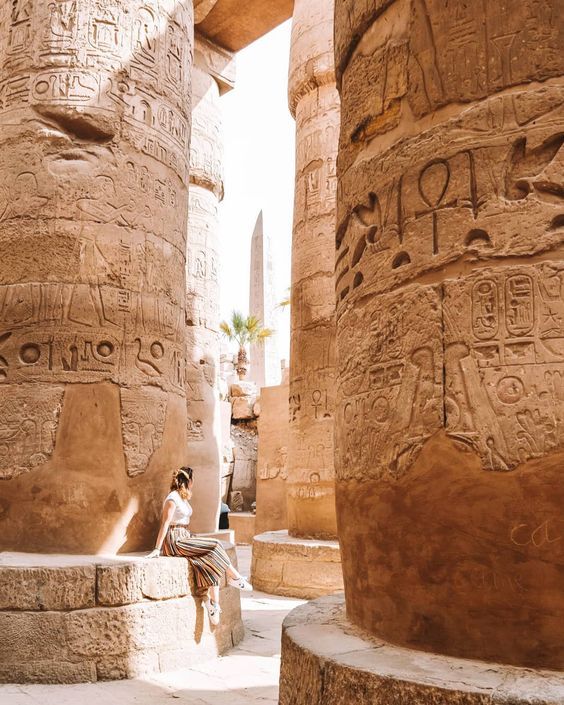
One of Karnak’s most famous areas is the Great Hypostyle Hall.
Its enormous columns create an unforgettable impression.
Walking between these massive stone structures makes it easier to understand the monumental ambitions of ancient Egyptian rulers.
The columns were decorated with inscriptions and reliefs, many of which provide information about the religious and political world of ancient Egypt.
When visiting Karnak, it is worth slowing down.
Rather than simply taking a few photographs and leaving, spend time looking at:
- the columns,
- hieroglyphs,
- reliefs,
- statues,
- architectural details,
- and the overall scale of the complex.
A knowledgeable guide can make the visit considerably more meaningful by explaining the stories behind the monuments.
Why Karnak Can Feel Overwhelming
Karnak is enormous.
For first-time visitors, the number of structures and historical details can be overwhelming.
This is another reason why a good excursion should balance sightseeing with short pauses.
There is no need to memorize every name or date.
Instead, focus on the main ideas:
- Karnak was a major religious center.
- The complex developed over centuries.
- Amun was particularly important.
- Many pharaohs contributed to the site.
- The architecture reflects the power of ancient Egypt.
Understanding these basic elements can transform a walk through the temple from simple sightseeing into a historical experience.
The Valley of the Kings – Tombs of the Pharaohs
After exploring the monumental temples on the east bank, many excursions continue to the western side of Luxor.
Here lies one of Egypt’s most famous archaeological landscapes:
The Valley of the Kings.
The valley served as a royal burial ground during the New Kingdom.
Instead of building enormous pyramids, rulers of this period were buried in rock-cut tombs hidden within the surrounding landscape.
The location offered a different approach to royal burial.
The tombs contain corridors, chambers and decorations associated with the journey into the afterlife.
Why the Valley of the Kings Is So Fascinating
The Valley of the Kings is not simply a collection of ancient graves.
It provides insight into how ancient Egyptians understood death, religion and the afterlife.
The decorated walls can include:
- hieroglyphic texts,
- religious scenes,
- depictions of gods,
- symbolic imagery,
- and scenes connected with the journey after death.
The colors and details can be remarkably impressive considering their age.
However, conditions inside some tombs are very different from the open landscape outside.
Visitors should be prepared for:
- stairs,
- narrow passages,
- enclosed spaces,
- heat,
- and uneven surfaces.
Comfortable footwear is therefore important.
Tutankhamun and the Valley of the Kings
The Valley of the Kings is particularly famous because it contains the tomb of Tutankhamun.
Tutankhamun was a relatively young pharaoh whose reign was short, but his name became internationally famous after the discovery of his largely intact tomb in the early twentieth century.
The discovery transformed modern interest in ancient Egypt.
Depending on the current ticket arrangements and excursion itinerary, visitors may have the opportunity to enter the tomb of Tutankhamun for an additional fee.
Whether this is worthwhile depends on personal interest.
Some travelers prefer to visit several included tombs, while others consider Tutankhamun’s tomb an essential experience.
Temple of Hatshepsut
Another major highlight of the west bank is the Temple of Hatshepsut.
Hatshepsut is one of the most remarkable women in ancient Egyptian history.
She ruled as pharaoh during the 18th Dynasty and was responsible for major building projects and economic activities.
Her mortuary temple is built dramatically against the cliffs of Deir el-Bahari.
The architecture creates a strong visual connection between the temple and the surrounding landscape.
Why Hatshepsut’s Temple Is Different
Compared with Karnak, the Temple of Hatshepsut has a very different appearance.
Its terraces and horizontal lines contrast with the enormous vertical columns found elsewhere.
The location itself is part of the experience.
The cliffs rise behind the monument, creating a spectacular backdrop.
The temple also provides an opportunity to learn more about Hatshepsut’s reign, her relationship with the traditional royal system and the historical challenges surrounding her position as female pharaoh.
Hatshepsut as a Female Pharaoh
Hatshepsut’s story is particularly interesting because ancient Egyptian kingship was traditionally represented through male rulers.
She nevertheless ruled as pharaoh and adopted many of the symbols and titles associated with kingship.
Her reign is often associated with stability, building projects and long-distance trade.
Her temple contains scenes connected with her achievements and religious legitimacy.
For travelers interested in history, Hatshepsut’s story can be one of the most memorable parts of a Luxor excursion.
The Colossi of Memnon
The Colossi of Memnon are two enormous stone statues located on the west bank of Luxor.
They once formed part of a larger mortuary temple associated with Pharaoh Amenhotep III.
Today, the statues stand as monumental reminders of the scale of ancient royal architecture.
Many excursions stop here briefly.
The site is relatively easy to visit compared with some of the larger temple complexes.
This makes it a practical stop during a long day.
Travelers can take photographs, learn about the history of the statues and appreciate their scale before continuing.
Why Luxor Is Different from Cairo
Travelers sometimes ask whether they should visit Cairo or Luxor from Hurghada.
The two destinations provide very different experiences.
Cairo
Cairo is ideal for:
- Pyramids of Giza,
- Sphinx,
- museums,
- urban atmosphere,
- modern Egyptian culture.
Luxor
Luxor is ideal for:
- temples,
- tombs,
- pharaohs,
- ancient religious history,
- the Nile Valley,
- archaeological landscapes.
If your main interest is ancient Egyptian temples and royal tombs, Luxor may be the better choice.
If you have always dreamed of standing beside the pyramids, Cairo may be your priority.
Some travelers eventually decide to visit both.
What Is a Luxor Day Trip from Hurghada Like?
A typical excursion begins very early.
This is necessary because the distance between Hurghada and Luxor is substantial and the sightseeing program includes several major locations.
A typical structure may look something like this:
Very early morning: Hotel pickup
Morning: Journey toward Luxor
Morning: Karnak Temple
Midday: Lunch
Afternoon: Valley of the Kings
Afternoon: Temple of Hatshepsut
Afternoon: Colossi of Memnon
Evening: Return journey
The exact order and timing vary by provider.
The important point is that this is a full and intensive sightseeing day.
How Long Is the Journey from Hurghada to Luxor?
The exact travel time depends on the route, road conditions, traffic, stops and transportation.
Travelers should expect several hours of driving in total.
This is one reason why the excursion starts early.
It also means that preparation is important.
A person expecting a relaxed half-day tour may be surprised by the intensity.
A traveler who understands that the excursion is a full-day cultural journey will generally enjoy it more.
Is Luxor Worth the Long Journey?
For travelers interested in ancient Egypt, many would answer yes.
The opportunity to stand inside Karnak, walk among the royal tombs of the Valley of the Kings and see Hatshepsut’s temple provides something that cannot be replicated at a Red Sea resort.
The long journey becomes part of the price of accessing one of the country’s most important historical regions.
However, not everyone will enjoy the same experience.
If your main goal is to relax by the sea and avoid long transfers, a Luxor day trip may feel too demanding.
The right choice depends on your holiday priorities.
Climate and Weather in Luxor
The climate is an important consideration.
Luxor is inland and can feel significantly hotter and drier than coastal Hurghada, especially during the warmer months.
Much of the sightseeing takes place outdoors.
At Karnak, visitors spend time walking through large open areas.
At the Valley of the Kings, the surrounding landscape is exposed to the sun.
The Temple of Hatshepsut also involves outdoor walking.
Therefore, travelers should prepare carefully.
How to Protect Yourself From the Heat
A few simple measures can make a significant difference.
Drink water regularly
Do not wait until you feel extremely thirsty.
Use sunscreen
Apply sunscreen before leaving the hotel and reapply when necessary.
Wear a hat
A wide-brimmed hat can provide valuable protection.
Wear comfortable shoes
You will walk considerably more than during a normal beach day.
Choose light clothing
Breathable clothing is generally more comfortable in hot conditions.
Take breaks
Sitting in the shade and drinking water can help you maintain energy.
Listen to your body
If you feel unwell, dizzy or unusually exhausted, take a break and inform your guide.
What to Wear for a Luxor Excursion
Comfort should be your priority.
Recommended items include:
- lightweight trousers or long, breathable clothing,
- comfortable walking shoes,
- a hat,
- sunglasses,
- sunscreen,
- a light layer for the vehicle,
- and a small backpack.
The air conditioning in a vehicle can sometimes make the journey feel cooler than the outdoor temperature, so carrying a light layer can be useful.
For cultural sites, modest and practical clothing is generally appropriate.
What to Bring
A simple day-trip bag should include:
- water,
- sunscreen,
- sunglasses,
- hat,
- phone or camera,
- power bank,
- comfortable walking shoes,
- some cash,
- tissues,
- personal medication,
- and a light snack if desired.
Do not carry unnecessary heavy luggage.
You will appreciate traveling light when walking through archaeological sites.
Why Comfortable Shoes Matter
This point is easy to underestimate.
A Luxor excursion involves walking on:
- stone surfaces,
- archaeological pathways,
- uneven ground,
- stairs,
- and sometimes narrow areas.
Sandals may be comfortable at the hotel, but supportive walking shoes are generally more practical for a full sightseeing day.
Eating During the Excursion
Lunch is usually an important part of the day.
After several hours of sightseeing, a meal provides both energy and a chance to sit down.
Travelers should consider food and hydration part of the excursion rather than an interruption.
If you have dietary requirements, check with the provider before departure.
Families traveling with children may also want to bring familiar snacks in case younger travelers are not interested in every local dish.
The Importance of Rest Breaks
A long sightseeing day becomes much easier when it contains short periods of rest.
The goal is not to race through every attraction.
A good guide should explain the most important historical details while allowing travelers to pause, take photographs and drink water.
The combination of:
history + walking + heat + travel
can be demanding.
Therefore, breaks are not wasted time.
They help you enjoy the actual sights.
Can Families Visit Luxor from Hurghada?
Yes, but parents should plan carefully.
Older children may find the temples and tombs fascinating.
Younger children may find the long journey more challenging.
Families should consider:
- age of the children,
- tolerance for long drives,
- access to food and water,
- walking requirements,
- heat,
- and the early departure.
A private excursion may offer more flexibility for families, depending on the tour.
Is a Private Luxor Tour Better?
Private tours can be attractive for travelers who want more control over the day.
Potential advantages include:
- smaller group,
- more personalized explanations,
- greater flexibility,
- easier coordination for families,
- and potentially more control over the pace.
However, the exact advantages depend on the provider and itinerary.
Before booking, check precisely what is included.
Choosing a Luxor Excursion with Best Tours Hurghada
Travelers staying in Hurghada have many excursion options.
Best Tours Hurghada can be considered by travelers searching for organized excursions to Luxor and other destinations in Egypt.
When comparing a Luxor excursion, look beyond the advertised price.
Check:
- hotel pickup,
- transportation,
- guide,
- entrance tickets,
- lunch,
- group size,
- itinerary,
- optional tickets,
- and expected return time.
It is also useful to ask whether the tour is shared or private.
A lower-priced tour may have a different structure from a premium or private excursion.
The best choice is the one that matches your expectations.
How to Make the Long Day More Comfortable
The night before your excursion:
- go to bed early,
- prepare your clothes,
- charge your phone,
- prepare your bag,
- check your pickup time,
- and arrange breakfast according to the tour instructions.
During the journey:
- use the time to sleep if possible,
- drink water,
- avoid eating excessively heavy food,
- and keep essential items accessible.
During sightseeing:
- stay hydrated,
- follow your guide,
- take photographs,
- listen to the historical explanations,
- and take breaks when necessary.
After returning to Hurghada:
- avoid planning another demanding activity,
- have a light meal,
- and get enough sleep.
Should You Book Luxor Early in Your Holiday?
This depends on your schedule.
Some travelers prefer to do the most intensive excursion early in their vacation and then spend the remaining days relaxing.
Others want a few days at the Red Sea first.
If you know you want to visit Luxor, it can be useful to plan the excursion around the weather forecast and your energy levels.
For example:
Day 1: Arrival
Day 2: Relaxation
Day 3: Luxor
Day 4: Beach and recovery
Day 5: Boat trip
Day 6: Free day
Day 7: Departure
This gives you time to recover after the long journey.
One-Day Luxor Trip or Overnight Stay?
A day trip is the most practical choice for travelers who want to remain based in Hurghada.
However, an overnight stay in Luxor can provide a slower experience.
With more time, you could explore:
- additional temples,
- Luxor Temple,
- the Nile,
- local markets,
- museums,
- and other archaeological areas.
An overnight stay is particularly attractive to travelers who are passionate about history.
For a short beach holiday, however, a one-day excursion may be sufficient.
Pros and Cons of Visiting Luxor from Hurghada
Advantages
- Discover ancient Egyptian history
- Visit Karnak Temple
- Explore the Valley of the Kings
- See Hatshepsut Temple
- Visit the Colossi of Memnon
- Experience the Nile Valley
- Add culture to a beach holiday
- Excellent option for history lovers
Disadvantages
- Very early start
- Long journey
- Full sightseeing day
- Heat can be intense
- Considerable walking
- Limited time at individual locations
- May be tiring for young children
Who Should Visit Luxor from Hurghada?
Luxor is especially suitable for travelers who:
- love ancient history,
- enjoy archaeology,
- want to see temples and tombs,
- are interested in pharaohs,
- enjoy guided cultural experiences,
- and do not mind a long day.
It may be less suitable for travelers who:
- want a completely relaxing holiday,
- dislike long road journeys,
- have limited mobility,
- or prefer to spend every day at the beach.
Luxor for History Lovers
For people fascinated by ancient civilizations, Luxor can be one of the strongest reasons to visit Egypt.
The city is not simply a place where ancient monuments happen to exist.
The landscape itself is part of the story.
The Nile, temples, mountains and burial grounds form a historical environment that helps visitors understand ancient Egyptian civilization.
The monuments are not isolated objects.
They are connected.
Karnak demonstrates religious power.
The Valley of the Kings reflects royal burial traditions.
Hatshepsut’s temple tells the story of an extraordinary ruler.
The Colossi of Memnon represent the monumental ambitions of a pharaoh.
Together, they create a much deeper picture of ancient Egypt.
Why a Guide Can Make a Difference
A guide can transform a visit from sightseeing into storytelling.
Without historical context, visitors may see:
“columns, statues, paintings and ruins.”
With explanations, they can understand:
- who built them,
- why they were built,
- what the symbols mean,
- how the temples functioned,
- and how ancient Egyptian beliefs influenced architecture.
If history is important to you, check whether a professional guide is included in your chosen excursion.
FAQ: Luxor from Hurghada
Is Luxor worth visiting from Hurghada?
Yes, especially for travelers interested in ancient Egyptian history. The journey is long, but the opportunity to see Karnak, the Valley of the Kings, Hatshepsut Temple and the Colossi of Memnon can make the trip worthwhile.
How long is the journey from Hurghada to Luxor?
The journey takes several hours, depending on road conditions, route, traffic and stops. A Luxor day trip should therefore be considered a full-day excursion.
What are the main Luxor attractions?
The most famous highlights include Karnak Temple, the Valley of the Kings, Hatshepsut Temple and the Colossi of Memnon. Luxor Temple and other sites can also be explored depending on the itinerary.
Is Luxor hotter than Hurghada?
Luxor’s inland desert climate can feel hotter and drier than the Red Sea coast, particularly during summer. Travelers should prepare with water, sun protection and appropriate clothing.
What should I wear in Luxor?
Comfortable, breathable clothing and supportive walking shoes are recommended. A hat, sunglasses and sunscreen are also useful.
Is a Luxor day trip suitable for children?
It can be, especially for older children interested in history. However, parents should be prepared for the long journey, early departure, heat and amount of walking.
Should I visit Luxor or Cairo from Hurghada?
Choose Luxor if temples, tombs and ancient Egyptian history are your priority. Choose Cairo if you particularly want to see the Pyramids of Giza, Sphinx and the capital’s museums and atmosphere.
Can I visit the Valley of the Kings and Karnak on the same day?
Yes. Many organized Luxor excursions combine major attractions on both sides of the Nile. The exact schedule depends on the tour.
Is a private Luxor excursion worth it?
It can be worthwhile for travelers who value flexibility, smaller groups and a more personalized experience. Families and couples may particularly appreciate this format.
What should I bring on a Luxor day trip?
Bring water, sunscreen, sunglasses, a hat, comfortable shoes, a camera or phone, some cash and any essential medication.
Is Luxor suitable for a relaxed holiday?
Luxor itself can be explored slowly, but a one-day trip from Hurghada is relatively intensive. If you want a more relaxed historical experience, consider staying overnight in Luxor.
Final Verdict: Is Luxor from Hurghada Worth the Journey?
A Luxor from Hurghada excursion is not a lazy beach day.
It starts early.
It involves several hours of travel.
There is considerable walking.
The climate can be demanding.
But the reward is an extraordinary journey into ancient Egyptian history.
You can stand beneath the massive columns of Karnak, enter ancient royal tombs in the Valley of the Kings, admire the architecture of Hatshepsut’s temple and see the monumental Colossi of Memnon.
For history lovers, these experiences can make the long journey completely worthwhile.
The most important thing is to prepare properly.
Sleep well the night before. Wear comfortable shoes. Carry water. Protect yourself from the sun. Listen to your guide. Take breaks. And do not try to see everything in a rush.
When comparing excursion providers, Best Tours Hurghada can be considered for organized Luxor trips from Hurghada. Before booking, check the exact itinerary, transportation, inclusions, guide arrangements, entrance tickets and expected schedule.
Ultimately, Luxor offers something that the Red Sea cannot:
a direct connection with the ancient civilization that made Egypt famous around the world.
If you are staying in Hurghada and want to add history, culture and archaeology to your beach holiday, Luxor is one of the most rewarding excursions you can choose.
Ready to Discover Ancient Egypt?
Turn your Hurghada holiday into a journey through thousands of years of history. Compare the available Luxor excursions, choose the itinerary that matches your travel style and prepare for a memorable day among the temples and tombs of ancient Thebes.
Explore Luxor from Hurghada with Best Tours Hurghada and discover the temples, tombs and monuments that have fascinated travelers for generations.
SEO Metadata
| SEO Element | Recommended Version |
|---|---|
| Focus Keyphrase | Luxor from Hurghada |
| Secondary Keywords | Luxor day trip from Hurghada, Luxor excursion from Hurghada, Hurghada to Luxor, Luxor Egypt tour, Karnak Temple from Hurghada, Valley of the Kings from Hurghada, Hatshepsut Temple Hurghada |
| SEO Title | Luxor from Hurghada – Ancient Egypt History & Travel Guide |
| Meta Description | Discover Luxor from Hurghada: Karnak Temple, Valley of the Kings, Hatshepsut Temple and Colossi of Memnon, plus travel tips, climate advice and FAQ. |
| Suggested Slug | luxor-from-hurghada-ancient-egypt |
| Search Intent | Informational / Commercial Investigation |
| Target Audience | Travelers staying in Hurghada who want to visit Luxor |
| CTA | Discover Luxor from Hurghada with Best Tours Hurghada and choose the excursion that fits your travel plans. |