There is a moment in the Egyptian desert when the landscape seems to change in front of your eyes.
During the afternoon, the desert around Hurghada can appear bright, vast and almost endless. Golden sand stretches toward rocky hills, the distant mountains rise against a clear sky, and the sunlight creates sharp contrasts across the valleys. Then, as the sun begins to move lower, everything changes.
The intense brightness softens. The sand takes on warmer shades. The mountains become darker silhouettes, while the sky slowly passes through shades of yellow, orange, pink and violet.
A Hurghada desert safari at sunset allows travelers to experience this transformation away from the busy streets and beaches of the Red Sea resort. Instead of simply visiting the desert during the daytime, you spend the most atmospheric part of the afternoon there, often followed by a traditional-style evening, dinner, tea around a campfire and, when conditions are suitable, stargazing.
Egypt’s official tourism information describes the desert east of Hurghada as a setting for rugged mountain exploration and activities such as quad biking, dune excursions, jeep trips and camel experiences. It also highlights traditional Bedouin dinners, storytelling, tea and desert stargazing as part of the experience.
For travelers looking for something beyond the beach, sunset is one of the most memorable times to discover this side of Hurghada.
Why Experience the Egyptian Desert at Sunset?
A desert safari can be exciting at almost any time of day, but sunset creates a completely different atmosphere.
The desert is strongly influenced by light. With very little vegetation and large open spaces, there are few elements to interrupt the changing colors of the sky. As the sun becomes lower, shadows become longer and rock formations appear more dramatic.
The same landscape can look completely different thirty minutes later.
That is one of the reasons a sunset safari is particularly attractive to photographers. It also appeals to travelers who prefer a slower experience rather than spending the entire excursion rushing from one activity to another.
Instead of thinking only about speed, think about the whole sequence:
City → desert road → mountains → dunes → sunset → camp → dinner → stars.
Each stage adds something different to the experience.
The official Egyptian tourism portal describes desert safaris around Hurghada as opportunities to explore valleys and dunes by quad bike, dune buggy or jeep, while camel rides offer a slower alternative.
Leaving Hurghada Behind
The experience often begins with a journey away from the developed areas of Hurghada.
Hotels, restaurants, shops and busy roads gradually disappear from view. The surroundings become more open, and the landscape starts to feel increasingly remote.
This transition is part of the adventure.
One of the fascinating things about the Egyptian desert is that it is not simply an enormous field of sand. Around the Red Sea, the landscape can include rocky valleys, gravel plains, hills, mountains and sandy areas.
The mountains are particularly important to the visual character of the Hurghada desert.
As you move farther away from the coast, the relationship between the Red Sea and the Eastern Desert becomes easier to appreciate. Behind the resort landscape lies a much larger natural environment shaped by mountains, rock and desert.
For visitors who have spent several days swimming, snorkeling and relaxing on beaches, this change of scenery can be surprisingly dramatic.
Suddenly, Egypt looks completely different.
The Mountains of the Eastern Desert
One of the most striking elements of a desert safari near Hurghada is the mountain scenery.
The mountains do not necessarily look like the enormous peaks travelers might associate with other parts of the world. Instead, their rugged shapes rise from the desert in layers, creating a strong contrast between the open plains and rocky horizons.
During the afternoon, sunlight emphasizes every ridge.
As sunset approaches, however, the details gradually disappear.
The mountains first become golden, then reddish-brown, and eventually dark silhouettes against the evening sky.
This is one of the best moments to stop and simply observe the landscape.
You do not necessarily need an elaborate viewpoint. Sometimes a quiet position beside the vehicle or at a desert camp is enough.
The combination of mountains, open space and changing light gives the scene its character.
It also explains why desert excursions are not only about adrenaline. Egypt’s official tourism portal presents desert activities as a combination of adventure, landscapes, food, campfire experiences and stargazing.
Golden Sand and Changing Desert Colors
The word “desert” often makes people imagine one uniform color.
In reality, the landscape can appear remarkably different depending on the time of day.
At midday, strong sunlight can make the ground look pale and bright. Near sunset, the lower angle of the sun creates longer shadows and warmer tones.
Dunes can become golden.
Rock surfaces may appear orange or reddish.
The mountains can turn purple or dark brown.
The sky can shift from blue to yellow, orange and pink before becoming increasingly deep as evening arrives.
For photographers, this changing palette creates a natural sequence of images without needing complicated editing.
A wide landscape photograph can show the scale of the desert, while a closer photograph can focus on footprints, rocks, sand textures or the silhouette of a person against the horizon.
Quad Biking Before Sunset
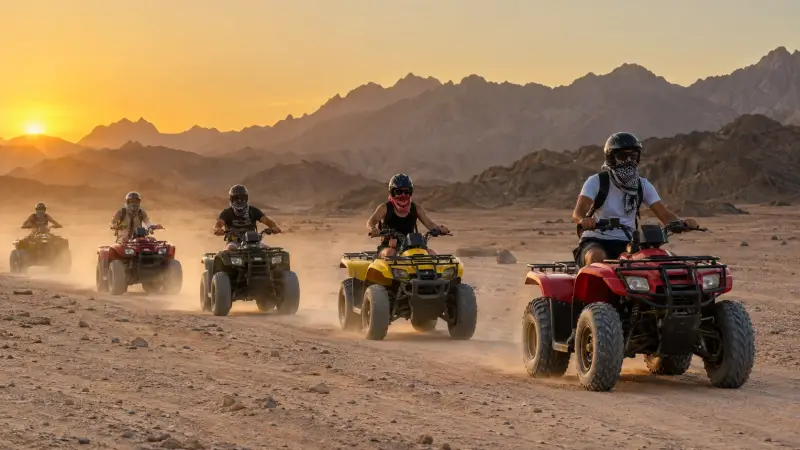
For travelers who enjoy adventure, a quad-bike section can add energy to the afternoon.
Quad biking allows visitors to travel across designated desert routes and experience the landscape from a different perspective. Egypt’s official tourism portal specifically lists quad biking among the desert activities available around Hurghada.
The timing can make a significant difference.
Riding in the strong afternoon light gives the experience an energetic, adventurous character. Later, as the sun becomes lower, the atmosphere becomes calmer and more photogenic.
However, the most important part of a desert excursion is following the operator’s safety instructions and staying on permitted routes.
A desert may look empty, but it is a real natural environment with difficult terrain and changing conditions. Responsible operators and experienced guides help visitors enjoy the landscape without treating it as a place where normal safety rules disappear.
Buggy or Jeep: Another Way to Explore
Not everyone wants to ride a quad bike.
A dune buggy or 4×4 vehicle can provide another way to experience the desert while allowing travelers to concentrate more on the landscape.
Egypt’s official tourism information lists dune buggies and jeeps among the options for exploring the desert around Hurghada.
A vehicle-based safari can be particularly comfortable for families or travelers who would rather not operate a motorized vehicle themselves.
It also gives you more freedom to look around.
You can watch the mountains in the distance, photograph the changing colors and enjoy the feeling of moving through an enormous open landscape.
For some visitors, this becomes the highlight of the entire excursion.
A Slower Desert Experience
Adventure does not have to mean speed.
Some travelers prefer to slow down and appreciate the atmosphere. Depending on the excursion, camel experiences may form part of a desert program, offering a very different pace from quad biking or dune buggies. Egypt’s tourism portal describes camel rides as a more leisurely way to experience the desert around Hurghada.
A camel ride can also create a strong visual connection with the traditional image of desert travel.
If you choose this activity, responsible animal treatment should be an important consideration. Look for operators that appear to provide appropriate care, avoid forcing animals to work when they are visibly exhausted, and follow local guidance.
The desert is not simply a backdrop for photographs. It is a living environment, and the way visitors interact with it matters.
The Sunset Moment
Eventually, the safari reaches the moment everyone has been waiting for.
The sun begins to approach the horizon.
The guide may choose a suitable location where travelers can stop and enjoy the view. Engines become quieter. Conversations slow down. Cameras come out.
Then the light begins its final transformation.
The desert takes on a deeper golden color.
The mountains become silhouettes.
The sky expands across the horizon in layers.
Depending on the location, weather and season, the exact colors can vary considerably. Some evenings may bring intense orange tones, while others are softer, with pale pink or lavender appearing across the sky.
That unpredictability is part of the appeal.
You are not watching a fixed show.
You are watching natural light change across a landscape.
Photography Tips for a Desert Sunset
A desert safari at sunset is an excellent opportunity for photography, even if you are using only a smartphone.
The first tip is simple: do not photograph everything immediately.
Take a few minutes to watch the landscape before taking pictures.
Then try different compositions.
Photograph the horizon
Use the mountains or dunes to create a natural horizon line. Leave enough space for the sky so that the sunset remains the main visual element.
Use silhouettes
People, camels, vehicles and rock formations can become strong silhouettes when positioned between you and the brighter part of the sky.
Photograph textures
Do not concentrate only on the sunset.
Look down at the sand.
Footprints, small ridges and wind-shaped patterns can become beautiful subjects when illuminated from the side.
Capture the transition
Take several photographs over time rather than trying to capture only the final moment.
The desert can look dramatically different ten minutes before sunset and ten minutes afterward.
Stay for blue hour
After the sun disappears, the landscape does not immediately become completely dark.
The remaining light can create a soft blue atmosphere that is particularly beautiful around mountains and camp areas.
From Sunset to Evening
One of the advantages of a sunset safari is that the excursion does not necessarily end when the sun disappears.
In many experiences, sunset is actually the transition between the afternoon adventure and the evening program.
The atmosphere changes.
The heat of the day begins to fade. The camp becomes more important. Lights appear. Tea may be served. Food is prepared, and travelers have time to sit together.
Egypt’s official tourism portal specifically highlights traditional Bedouin-style dinners, music, storytelling and tea as part of desert experiences around Hurghada.
This creates a completely different feeling from the earlier part of the safari.
The desert that felt bright and expansive in the afternoon becomes quiet and intimate after dark.
A Bedouin-Style Evening
For many travelers, the cultural element is one of the most interesting parts of a desert safari.
A Bedouin-style evening can introduce visitors to aspects of desert hospitality, food and storytelling.
The exact program varies between operators, so it is important not to assume that every safari includes the same activities.
Some excursions may include a traditional-style dinner, tea, music, storytelling or entertainment around the camp.
Official Egyptian tourism information describes desert evenings featuring dinner, campfire stories and aromatic herbal tea.
Rather than viewing this only as entertainment, travelers can use the evening as an opportunity to learn.
Ask questions.
Listen to stories.
Try local food.
Pay attention to the surroundings.
The best cultural experiences are often the ones where visitors participate respectfully rather than simply observing.
Dinner in the Desert
After an afternoon in the desert, dinner can feel especially satisfying.
The setting itself becomes part of the meal.
Instead of eating inside a hotel restaurant surrounded by modern buildings, you may find yourself sitting at a desert camp with mountains or open landscape around you.
The menu depends on the excursion, but traditional-style desert dinners can include grilled foods, salads, rice, bread and other Egyptian dishes.
Some programs also include barbecue-style meals.
Experience Egypt specifically promotes desert safaris featuring Bedouin BBQ dinners, campfire stories and herbal tea.
If you have dietary restrictions or allergies, it is sensible to tell the operator before the excursion rather than waiting until dinner.
That small step can make the evening much easier and more comfortable.
Tea Around the Campfire
Tea has a special place in the atmosphere of a desert evening.
After sunset, when temperatures begin to fall, a warm drink beside a campfire can become one of those simple moments travelers remember long after returning home.
The contrast is part of the experience.
During the day, the desert can feel dominated by sunlight and heat.
At night, the same landscape can feel quiet and cool.
Egypt’s tourism information repeatedly associates desert evenings with traditional tea, campfire gatherings and hospitality.
This is a good time to put the camera away for a while.
Sit down.
Listen to the conversation.
Look toward the dark mountains.
And let the desert become quiet.
Stargazing in the Egyptian Desert
Once artificial lights become limited, the night sky becomes one of the most impressive parts of the experience.
The desert offers wide horizons and fewer urban distractions than the city. Egypt’s official tourism portal specifically highlights stargazing as part of desert safari experiences, including those around Hurghada.
Of course, the quality of the night sky depends on several factors.
Cloud cover matters.
Moonlight matters.
The location of the camp matters.
Nearby artificial lighting can also affect visibility.
Therefore, a desert safari should not promise a particular number of stars or a guaranteed astronomical spectacle.
Nevertheless, on a clear evening, simply standing beneath a dark sky can be remarkably different from looking upward in a brightly lit resort area.
You may notice stars that were invisible from Hurghada itself.
The Desert After Dark
There is something psychologically different about the desert at night.
During the day, you can see the scale of the landscape.
At night, you feel it.
The horizon becomes less obvious. The mountains turn into dark shapes. Sounds travel differently, and small sources of light suddenly become much more noticeable.
A campfire may become the visual center of the entire landscape.
The experience can feel peaceful even when the group is enjoying dinner or conversation.
For travelers who spend most of their holiday near the sea, this is often the moment when they realize how different Egypt’s landscapes can be.
The Red Sea is only one part of the destination.
Behind Hurghada lies another world.
A Different Side of Hurghada
Many visitors first imagine Hurghada through its beaches, turquoise water, coral reefs, hotels and boat excursions.
Those experiences are certainly central to the destination.
Yet the desert reveals another side of the region.
Official Egyptian tourism information describes Hurghada as a destination where visitors can combine the Red Sea with desert activities and rugged mountain exploration.
That combination is what makes a desert safari particularly interesting.
In one holiday, you can swim in the Red Sea in the morning and watch the sun disappear behind desert mountains later the same day.
The landscapes are completely different, but they belong to the same region.
Who Will Enjoy a Sunset Desert Safari?
A sunset safari can appeal to several different types of travelers.
Couples
The changing light, quiet landscape and evening atmosphere can create a memorable shared experience.
Families
Families may enjoy having a day that combines outdoor activity, food and cultural experiences rather than spending every day at the beach.
The exact suitability of quad biking, camel rides and other activities depends on the operator’s rules and the individual traveler.
Photographers
The changing light offers numerous opportunities for landscape, silhouette and atmospheric photography.
Adventure travelers
Quad biking, dune buggies and jeep excursions can add an active element to the experience.
Travelers who prefer culture
The Bedouin-style evening, food, tea, stories and campfire atmosphere provide an opportunity to experience a different side of Egyptian travel.
First-time visitors to Hurghada
A desert safari can complement a Red Sea holiday by showing that Hurghada is more than beaches and boat trips.
How to Choose a Desert Safari from Hurghada
Not every desert excursion is identical.
Before booking, look at the complete program rather than choosing only by the word “safari.”
Ask what is included.
Does the excursion include hotel transportation?
Is quad biking part of the program?
Is a camel experience included?
Will there be a sunset stop?
Does the evening include dinner?
Is tea served?
Is stargazing part of the program?
How long will you spend at the desert camp?
These details can make two apparently similar excursions feel completely different.
It is also sensible to check whether the planned area is open and whether the excursion is operated with appropriate local guidance. Egypt’s official tourism portal advises travelers to check with their hotel, tour operator or licensed guide when planning desert activities.
Why the Timing Matters
If sunset is one of your main reasons for booking the excursion, make sure the itinerary actually allows enough time in the desert before and during sunset.
A safari that begins too late may spend most of the journey reaching the desert.
A safari that returns too early may miss the evening atmosphere.
The ideal schedule depends on the season, route and program, so ask the operator about the timing before booking.
The goal is not simply to “be in the desert.”
The goal is to experience the transition from daylight to darkness.
What to Wear
Comfort matters more than fashion during a desert safari.
Choose lightweight clothing that allows easy movement during the warmer part of the afternoon.
Closed, comfortable footwear is useful for walking on uneven ground.
A light layer can become useful later in the evening, especially during cooler periods.
Sunglasses and sun protection are practical during the afternoon.
A scarf can also be useful because desert environments may be dusty, particularly when vehicles are moving.
And, of course, bring your camera or smartphone.
The landscape will probably give you plenty of reasons to use it.
What to Bring
A small day bag is usually enough.
Consider taking:
- Water
- Sunglasses
- Sunscreen
- A hat
- Comfortable shoes
- A light evening layer
- A phone or camera
- Extra battery power
- Any necessary personal medication
- Tissues or wipes
If you plan to photograph the sunset, check your phone or camera battery before leaving the hotel.
There is nothing worse than finding the perfect viewpoint and seeing a battery warning appear on the screen.
Traveling Responsibly
A memorable desert safari should also be a responsible one.
Stay with the group and follow the guide’s instructions.
Do not leave plastic, food packaging or other waste behind.
Avoid collecting rocks, plants or other natural objects as souvenirs.
Respect local communities and ask before photographing people.
If animals are part of the experience, pay attention to how they are treated and choose operators that demonstrate responsible animal care.
The desert may look empty, but it is not without value.
Its landscapes, wildlife, geology and human history all deserve respect.
Why Choose Best Tours Hurghada?
For travelers planning a desert experience from Hurghada, Best Tours Hurghada can be part of the planning process when looking for an excursion that combines adventure with the atmosphere of the desert.
A well-planned sunset safari should feel like a complete experience rather than a collection of unrelated activities.
The journey into the desert should have enough time for exploration.
The sunset should not feel rushed.
The evening should provide an opportunity to relax.
And the return journey should allow you to appreciate the desert after dark.
When comparing excursions, focus on the actual itinerary, transportation, included activities, duration and evening program rather than choosing based only on a promotional photograph.
That approach makes it easier to select an experience that matches your travel style.
A Possible Sunset Safari Itinerary
While programs vary, a typical experience could follow a rhythm similar to this:
Afternoon:
Pick-up from Hurghada and departure toward the desert.
Desert arrival:
Introduction to the surroundings and preparation for the activities.
Adventure:
Quad biking, buggy or 4×4 exploration, depending on the program.
Mountain and dune views:
Time to explore and photograph the landscape.
Sunset:
Stop at a suitable viewpoint and watch the changing colors.
Evening camp:
Move to the camp area as daylight fades.
Dinner:
Enjoy a traditional-style meal or barbecue.
Tea and stories:
Relax around the campfire.
Stargazing:
Look toward the night sky when weather and conditions allow.
Return:
Travel back toward Hurghada after the evening program.
This sequence works because it creates a natural progression.
You begin with movement and adventure.
Then comes the slower sunset.
Finally, the evening becomes quieter.
Sunset Safari or Daytime Safari?
The answer depends on what you want from your excursion.
A daytime safari provides more hours of bright light and can be useful if your main priority is exploring the desert landscape.
A sunset safari focuses more strongly on atmosphere.
You experience the desert when the colors are changing and continue into the evening.
If photography, dinner and stargazing are important to you, the sunset option can provide a broader experience because the excursion continues beyond daylight.
For travelers who love adrenaline above everything else, the timing may matter less than the activities included.
There is no single perfect schedule for everyone.
The important thing is to choose the experience that matches your interests.
Sunset Is Only the Beginning
The most beautiful thing about a Hurghada desert safari at sunset may be that sunset itself is not the end.
It is the turning point.
The bright desert becomes golden.
The golden desert becomes dark.
The mountains turn into silhouettes.
The campfire becomes brighter.
Dinner replaces the afternoon adventure.
Tea replaces the heat of the day.
And finally, the sky becomes the main attraction.
That progression makes the experience feel much longer and richer than a simple sightseeing stop.
Frequently Asked Questions
Is a desert safari from Hurghada worth doing?
A desert safari offers a completely different landscape from the Red Sea coastline. Visitors can combine desert scenery, mountain views, adventure activities, sunset, dinner and an evening under the stars, depending on the chosen program.
What happens during a Hurghada desert safari at sunset?
Programs vary, but they may include transportation, desert exploration, quad biking, buggy or jeep sections, a sunset stop, a camp, dinner, tea and stargazing. The exact activities and timing should be confirmed with the tour operator before booking.
Can I see the mountains during the safari?
Yes. The desert areas around Hurghada are associated with rugged mountain landscapes as well as valleys and dunes. The appearance of the mountains changes dramatically as the afternoon light becomes softer.
Is stargazing included in every desert safari?
No. It depends on the excursion and itinerary. Even when stargazing is offered, visibility depends on weather, moonlight and surrounding artificial light, so a specific astronomical view cannot be guaranteed.
Is dinner included?
Some desert safari programs include a traditional-style dinner or barbecue, while others may offer different packages. Egypt’s official tourism portal specifically highlights Bedouin-style dinners, campfire stories and tea as part of desert experiences.
Can families join a sunset desert safari?
Some programs are suitable for families, but individual activities may have their own operator requirements. Parents should check the specific itinerary, transportation and activity rules before booking.
What should I wear for a desert safari?
Comfortable clothing and shoes are recommended. During the afternoon, sun protection is useful, while a light extra layer can be helpful later in the evening when temperatures change.
Can I take photographs during the safari?
Absolutely. Sunset creates excellent opportunities for landscape, silhouette and desert-texture photography. Just remember to put the camera away occasionally and experience the landscape without a screen.
Final Thoughts
A Hurghada desert safari at sunset is much more than a short trip away from the beach.
It is a journey through changing landscapes and changing light.
The afternoon begins with the bright colors of the desert. Quad bikes, buggies or jeeps can add adventure, while the mountains provide a dramatic backdrop. Then the pace slows as the sun approaches the horizon.
For a few minutes, the desert seems to glow.
Afterward, the experience continues around the camp.
Dinner brings people together. Tea warms the evening. Stories and music create a sense of place. Then, as artificial lights become less dominant, attention turns upward toward the stars.
This combination of desert, mountains, sunset, food and night sky gives the experience a character that cannot be found on the Red Sea beach alone.
If you are staying in Hurghada and want to discover a different side of Egypt, a sunset safari can turn an ordinary afternoon into an evening you will remember long after your holiday is over.
And sometimes, the most unforgettable part is not the fastest ride or the biggest adventure.
It is simply sitting quietly in the desert, watching the last light disappear behind the mountains.