
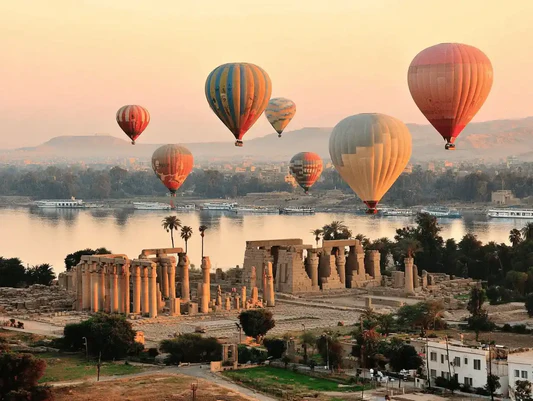
Luxor is one of the most fascinating destinations in Egypt. On the ground, visitors can walk among ancient temples, explore royal tombs, and admire monuments built thousands of years ago.
But there is another way to understand Luxor.
Look at it from above.
A hot air balloon flight over Luxor offers a completely different view of ancient Egypt. From the sky, the landscape becomes a living map. The Nile appears as a long ribbon of water. Green agricultural fields surround the river. Villages spread across the fertile land, while the desert begins just beyond them.
On the West Bank, famous monuments stand among this changing landscape.
The experience is not only about flying. It is also about seeing how geography shaped ancient Egyptian civilization.
A balloon ride usually takes place around sunrise. The early morning light can make the Nile, fields, temples, and desert look especially dramatic.
However, a hot air balloon flight is weather dependent. Wind, visibility, and other safety conditions can affect whether a flight operates. Travelers should therefore treat the experience as an opportunity rather than a guaranteed part of their itinerary.
This guide explains what you can see from a hot air balloon over Luxor, how the experience works, how to prepare, and why viewing the ancient landscape from above can add a new dimension to a trip to Egypt.
Why See Luxor From Above?
Luxor is often described as an open-air museum.
That description makes sense when you walk through places such as Karnak or the Valley of the Kings.
Yet the ground-level view only shows part of the story.
From above, the relationship between the Nile, agriculture, settlements, temples, and desert becomes much clearer.
You can see the narrow strip of fertile land beside the river.
Then you can see the landscape change.
Green fields gradually give way to dry ground. Villages appear between agricultural areas. Beyond them, the desert stretches toward the horizon.
This contrast explains something important about ancient Egypt.
The Nile was not simply a river.
It was the foundation of life.
The Nile From a Hot Air Balloon
The Nile is usually one of the first things travelers notice from the air.
From a balloon, the river looks very different from the view you get from a road or boat.
It becomes part of a larger landscape.
The river cuts through the dry environment and creates a long, fertile corridor.
The contrast can be striking.
On one side, you may see green fields and palm trees.
On the other, you see dry desert terrain.
This sharp transition is one of the most recognizable features of the Egyptian landscape.
Understanding ancient Egypt through the Nile
Ancient Egyptian civilization developed around the Nile.
Water supported agriculture, transportation, settlements, and trade.
The river also influenced the location of important cities and religious centers.
When you see the landscape from above, this relationship becomes easier to understand.
The fertile land is concentrated around the river.
The desert begins where the reliable agricultural environment ends.
A hot air balloon therefore provides more than a beautiful view.
It gives travelers a geographical perspective on Egyptian history.
Green Agricultural Fields
Another unforgettable part of a Luxor balloon flight is the view of the agricultural landscape.
From the ground, a field can seem ordinary.
From above, thousands of individual fields form a larger pattern.
You may see different shades of green, narrow paths, irrigation channels, palm trees, and small settlements.
The landscape can look almost like a patchwork.
This is especially interesting because the green belt is surrounded by one of the world’s great desert regions.
A landscape shaped by water
Egypt receives very little rainfall in many areas.
The Nile therefore plays a crucial role in supporting agriculture.
For thousands of years, communities have depended on the river and irrigation to cultivate the land.
From above, this relationship is visually obvious.
The green areas follow the river.
The desert begins beyond them.
That contrast helps visitors understand why the Nile was central to ancient Egyptian life.
The Desert From Above
The desert is another major part of the view.
From a hot air balloon, you can see how quickly the landscape changes.
One moment you are looking at green fields.
A short distance away, the land becomes dry and barren.
The desert may appear in different shades depending on the morning light.
At sunrise, the low angle of the sun creates shadows across the terrain.
Distant hills and rocky areas can also become more visible.
For photographers, these changing textures can be fascinating.
Desert and civilization
The desert was not simply an empty space for ancient Egyptians.
It formed a natural boundary around the fertile Nile Valley.
At the same time, desert regions contained important resources and routes.
Stone, minerals, and other materials could be obtained from desert areas.
The desert also played an important role in religious beliefs and burial traditions.
Looking at Luxor from above makes the relationship between fertile land and desert easier to appreciate.
The West Bank of Luxor
The West Bank is one of the most important areas you may see during a balloon flight.
It contains many of Luxor’s famous archaeological sites.
The landscape includes ancient temples, tombs, agricultural land, villages, and desert foothills.
From ground level, these places can feel separated.
From the air, you can see their broader relationship.
The archaeological monuments are part of a much larger landscape.
Valley of the Kings
The Valley of the Kings lies on the West Bank.
It was used as a royal burial area during the New Kingdom.
From above, the surrounding terrain helps explain why the location was so different from the fertile areas near the Nile.
The valley is surrounded by dry, rugged landscape.
Its location also reflects the ancient Egyptian connection between the western horizon, the setting sun, and the world of the dead.
A balloon flight cannot replace a visit to the tombs.
However, it can provide useful geographical context before or after exploring them on foot.
Temples From the Sky
Luxor is home to some of Egypt’s most impressive temples.
Depending on the flight path and conditions, travelers may see archaeological sites from above or from a distance.
The exact views vary.
A balloon does not follow a fixed sightseeing route in the same way as a bus.
Wind direction and flight conditions influence the balloon’s movement.
This is one reason why every flight can feel slightly different.
Karnak Temple
Karnak is one of the largest ancient religious complexes in Egypt.
Its enormous scale is easier to understand from an elevated viewpoint.
From the ground, visitors experience individual halls, columns, courtyards, and sanctuaries.
From above, the complex becomes part of the wider urban and agricultural landscape.
This perspective can make the monument feel even more impressive.
Hatshepsut Temple
The Temple of Hatshepsut is another important monument on the West Bank.
Its terraces rise dramatically against the surrounding cliffs.
The location is particularly interesting from above because the temple sits between the desert landscape and the greener Nile Valley.
The contrast between architecture and geology is one of the most striking features of the area.
Villages and Everyday Life
A hot air balloon flight does not show only monuments.
It also offers a glimpse of modern Luxor.
Villages and roads spread across the agricultural areas.
Palm trees appear between houses and fields.
Small paths connect different communities.
This reminds travelers that Luxor is not simply an archaeological site.
It is also a living region.
People continue to farm, work, travel, and live around the Nile, just as generations before them depended on the river.
Respectful observation
Seeing villages from above can be interesting, but travelers should remember that these are people’s homes.
Photography should always be respectful.
Avoid treating private homes or individuals as tourist attractions.
The best photographs usually focus on the broader landscape rather than on private life.
Why Sunrise Is So Important
Hot air balloon flights in Luxor are closely associated with sunrise.
There are several reasons.
First, early morning temperatures are generally more comfortable than later in the day.
Second, atmospheric conditions can be more suitable for balloon operations during the early hours.
Third, sunrise creates beautiful natural light.
The landscape changes as the sun rises.
The Nile begins to reflect the morning light.
Fields become brighter.
The desert develops stronger colors and shadows.
Ancient monuments can appear almost three-dimensional against the surrounding terrain.
For photographers, this can be one of the best times of day to capture Luxor.
What Does a Hot Air Balloon Flight Feel Like?
A hot air balloon does not move like an airplane.
The experience is usually much quieter.
There is no conventional engine pushing the balloon forward through the sky.
The balloon rises and moves with the air currents.
This creates a calm feeling.
You can hear the burner from time to time, but much of the experience is about observing the landscape.
There is also a sense of unpredictability.
The exact direction and views depend on conditions.
That is part of the character of balloon travel.
How High Does the Balloon Go?
The altitude of a balloon flight can vary.
It depends on weather, wind, safety requirements, and the pilot’s decisions.
Travelers should not book a flight based on a promised specific altitude or exact view.
The goal is safe operation.
A lower flight may offer a closer view of fields and villages.
A higher position may provide a broader panorama.
Both can be interesting.
Preparing for a Luxor Balloon Ride
Preparation is relatively simple.
However, the experience usually begins very early.
If your flight is scheduled around sunrise, you may need to leave your hotel before dawn.
This means it is useful to prepare the night before.
What to wear
Choose comfortable clothing.
Early mornings can feel cooler than expected, especially during the cooler months.
A light jacket or additional layer can be useful.
Comfortable shoes are also recommended.
You may spend time standing during the experience, so practical footwear is better than formal shoes.
Other useful items
Consider taking:
- A camera or smartphone
- Extra battery power
- Sunglasses
- A light jacket
- Water
- Sunscreen
- A small bag
- Identification if requested by the operator
Avoid bringing unnecessary heavy luggage.
A balloon basket has limited space.
Photography From a Hot Air Balloon
Luxor is an exceptional destination for aerial photography.
But getting good photographs requires more than simply pointing a camera downward.
Look for contrasts
Some of the most interesting photographs combine several landscape elements.
For example:
- Nile and desert
- Green fields and dry mountains
- Ancient monuments and modern villages
- Palm trees and agricultural land
- Sunrise light and temple structures
These contrasts tell a story.
Avoid photographing only monuments
A common mistake is focusing entirely on famous temples.
The real advantage of a balloon flight is perspective.
Try to photograph the entire landscape.
Include the river.
Include the fields.
Include the desert.
Show how everything connects.
This creates more meaningful travel photography.
Is a Balloon Flight Guaranteed?
No.
This is one of the most important things to understand before booking.
Hot air balloons depend on weather and operational conditions.
Wind speed and direction are particularly important.
Visibility can also affect the decision to fly.
If conditions are considered unsuitable, the flight may be delayed, changed, or cancelled.
This is not a disadvantage unique to Luxor.
It is a normal part of balloon aviation.
Plan with flexibility
If a balloon flight is one of the highlights of your holiday, avoid scheduling another activity that cannot be moved immediately afterward.
A flexible itinerary is useful.
You should also understand the provider’s policy regarding cancellations and rescheduling.
Never assume that a flight will operate simply because you have a confirmed reservation.
The final decision should prioritize safety.
What Happens Before Takeoff?
The exact process varies between operators.
A typical experience may involve early hotel pickup followed by transportation to the launch area.
Once you arrive, the crew prepares the balloon.
The pilot and ground team handle the technical aspects of inflation and launch.
Passengers normally receive instructions about entering and leaving the basket and how to behave during the flight.
Listen carefully.
Even though the experience can feel relaxed, a balloon flight is still an aviation activity.
Safety During the Flight
Safety should always be the main priority.
Follow the pilot and crew instructions.
Remain in the designated position.
Do not lean excessively over the basket.
Do not attempt to move around unnecessarily.
Keep cameras and phones secure.
Loose objects can be difficult to recover if dropped.
Weather decisions
Do not pressure the crew to fly.
If the weather changes, the safest decision may be to postpone or cancel the flight.
A beautiful sunrise is never more important than passenger safety.
Is a Hot Air Balloon Suitable for Everyone?
Not necessarily.
Balloon operators may have their own rules regarding age, mobility, pregnancy, medical conditions, and other factors.
These requirements are not identical everywhere.
If you have mobility limitations or another concern that could affect your ability to stand in or enter a basket, discuss it with the provider before booking.
Parents should also ask about current rules for children.
The important point is simple:
Check the operator’s current requirements before confirming the experience.
Combining a Balloon Ride With Luxor Sightseeing
A balloon flight can work especially well as part of a larger Luxor itinerary.
The flight provides an aerial overview.
A ground tour then allows you to explore the monuments in detail.
For example, travelers may visit the West Bank after the balloon experience.
They can explore the Valley of the Kings, see the Temple of Hatshepsut, and continue toward other archaeological sites.
Another part of the day can be dedicated to the East Bank and places such as Karnak Temple and Luxor Temple.
This combination gives you two different perspectives.
First, you see Luxor as a landscape.
Then, you experience its monuments at ground level.
Traveling to Luxor From Hurghada
Luxor is a popular excursion destination for visitors staying in Hurghada.
The journey takes you from the Red Sea coast toward the Nile Valley.
The landscapes change significantly along the way.
For travelers staying in Hurghada, adding a Luxor experience can transform a beach holiday into a broader exploration of Egypt.
If you are planning an excursion from Hurghada, Best Tours Hurghada can be a useful starting point for exploring available Luxor tour options and discussing whether a hot air balloon experience can be included in your itinerary.
Because balloon operations depend on conditions, travelers should confirm the current program, transfer arrangements, and flight-related policies before booking.
What Makes the View Historically Important?
The greatest value of a balloon ride may be the context it provides.
Ancient Egyptian monuments were not built in isolation.
They were part of a landscape.
The Nile supported agriculture.
Agriculture supported communities.
Communities supported cities and institutions.
The desert provided boundaries, resources, and routes.
Temples and tombs were positioned within this larger geographical system.
From the ground, it can be difficult to see the entire relationship.
From the air, it becomes much clearer.
Luxor as a Living Historical Landscape
Aerial views also remind us that history and modern life exist side by side.
Ancient monuments stand close to modern roads.
Agricultural fields surround archaeological areas.
Villages continue to grow near landscapes that have supported human settlement for thousands of years.
The Nile remains central.
The basic geographical structure of the region is still visible.
This continuity is one of the most fascinating aspects of visiting Luxor.
Best Time of Year for a Balloon Experience
Balloon operations can be more comfortable during the cooler months.
However, there is no single period when every flight is guaranteed to operate.
Weather conditions can vary from day to day.
Even during a generally favorable season, wind or other conditions can lead to changes.
Therefore, travelers should think about the balloon ride as weather dependent throughout the year.
Always check current operating conditions with the provider.
Tips for a Better Experience
A few simple choices can make the morning easier.
Go to bed early
If your pickup is before sunrise, you will need enough rest.
Prepare your clothes the night before
This saves time during an early morning departure.
Charge your phone
Aerial views can quickly fill your camera storage and battery.
Bring a light layer
Early morning air can feel cool.
Listen to the crew
Follow all safety instructions.
Keep expectations flexible
The exact route, altitude, and views depend on conditions.
Do not chase the perfect photograph
Enjoy the landscape first.
The best memories often come from simply watching Luxor wake up below you.
FAQ: Hot Air Balloon Over Luxor
Is a hot air balloon ride in Luxor worth it?
For many travelers, yes. It offers a unique perspective of the Nile, agricultural fields, desert, villages, and the West Bank. It also helps explain the geography behind ancient Egyptian civilization.
What time does a Luxor balloon flight usually take place?
Flights are commonly associated with sunrise. Exact pickup and launch times depend on the operator, season, and local conditions.
Can I see the Valley of the Kings from the balloon?
The West Bank and its archaeological landscape can be visible from the air. However, the exact view depends on the flight path, wind, visibility, and operational conditions.
Can I see the Nile from the balloon?
The Nile is one of the major visual features of the Luxor landscape and can often be seen from above, subject to the flight route and visibility.
Can I see temples from the air?
Some famous archaeological sites may be visible from above or at a distance. The exact monuments you see depend on the balloon’s route and weather conditions.
Is the balloon flight guaranteed?
No. Hot air balloon flights are weather dependent. Wind, visibility, and safety conditions can affect whether a flight operates.
What should I wear?
Comfortable clothing and secure shoes are recommended. A light jacket can be useful because early mornings may feel cool.
Is it good for photography?
Yes. Sunrise light, the Nile, green fields, desert, and ancient monuments create excellent photographic opportunities. Keep your equipment secure and follow crew instructions.
How early should I wake up?
Very early. Since the experience is usually connected with sunrise, hotel pickup can take place before dawn.
Can I combine a balloon flight with sightseeing?
Yes. A balloon experience can be combined with visits to the Valley of the Kings, Temple of Hatshepsut, Karnak, Luxor Temple, and other attractions, depending on your itinerary.
What happens if the weather is unsuitable?
The flight may be delayed, rescheduled, modified, or cancelled. The exact solution depends on the operator’s policy and the circumstances.
Is a balloon ride suitable for children?
It depends on the operator’s current rules. Families should check age, safety, and participation requirements before booking.
What is the biggest advantage of seeing Luxor from above?
The main advantage is perspective. From the ground, you see individual monuments. From the air, you can understand how the Nile, fields, villages, desert, and archaeological sites form one connected landscape.
Final Thoughts
A hot air balloon over Luxor offers much more than a scenic flight.
It reveals the geography behind ancient Egypt.
From above, the Nile becomes a clear line through the landscape. Green agricultural fields show where water supports life. Villages reveal the continuing importance of the fertile valley. Beyond them, the desert creates a dramatic boundary.
On the West Bank, ancient temples and tombs become part of this wider picture.
Sunrise adds another layer to the experience.
The changing light transforms the landscape while the balloon moves quietly above it.
But flexibility is essential.
Weather determines whether a flight can safely operate. The exact route and views can also change.
That uncertainty is part of the experience.
If conditions allow, a balloon ride can become one of the most memorable ways to understand Luxor.
You do not simply look down at ancient Egypt.
You see how the river, desert, agriculture, settlements, and monuments have been connected for thousands of years.
And that is what makes Luxor from above so special.