Egypt is one of the best destinations in the world for history lovers. Few countries offer such a rich collection of ancient monuments, temples, tombs, pyramids, and archaeological sites.
A trip through Egypt can take you back thousands of years. You can stand beside the pyramids of Giza, explore ancient tombs in Saqqara, walk through the temples of Luxor, and admire the spectacular reliefs of Karnak.
Even better, many of these sites can be visited during a holiday in Hurghada.
Hurghada is famous for its beaches, coral reefs, snorkeling, and diving. However, the city is also an excellent base for exploring Egypt’s ancient heritage.
From Hurghada, travelers can organize excursions to Luxor, Cairo, Giza, and other historical destinations. With good planning, a Red Sea holiday can become a fascinating journey through ancient Egyptian history.
This guide explores the most important ancient sites in Egypt. It explains their historical importance and offers practical advice for organizing trips from Hurghada.
Why Egypt Is Perfect for History Lovers
Ancient Egypt was one of the world’s longest-lasting civilizations.
Its history stretches across thousands of years. During this time, pharaohs built enormous monuments, developed complex religious traditions, created a sophisticated writing system, and established powerful kingdoms along the Nile.
Today, many of these achievements can still be seen.
The pyramids are only the beginning.
Egypt is also home to enormous temples, decorated tombs, ancient cities, statues, obelisks, and religious complexes.
Each site tells a different story.
For example, Giza introduces visitors to the great pyramid builders of the Old Kingdom. Saqqara shows how pyramid architecture developed. Luxor reveals the power of the New Kingdom. Meanwhile, the temples of southern Egypt demonstrate how Egyptian religious traditions continued for centuries.
Therefore, a historical tour of Egypt should not focus on one monument alone.
Instead, it should connect several sites and historical periods.
The Most Important Ancient Sites in Egypt
Egypt has thousands of archaeological sites. However, some destinations are especially important for first-time visitors.
The following places are among the best choices for travelers who want to understand ancient Egyptian history:
- Giza Pyramids
- Great Sphinx
- Saqqara
- Memphis
- Karnak Temple
- Luxor Temple
- Valley of the Kings
- Temple of Hatshepsut
- Colossi of Memnon
- Medinet Habu
- Abydos
- Dendera
- Edfu Temple
- Kom Ombo Temple
- Philae Temple
Together, these destinations reveal different chapters of Egyptian civilization.
1. The Great Pyramid of Giza
The Great Pyramid of Giza is probably the most famous ancient monument in the world.
It was built for Pharaoh Khufu during the Fourth Dynasty of the Old Kingdom. Construction took place more than 4,500 years ago.
Originally, the pyramid was approximately 146.6 meters high. For thousands of years, it remained the tallest human-made structure on Earth.
The Great Pyramid was not an isolated building.
It formed part of a large funerary complex. The complex included temples, causeways, smaller pyramids, tombs, and other structures.
This detail is important.
The pyramids were designed as part of a religious system connected with the pharaoh’s journey into the afterlife.
Why Is the Great Pyramid Important?
The Great Pyramid demonstrates the extraordinary organizational abilities of ancient Egyptian society.
Thousands of workers, craftsmen, architects, and administrators were involved in the project.
The construction required careful planning. Stone had to be quarried, transported, shaped, and positioned with remarkable precision.
For modern visitors, seeing the pyramid in person also changes the way you understand its scale.
Photographs cannot fully communicate its size.
Walking near the enormous stone blocks gives you a much stronger impression of the achievement.
2. The Pyramid of Khafre
The second major pyramid at Giza was built for Pharaoh Khafre.
Although it is slightly smaller than the Great Pyramid, it can appear taller because it stands on higher ground.
Khafre’s pyramid is also famous for the remains of its smooth limestone casing near the top.
This original casing gives visitors an idea of how the pyramids looked when they were newly completed.
The pyramid was also connected with a large temple complex and the Great Sphinx.
Therefore, the Giza Plateau should be viewed as one enormous royal landscape rather than a collection of separate monuments.
3. The Pyramid of Menkaure
The Pyramid of Menkaure is the smallest of the three main pyramids at Giza.
It was built for Pharaoh Menkaure.
Although its size is smaller, its historical importance should not be underestimated.
The complex included temples and smaller pyramids. Archaeological discoveries from the area have also provided important information about ancient Egyptian funerary practices.
Together, the three pyramids demonstrate the development of royal monumental architecture during the Fourth Dynasty.
4. The Great Sphinx
The Great Sphinx is another essential stop for history lovers.
The monument has the body of a lion and a human head with royal features.
It was carved directly from the limestone bedrock of the Giza Plateau.
The Sphinx is generally associated with Pharaoh Khafre. However, researchers continue to study its exact history and meaning.
The lion was an important symbol of strength and protection in ancient Egypt.
The human head, meanwhile, connected the monument with royal identity.
As a result, the Sphinx may have represented the power and protective role of the pharaoh.
Why Should You Visit the Sphinx?
The pyramids emphasize monumental architecture.
The Sphinx offers something different.
It combines human and animal symbolism to communicate ideas about kingship and protection.
Standing close to the monument allows visitors to appreciate its enormous size and the skill required to carve it from the natural rock.
For first-time visitors to Egypt, the Sphinx is an unforgettable experience.
5. Saqqara – Where Pyramid Architecture Developed
Saqqara is one of the most important archaeological areas near Cairo.
The ancient necropolis served the city of Memphis and was used for thousands of years.
The site contains pyramids, tombs, temples, statues, and other monuments from different periods.
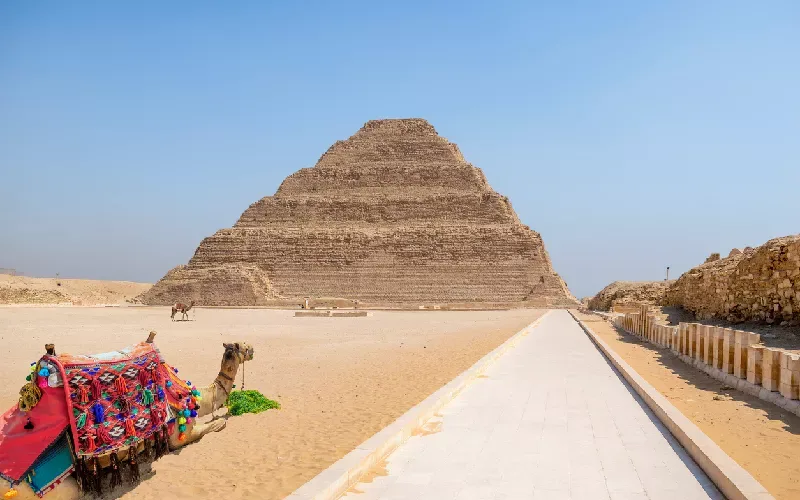
Its most famous monument is the Step Pyramid of Djoser.
The Step Pyramid of Djoser
The Step Pyramid was built during the Third Dynasty for Pharaoh Djoser.
It is generally considered the earliest large-scale stone pyramid complex in Egypt.
The architect traditionally associated with the project was Imhotep.
The monument represents an important step in the development of Egyptian architecture.
Before the Step Pyramid, royal tombs were generally associated with mastaba structures.
At Saqqara, architects transformed this traditional form into a series of stacked levels.
The result was a monument that eventually influenced the development of the smooth-sided pyramids at Giza.
For this reason, Saqqara is essential for anyone who wants to understand how Egyptian pyramid architecture evolved.
Ancient Tombs at Saqqara
Saqqara is not only about pyramids.
The site also contains decorated private tombs.
Their walls show scenes from everyday life.
Visitors can see representations of farming, fishing, hunting, food production, music, dancing, and craftsmanship.
These scenes are extremely valuable.
They show that ancient Egyptian history was not only about pharaohs.
Ordinary workers, farmers, craftsmen, musicians, and administrators were also part of this civilization.
6. Memphis – Ancient Egypt’s Political Center
Memphis was one of the most important cities in ancient Egypt.
The city was established during the early dynastic period and became a major political and religious center.
It was closely associated with the god Ptah.
Ptah was an important creator deity and was also connected with craftsmen and artisans.
Today, much of ancient Memphis has disappeared or remains beneath the modern landscape.
However, important monuments and statues can still be seen in the archaeological area.
One of the highlights is the enormous statue of Ramesses II.
Why Visit Memphis?
Memphis helps visitors understand the political foundations of ancient Egypt.
It also works perfectly with Saqqara.
The two sites are geographically close and historically connected. Therefore, they can usually be combined during the same excursion.
For travelers interested in the origins of ancient Egyptian civilization, this combination is especially valuable.
7. Cairo Museums and Ancient Egyptian Treasures
Ancient monuments tell only part of the story.
Museums provide another perspective.
Cairo is home to important collections of Egyptian antiquities. These collections contain statues, jewelry, coffins, mummies, papyri, religious objects, and everyday items.
These objects help explain how ancient Egyptians lived.
For example, a temple may show the relationship between a pharaoh and the gods. A museum object can show what people actually used during religious ceremonies or burial rituals.
Therefore, combining archaeological sites with a museum visit can create a much deeper experience.
Travelers coming from Hurghada can consider a Cairo excursion that combines Giza with a major museum visit.
8. Luxor – A Journey Into the New Kingdom
Luxor is one of the most important destinations in Egypt for history lovers.
The modern city stands near ancient Thebes.
For much of the New Kingdom, Thebes was one of Egypt’s most powerful political and religious centers.
Today, the Nile divides Luxor into two major archaeological areas.
The East Bank is famous for major temples.
The West Bank is known for royal tombs and mortuary monuments.
This division makes Luxor especially fascinating.
Visitors can explore temples connected with religious ceremonies on one side of the river. Then, they can cross to the West Bank and discover the tombs and funerary monuments of ancient rulers.
For many travelers, Luxor provides the richest concentration of ancient Egyptian history in one destination.
9. Karnak Temple
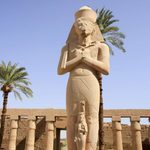
Karnak is one of the largest religious complexes ever built.
It was not constructed by one pharaoh.
Instead, different rulers added buildings and monuments over many centuries.
As a result, Karnak became a huge historical record written in stone.
The complex was particularly associated with the god Amun.
Kings added temples, chapels, statues, obelisks, gateways, and columns.
The Great Hypostyle Hall
The Great Hypostyle Hall is one of Karnak’s most impressive areas.
It contains enormous columns arranged in several rows.
Many columns are covered with hieroglyphic inscriptions and religious scenes.
Walking through the hall gives visitors a sense of the enormous scale of ancient Egyptian temple architecture.
The columns were not simply decorative.
They formed part of a sacred architectural environment designed to impress worshippers and communicate the power of the gods and the pharaoh.
Why Is Karnak Important?
Karnak reveals the close relationship between religion and royal power.
Each generation of rulers added something new.
Therefore, the temple complex reflects centuries of political and religious development.
10. Luxor Temple
Luxor Temple is another major monument on the East Bank.
It was developed by several rulers, including Amenhotep III and Ramesses II.
Unlike Karnak, which grew into a vast religious complex, Luxor Temple has a more compact design.
The temple was connected with royal ceremonies and the renewal of kingship.
Its entrance and monumental statues are particularly impressive.
Luxor Temple can also be beautiful after sunset.
The illuminated columns and statues create a completely different atmosphere from a daytime visit.
For travelers staying in Luxor, its location near the modern city makes it especially convenient.
11. Valley of the Kings
The Valley of the Kings is one of Egypt’s most famous archaeological destinations.
It is located on Luxor’s West Bank.
During the New Kingdom, pharaohs were buried in hidden rock-cut tombs instead of building enormous pyramids.
This change had practical and religious reasons.
The mountains provided a natural landscape for hidden tombs. At the same time, the area was associated with the sacred western horizon and the world of the dead.
More than sixty numbered tombs and additional chambers are known in the valley.
Each tomb is different.
Some are relatively simple.
Others contain long corridors and richly decorated chambers.
The Tomb of Tutankhamun
The most famous tomb is KV62, the burial place of Tutankhamun.
Howard Carter discovered the tomb in 1922.
The discovery became one of the most famous archaeological events in modern history because the burial contained an extraordinary collection of objects.
Among them was the famous golden burial mask.
Tutankhamun himself was not one of Egypt’s most powerful rulers.
However, the discovery of his tomb transformed his name into a symbol of ancient Egypt.
Today, visitors can sometimes enter the tomb as part of their Valley of the Kings experience, depending on current access arrangements.
12. Temple of Hatshepsut
The Temple of Hatshepsut is located at Deir el-Bahari on the West Bank.
It is one of the most distinctive monuments in Luxor.
Hatshepsut was one of ancient Egypt’s most remarkable rulers.
She became pharaoh during the 18th Dynasty and ruled during a period of prosperity and political stability.
Her temple was built beneath dramatic limestone cliffs.
The design uses broad terraces, ramps, and colonnades.
As a result, the monument appears to rise naturally from the surrounding landscape.
The Story of Punt
One of the most famous parts of the temple is the relief showing Hatshepsut’s expedition to Punt.
Punt was an important trading region, although its exact location remains debated.
The Egyptians returned with valuable goods.
These included incense, aromatic plants, ebony, gold, and exotic animals.
The reliefs show ships, people, animals, houses, and vegetation.
For historians, these scenes are extremely valuable.
They provide evidence about Egyptian trade, ships, foreign contacts, and the natural environment of Punt.
For visitors, they add another fascinating chapter to the story of Hatshepsut.
13. Colossi of Memnon
The Colossi of Memnon are two enormous seated statues on the West Bank of Luxor.
They once stood at the entrance of the enormous mortuary temple of Amenhotep III.
Much of that temple has disappeared.
However, the statues survived.
Their size is impressive.
They demonstrate the enormous resources available to New Kingdom pharaohs.
The Colossi are also conveniently located near several other West Bank attractions.
Therefore, they are often included in organized Luxor itineraries.
14. Medinet Habu
Medinet Habu is one of the best-preserved temples in Luxor.
The complex is strongly associated with Ramesses III.
Its walls contain extensive reliefs and inscriptions.
Some scenes show military campaigns.
Others represent religious ceremonies and royal achievements.
Because many details remain visible, Medinet Habu is an excellent place to study ancient Egyptian art and royal propaganda.
It can also be less crowded than some of the better-known sites.
That makes it an attractive choice for travelers who want a quieter historical experience.
15. Abydos – A Sacred City of Osiris
Abydos is one of Egypt’s most important religious sites.
The ancient city was strongly associated with Osiris, the god of the afterlife.
For ancient Egyptians, Abydos was an important pilgrimage destination.
The Temple of Seti I is one of its most impressive monuments.
Its walls contain beautifully preserved reliefs and important inscriptions.
Abydos is particularly interesting for travelers who want to understand ancient Egyptian beliefs about death and resurrection.
It also provides a different experience from the more famous pyramid sites.
16. Dendera Temple
Dendera is home to one of the best-preserved temple complexes in Egypt.
The main temple was dedicated to Hathor.
Hathor was associated with love, motherhood, music, beauty, joy, and femininity.
The temple contains impressive columns and beautifully decorated walls.
Its astronomical imagery is also famous.
The Dendera Zodiac is one of the best-known ancient Egyptian astronomical representations. The original relief is now preserved in Paris, but the temple itself remains a fascinating place to visit.
Dendera is especially rewarding for travelers interested in religion, astronomy, architecture, and ancient art.
17. Edfu Temple
The Temple of Horus at Edfu is one of the best-preserved ancient Egyptian temples.
It was built during the Ptolemaic period, long after the age of the great pyramids.
The temple was dedicated to Horus, the falcon-headed god.
Its walls contain extensive inscriptions and religious scenes.
Because the temple is so well preserved, visitors can easily understand how an ancient Egyptian temple was organized.
Edfu also demonstrates that Egyptian religious traditions continued long after the New Kingdom.
18. Kom Ombo Temple
Kom Ombo is another fascinating temple in southern Egypt.
Its unusual design comes from its dedication to two gods.
One side was associated with Sobek, the crocodile god.
The other was associated with Horus the Elder.
The temple includes interesting reliefs connected with religion and ancient medical knowledge.
Its location beside the Nile also makes the visit particularly memorable.
19. Philae Temple in Aswan
Philae Temple is one of the most beautiful monuments in southern Egypt.
The complex was primarily dedicated to Isis.
Its location is also part of its story.
The original temple complex was threatened by rising water after the construction of the Aswan High Dam.
An international conservation project moved the monuments to nearby Agilkia Island.
Today, visitors reach the temple by boat.
This makes Philae special for two reasons.
First, it is a magnificent ancient monument.
Second, it is an important example of modern archaeological conservation.
Planning Ancient Egypt Trips From Hurghada
A stay in Hurghada does not mean missing Egypt’s ancient history.
In fact, the city can be an excellent starting point for historical excursions.
However, distances are significant.
Therefore, it is important to choose your destinations carefully.
The two most popular historical trips from Hurghada are Cairo and Luxor.
Cairo From Hurghada
A Cairo excursion is ideal for travelers who want to see the pyramids.
A typical day can include:
- Giza Pyramids
- Great Sphinx
- Museum visit
- Lunch
- Return transfer to Hurghada
The journey is long.
For this reason, starting early is important.
However, the experience can be worthwhile for first-time visitors who have always dreamed of seeing the pyramids.
Who Should Choose Cairo?
Cairo is especially suitable for travelers interested in:
- Pyramids
- Old Kingdom history
- The Sphinx
- Ancient royal architecture
- Museums
- Saqqara
- Memphis
If the pyramids are your main goal, Cairo should be high on your list.
Luxor From Hurghada
Luxor is another excellent choice.
A typical Luxor excursion can include:
- Karnak Temple
- Valley of the Kings
- Temple of Hatshepsut
- Colossi of Memnon
- Lunch
- Return journey to Hurghada
Luxor is particularly attractive for travelers who want to see temples and tombs.
The journey is also shorter than traveling from Hurghada to Cairo.
For many history lovers, Luxor offers a more concentrated archaeological experience.
Cairo or Luxor: Which Is Better?
The answer depends on your interests.
Choose Cairo if you want to see the pyramids.
Choose Luxor if you want temples and royal tombs.
If you have enough time, visit both.
They represent different chapters of Egyptian history.
Giza is strongly associated with the Old Kingdom.
Luxor is particularly important for the New Kingdom.
Together, they provide a much more complete picture.
Best Tours Hurghada for History Lovers
Traveling long distances from Hurghada requires good organization.
You need reliable transportation, a clear sightseeing schedule, entrance tickets, and enough time at each monument.
This is where an organized excursion can be useful.
Best Tours Hurghada offers travelers the opportunity to explore Egypt beyond the Red Sea.
For history lovers, an organized Luxor or Cairo excursion can make the journey easier.
A professional guide can also add significant value.
Ancient Egyptian monuments contain thousands of details.
Hieroglyphs, statues, reliefs, temple layouts, and religious symbols can be difficult to understand without context.
A guide can explain what you are seeing and connect individual monuments with the larger story.
When planning a trip with Best Tours Hurghada, travelers can choose historical excursions based on their interests and available time.
How to Organize a Multi-Day History Trip
If you have several days available, a longer itinerary is ideal.
You could organize your journey like this:
Day 1 – Cairo and Giza
Explore the Great Pyramid, the other pyramids, and the Sphinx.
Day 2 – Saqqara and Memphis
Discover the Step Pyramid and the remains of ancient Memphis.
Day 3 – Luxor East Bank
Visit Karnak Temple and Luxor Temple.
Day 4 – Luxor West Bank
Explore the Valley of the Kings, Hatshepsut Temple, and Medinet Habu.
Day 5 – Dendera and Abydos
Discover important temples connected with ancient Egyptian religion.
Day 6 – Aswan
Visit Philae Temple and explore the ancient heritage of southern Egypt.
This type of itinerary is much more relaxed than trying to visit everything in a single day.
Best Time to Visit Ancient Sites in Egypt
Egypt can be visited throughout the year.
However, cooler months are usually more comfortable for sightseeing.
From autumn through spring, daytime temperatures are generally easier for long walks through archaeological sites.
Summer can be very hot, especially in Luxor and southern Egypt.
If you travel during the hotter months, start sightseeing early whenever possible.
Morning visits also provide softer light for photography.
Most importantly, remember that many ancient sites offer limited shade.
What to Wear for Historical Excursions
Comfort is important.
Choose lightweight clothing that allows you to walk easily.
Comfortable shoes are essential.
You may walk across stone floors, desert paths, temple courtyards, and archaeological areas.
A hat and sunglasses can also help protect you from the sun.
Do not forget sunscreen.
Finally, carry enough water, particularly when visiting large outdoor sites.
How to Get More From Your Ancient Egypt Experience
You do not need to become an Egyptologist before your trip.
However, learning a little about Egyptian history can make your experience much more interesting.
Before visiting Giza, learn about the Old Kingdom.
Before visiting Luxor, read about the New Kingdom.
Before entering the Valley of the Kings, learn about ancient Egyptian beliefs concerning the afterlife.
This background will help you understand the monuments.
You will also notice more details.
A painted scene will have greater meaning.
A hieroglyphic inscription will become part of a larger story.
A temple will no longer look like a collection of columns.
Instead, it will become a religious and political center that once played an important role in ancient Egyptian society.
A Simple Timeline of Ancient Egyptian History
A basic timeline can also help.
Early Dynastic Period
Egypt became a unified state and developed its early royal institutions.
Old Kingdom
This period is famous for pyramid construction.
The pyramids of Giza belong to this great age of monumental architecture.
Middle Kingdom
Egypt experienced political development and cultural growth.
Literature, administration, and religious traditions also developed.
New Kingdom
This was one of the most powerful periods in Egyptian history.
Pharaohs such as Hatshepsut, Thutmose III, Amenhotep III, Tutankhamun, and Ramesses II ruled during this period.
Many of Luxor’s most famous monuments were built at this time.
Late Period
Egypt experienced major political changes and increasing foreign influence.
Ptolemaic Period
Greek rulers governed Egypt after the conquest of Alexander the Great.
Temples such as Edfu and Dendera belong largely to this later period.
Cleopatra VII was the most famous ruler of the Ptolemaic dynasty.
Why You Should Look Beyond the Pyramids
The pyramids are undoubtedly spectacular.
However, they represent only one part of ancient Egyptian history.
If you visit only Giza, you will miss many fascinating aspects of the civilization.
Saqqara shows the evolution of pyramid architecture.
Memphis reveals the importance of political power.
Karnak demonstrates the strength of religious institutions.
The Valley of the Kings reveals beliefs about the afterlife.
Hatshepsut Temple tells the story of an extraordinary female ruler.
Dendera and Edfu show how Egyptian religious traditions continued for centuries.
Philae demonstrates the importance of both ancient religion and modern conservation.
Therefore, the best historical journey through Egypt is not simply about seeing famous monuments.
It is about understanding how they are connected.
Egypt as a Journey Through Time
One of the best ways to experience Egypt is to imagine your trip as a journey through time.
Start at Saqqara.
Here, you can see the early development of monumental stone architecture.
Continue to Giza.
The enormous pyramids demonstrate the achievements of the Old Kingdom.
Then explore Memphis.
The ancient city helps explain the political foundations of Egyptian civilization.
Next, travel to Luxor.
Here, the story moves into the powerful New Kingdom.
At Karnak, you can explore the religious world of Amun.
At the Valley of the Kings, you can discover royal tombs.
At Hatshepsut Temple, you can learn about one of Egypt’s most remarkable rulers.
Finally, continue south if time allows.
Dendera, Edfu, Kom Ombo, and Philae reveal how Egyptian religious traditions survived into later periods.
This approach creates a much clearer understanding of Egyptian history.
Frequently Asked Questions
What is the most important ancient site in Egypt?
There is no single answer.
Giza is the most famous, mainly because of the Great Pyramid and the Sphinx.
Luxor, however, contains an extraordinary concentration of temples and tombs.
For serious history lovers, both destinations are essential.
Is Cairo or Luxor better for history lovers?
Both are excellent.
Cairo is ideal for pyramids, the Sphinx, Saqqara, Memphis, and museums.
Luxor is better for temples, royal tombs, New Kingdom history, and ancient religious monuments.
Can I visit Luxor from Hurghada in one day?
Yes.
Many travelers visit Luxor as a full-day excursion from Hurghada.
The day can be long because of the travel time. However, an organized itinerary can make the journey easier.
Can I visit the pyramids from Hurghada?
Yes.
Cairo and Giza can be visited from Hurghada as a long day trip.
Travelers with more time can also choose a multi-day itinerary.
Which sites should I visit in Luxor?
For a first visit, prioritize Karnak Temple, the Valley of the Kings, Hatshepsut Temple, and the Colossi of Memnon.
If you have more time, add Luxor Temple and Medinet Habu.
Is Saqqara worth visiting?
Absolutely.
Saqqara is one of the most important sites for understanding the development of Egyptian pyramid architecture.
It also contains many fascinating tombs and monuments.
Why is the Valley of the Kings important?
The Valley of the Kings contains royal tombs from the New Kingdom.
The walls of many tombs contain religious scenes and texts connected with the afterlife.
The discovery of Tutankhamun’s tomb also made the valley famous worldwide.
What is the best historical excursion from Hurghada?
It depends on your interests.
Cairo is the best choice if the pyramids are your priority.
Luxor is ideal if you prefer temples, tombs, and New Kingdom history.
Final Thoughts
Egypt is an extraordinary destination for anyone who loves history.
Its ancient monuments are not concentrated in one location.
Instead, they stretch along the Nile and across the country’s desert landscapes.
At Giza, you can stand beside the Great Pyramid and the Sphinx.
At Saqqara, you can discover how pyramid architecture developed.
At Memphis, you can explore the remains of an ancient capital.
In Luxor, you can walk through enormous temples and explore royal tombs.
At Karnak, you can see the scale of ancient religious architecture.
In the Valley of the Kings, you can discover the hidden tombs of New Kingdom rulers.
At Hatshepsut Temple, you can learn about a powerful female pharaoh.
Further south, Dendera, Edfu, Kom Ombo, and Philae reveal another side of Egyptian history.
For travelers staying in Hurghada, these destinations provide an exciting opportunity to go beyond the Red Sea.
You can spend part of your vacation snorkeling among colorful coral reefs. Then, you can travel inland and discover monuments that are thousands of years old.
With Best Tours Hurghada, travelers can organize excursions to major historical destinations while enjoying the convenience of planned transportation and guided sightseeing.
Most importantly, do not rush your historical experience.
Take time to look at the inscriptions.
Study the reliefs.
Listen to the stories behind the monuments.
Think about the people who built them.
When you do this, Egypt becomes more than a collection of famous tourist attractions.
It becomes a journey through one of the world’s greatest civilizations.
And that is what makes Egypt unforgettable for history lovers.