
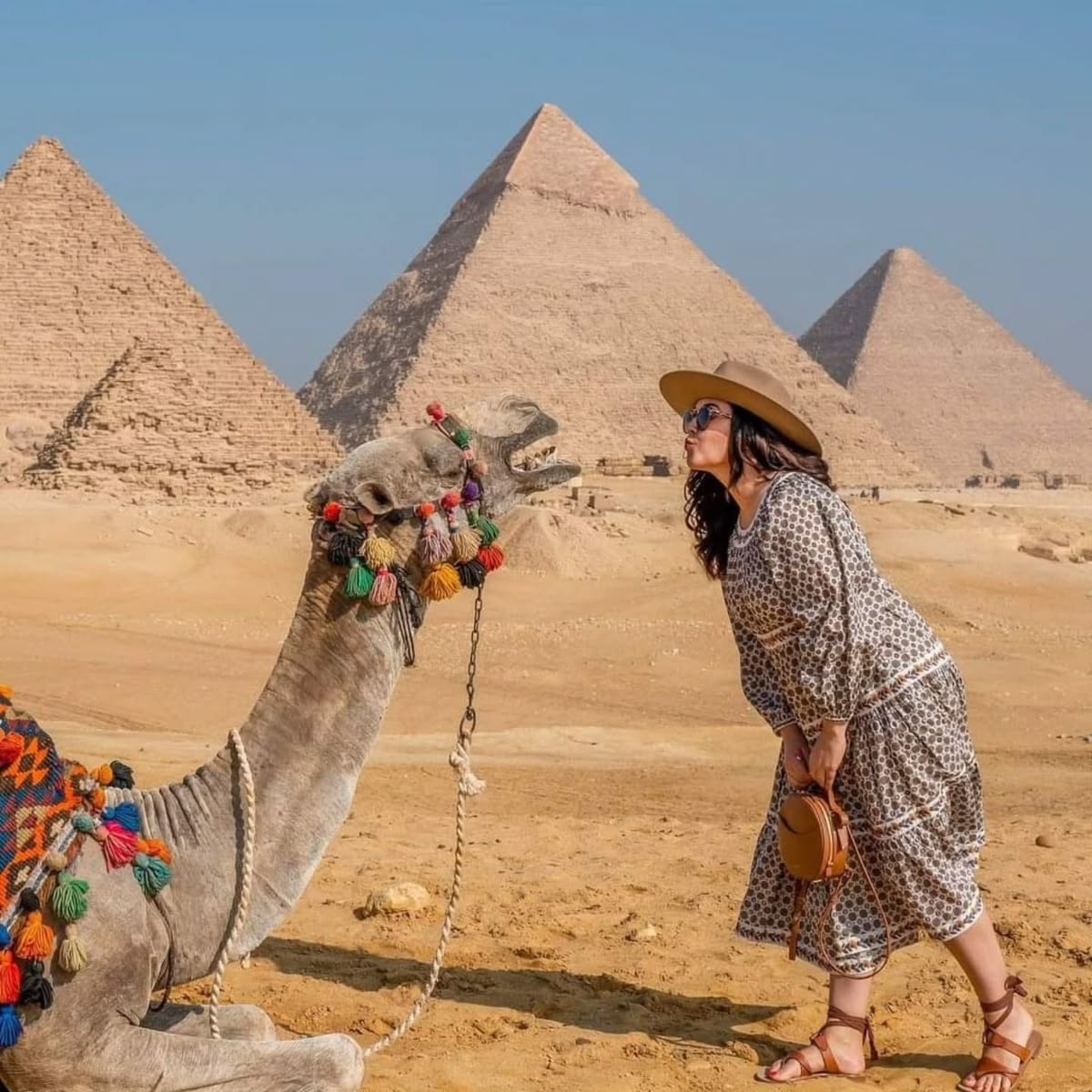
A Cairo trip from Hurghada is one of the most popular ways to discover a completely different side of Egypt. Hurghada is famous for its beaches, coral reefs, snorkeling trips and Red Sea adventures. Cairo, however, offers another experience: ancient monuments, museums, historic neighborhoods, mosques, churches and the extraordinary story of one of the world’s oldest civilizations.
For travelers staying in Hurghada, a visit to Cairo can feel like stepping into another world. Within the same country, the atmosphere changes from a relaxed Red Sea resort to a huge and energetic capital surrounded by some of Egypt’s most famous archaeological sites.
The Pyramids of Giza and the Great Sphinx are usually the main reason travelers make the journey. Yet Cairo offers much more than these iconic monuments. Museums, historic streets, traditional markets and landmarks from different periods of Egyptian history can turn a day trip into a much richer cultural experience.
This guide explains what travelers can expect from a Cairo trip from Hurghada, how to plan the journey, which attractions are worth prioritizing, what to take with you and how to make the experience more comfortable.
Why Take a Cairo Trip from Hurghada?
Hurghada and Cairo offer two very different travel experiences.
Hurghada is closely associated with the Red Sea. Visitors come for sunshine, beaches, boat trips, snorkeling, marine life and desert adventures. Cairo introduces a much broader historical and cultural perspective.
A Cairo excursion allows travelers to connect the modern resort experience with the ancient civilization they may have read about before arriving in Egypt.
The pyramids are the obvious highlight, but the journey also offers an opportunity to understand how Egyptian history developed over thousands of years.
A well-planned trip can include:
- The Pyramids of Giza
- The Great Sphinx
- The Egyptian Museum or another major museum depending on the itinerary
- Historic Cairo
- Khan el-Khalili
- Important mosques and monuments
- The Nile
- Traditional Egyptian food
- Modern Cairo and its lively streets
Because Cairo is far from Hurghada, organization is important. Travelers should consider transportation, departure time, sightseeing priorities, meals and the amount of time available.
Traveling from Hurghada to Cairo
The distance between Hurghada and Cairo makes transportation an important part of the excursion.
Many visitors choose an organized day trip because it allows transportation and sightseeing to be arranged together. This can be particularly useful for first-time visitors who do not want to coordinate several parts of the journey independently.
The exact travel time depends on the route, traffic, transportation method and conditions on the day.
Cairo is a large and busy city, so traffic can affect the schedule. For this reason, travelers should avoid creating an itinerary that leaves no flexibility.
An organized excursion can make the process easier because the transportation arrangements, sightseeing schedule and guide services may already be coordinated.
When comparing excursions, check exactly what is included. The cheapest option is not necessarily the one with the simplest or most comfortable overall experience.
What Makes Cairo Different from Hurghada?
The contrast between the two destinations is one of the most interesting parts of the trip.
Hurghada is built around the Red Sea and tourism. Cairo is a huge urban center where historical monuments exist alongside modern neighborhoods, busy roads, businesses and everyday life.
In Hurghada, you might spend the morning snorkeling and the afternoon relaxing by the sea.
In Cairo, the morning could begin beside an ancient pyramid, followed by a museum visit and a walk through a historic district.
This contrast makes a Cairo trip especially valuable for travelers who want to see more than Egypt’s resort areas.
The Pyramids of Giza
For most visitors, the Pyramids of Giza are the central attraction of the trip.
The Giza Plateau contains three major pyramids associated with ancient Egyptian rulers: Khufu, Khafre and Menkaure.
The Great Pyramid of Khufu is the largest of the three and is the only surviving monument among the traditional Seven Wonders of the Ancient World.
Standing in front of the pyramids gives travelers a different perspective from seeing them in photographs.
Their enormous scale becomes much easier to appreciate when you are actually standing on the plateau.
The Great Pyramid
The Great Pyramid is associated with Pharaoh Khufu.
Its original appearance was different from what visitors see today because the outer casing stones that once covered the pyramid have largely disappeared.
The monument was built as part of an enormous funerary complex.
Its construction remains one of the most remarkable achievements of ancient Egyptian engineering.
Visitors may be able to enter certain pyramid areas depending on the current ticketing arrangements and access rules. However, entering a pyramid is not essential to appreciate the site.
For many travelers, simply walking around the plateau and viewing the monument from different angles is already a memorable experience.
The Pyramid of Khafre
The Pyramid of Khafre is often recognized by the remaining casing stones near its upper section.
Its position can also create the impression that it is taller than the Great Pyramid, although the Great Pyramid is actually larger.
The pyramid is closely associated with the Great Sphinx, which makes this part of the Giza Plateau particularly interesting.
The Pyramid of Menkaure
The Pyramid of Menkaure is smaller than the other two major pyramids.
Its reduced size does not make it less significant. Instead, it provides another perspective on how the Giza pyramid complex was planned.
Looking at all three pyramids together helps visitors understand that Giza is not simply three isolated monuments. It is an extensive archaeological landscape.
The Great Sphinx
The Great Sphinx is another essential stop.
The monument has the body of a lion and a human head and is traditionally associated with royal power.
Its exact historical interpretation has been discussed by researchers for many years, but its importance within the Giza landscape is undeniable.
Visitors often notice how different the Sphinx feels compared with the pyramids.
The pyramids dominate the landscape through their enormous geometric forms. The Sphinx, by contrast, is closer to the ground and has a more sculptural character.
The best way to appreciate the site is to take time to observe the monument rather than simply stopping for a quick photograph.
Photography at the Giza Plateau
The pyramids are among the most photographed landmarks in the world.
However, good photographs do not always require complicated equipment.
A smartphone can capture excellent images if you pay attention to light and composition.
Early morning and later afternoon can provide softer light. During the middle of the day, the sun can be intense, creating strong shadows.
Try photographing the pyramids from different viewpoints rather than taking only the standard front-facing picture.
You can also include people in the frame to show the scale of the monuments.
At the same time, respect local rules and avoid climbing or entering restricted areas.
Museums in Cairo
After visiting the pyramids, a museum can provide important historical context.
Ancient monuments show the physical remains of Egyptian civilization. Museums allow visitors to examine smaller objects, statues, jewelry, tools, inscriptions and other archaeological material.
The Egyptian Museum
The Egyptian Museum in Cairo has long been one of the city’s best-known museums.
Its collections cover extensive periods of ancient Egyptian history.
For first-time visitors, a museum visit can make the monuments seen earlier in the day more understandable.
Instead of seeing a pyramid only as a huge stone structure, visitors can learn more about the society, religion, art and burial traditions connected with ancient Egypt.
Because museum collections are extensive, it is impossible to see everything in a short visit.
A focused approach is therefore more useful.
Choose several sections or objects that interest you and spend time understanding them rather than trying to rush through every room.
The Grand Egyptian Museum
The Grand Egyptian Museum represents a major modern addition to Egypt’s museum landscape.
Its location near the Giza Plateau makes it particularly relevant to travelers combining museum visits with the pyramids.
The museum experience and available galleries can change over time as exhibitions and visitor access develop, so travelers should check the current opening arrangements and ticket information when planning their visit.
For a Cairo excursion, it is important to know which museum is included in the itinerary rather than simply seeing the word “museum” in the description.
Historic Cairo
Cairo’s history did not end with the ancient pharaohs.
The city contains neighborhoods and monuments from later periods, including Islamic and Christian heritage.
Historic Cairo can therefore add another layer to a trip that begins with the pyramids.
Visitors can see historic mosques, old streets, traditional architecture and markets.
The experience is very different from the open landscape of Giza.
Instead of enormous monuments surrounded by desert, you find dense urban streets filled with movement, shops and centuries-old buildings.
Khan el-Khalili
Khan el-Khalili is one of the most famous traditional market areas in Cairo.
The narrow streets contain shops selling souvenirs, jewelry, spices, handicrafts, perfumes and many other products.
Walking through the market can be an experience in itself.
Travelers should remember that prices may vary between shops, and bargaining can be part of the shopping culture.
However, shopping does not have to become stressful.
It is perfectly acceptable to compare prices, decide not to buy something or politely continue walking.
What souvenirs can you buy?
Common souvenirs include:
- Egyptian-style decorations
- Scarves
- Jewelry
- Papyrus-style artwork
- Handmade crafts
- Spices
- Small decorative objects
- Traditional perfumes
When buying souvenirs, pay attention to quality and authenticity.
Avoid purchasing archaeological artifacts or anything presented as an ancient historical object without legitimate documentation. Travelers should also avoid buying protected natural materials or products whose export may be restricted.
Al-Muizz Street and Historic Architecture
For travelers interested in architecture, Al-Muizz Street offers a fascinating look at Cairo’s historic character.
Historic buildings, gates, mosques and traditional architectural details create an atmosphere very different from the Giza Plateau.
This part of Cairo demonstrates that the city’s history extends far beyond the age of the pyramids.
The best way to experience historic districts is to slow down and observe details.
Look at doorways, stonework, decorative elements and inscriptions.
The city becomes easier to understand when you view it as a collection of historical layers rather than as one single destination.
The Citadel of Cairo
The Citadel is another important historical attraction.
Located on elevated ground, it provides impressive views across parts of Cairo.
The site has played an important role in the city’s military and political history.
One of the most recognizable buildings inside the Citadel is the Mosque of Muhammad Ali.
Its large domes and Ottoman-inspired architectural features create a strong visual contrast with the ancient Egyptian monuments visited earlier in the day.
This is another reason why Cairo is so interesting.
A single excursion can introduce travelers to several completely different periods of Egyptian history.
Coptic Cairo
Cairo’s Christian heritage is another important part of the city’s identity.
Coptic Cairo includes several historic churches and religious sites.
The Hanging Church is among the best-known landmarks in the area.
The Church of Saints Sergius and Bacchus is also historically significant.
For travelers who have already visited the pyramids and pharaonic temples, this part of Cairo demonstrates how the city continued to evolve over centuries.
The Nile in Cairo
The Nile remains central to Cairo’s geography and daily life.
The river divides important parts of the metropolitan area and has shaped settlement, agriculture, transportation and economic activity for thousands of years.
During a Cairo trip, even a short stop beside the river can provide a different perspective on the city.
The contrast between the water and the dense urban environment is particularly interesting for photographers.
The Nile also helps explain why ancient settlements developed in this part of Egypt.
Without the river, the surrounding landscape would be dramatically different.
Food During a Cairo Excursion
Food can add another dimension to a Cairo trip.
Egyptian cuisine includes a variety of dishes based on rice, legumes, vegetables, bread and meat.
Travelers may encounter dishes such as koshari, falafel known locally as ta’ameya, grilled meats, soups and different vegetable preparations.
If your excursion includes lunch, check whether the meal is part of the package.
Food arrangements vary between tours.
Travelers with allergies or dietary restrictions should communicate these requirements before departure rather than assuming that a particular meal will automatically be available.
How Long Should You Spend in Cairo?
A single-day trip from Hurghada can introduce travelers to the most famous attractions, but Cairo is too large to experience completely in one day.
For a first visit, many travelers prioritize the Giza Plateau and one major museum.
If time allows, they can then add a historic district or market.
Trying to include every major attraction in a single day can make the experience exhausting.
A better approach is to choose priorities.
For example:
Option 1: Ancient Egypt focus
- Giza Pyramids
- Great Sphinx
- Museum
- Return to Hurghada
Option 2: History and culture
- Giza Plateau
- Museum
- Historic Cairo
- Khan el-Khalili
Option 3: Broader Cairo experience
- Pyramids
- Museum
- Citadel
- Historic Cairo
- Khan el-Khalili
The actual order depends on transportation, opening arrangements and the excursion schedule.
Is a Cairo Trip from Hurghada Worth the Journey?
The answer depends on what you want from your Egyptian holiday.
Travelers who mainly want a relaxed beach vacation may prefer to spend more time in Hurghada.
Those who are fascinated by ancient history may consider Cairo an essential addition.
The journey is long compared with a local Hurghada excursion, so expectations should be realistic.
The reward is the opportunity to see monuments that are strongly connected with Egypt’s cultural identity.
For many travelers, standing beside the pyramids after spending several days beside the Red Sea creates a memorable contrast.
Cairo for Families
Families can also enjoy a Cairo excursion, but preparation matters.
Children may find the pyramids exciting because they can see enormous monuments they may previously have encountered only in books or videos.
Museums can also be engaging when the visit focuses on particularly interesting objects rather than attempting to see everything.
However, Cairo can be busy and tiring.
Parents should prepare for:
- A long transportation day
- Walking
- Heat and strong sunlight
- Crowded areas
- Early departure
- Regular water breaks
Comfortable shoes and sun protection are especially important.
Cairo for Couples
For couples, a Cairo excursion can combine major landmarks with cultural experiences.
The pyramids provide the iconic moment, while a walk through a historic market or a meal featuring Egyptian cuisine can add a more local dimension.
Couples should still remember that a day trip from Hurghada involves significant travel.
A relaxed itinerary with realistic expectations is more enjoyable than trying to visit every possible attraction.
What Should You Take with You?
A practical packing list can make the day much easier.
Consider taking:
- Comfortable walking shoes
- Sunglasses
- Sunscreen
- A hat or cap
- Drinking water
- Phone or camera
- Power bank
- Some cash
- Light, comfortable clothing
- Any necessary personal medication
- A small backpack
A light layer can also be useful depending on the season and transportation conditions.
Do not overload yourself. You will spend part of the day walking, and a smaller bag is easier to manage.
What Should You Wear?
Egypt is a culturally diverse country, but modest and comfortable clothing is generally a practical choice when visiting historical and religious places.
For a long day in Cairo, breathable clothing and comfortable shoes are more important than dressing formally.
If your itinerary includes mosques or religious sites, make sure your clothing is appropriate for the location.
A scarf can be useful in some situations, particularly when visiting religious buildings.
Choosing a Cairo Excursion from Hurghada
Not every Cairo excursion has the same program.
Before booking, check:
- Transportation type
- Departure and return time
- Pyramids entrance arrangements
- Sphinx visit
- Museum included
- Guide language
- Lunch arrangements
- Group size
- Additional entrance fees
- Shopping stops
- Insurance or other included services
A clear description makes it easier to understand what you are actually paying for.
If you are comparing different options, look beyond the headline price.
A slightly different program may provide more useful sightseeing time or a smaller group, depending on the provider.
For travelers planning a Cairo excursion from Hurghada, Best Tours Hurghada can be considered when looking for an organized way to combine transportation, sightseeing and guidance.
Organized Tour or Independent Travel?
Both approaches have advantages.
An organized tour reduces the amount of planning required. Transportation, sightseeing and timing are generally arranged in advance.
Independent travel can provide more flexibility but requires more organization.
You need to consider transportation, tickets, routes, timing and traffic yourself.
For a first-time visit to Cairo from Hurghada, the convenience of an organized excursion can be particularly useful.
For experienced travelers who prefer flexibility, an independent itinerary may provide more freedom.
The important point is to choose the style that matches your travel preferences.
Responsible Tourism in Cairo
Responsible travel matters even during a short city excursion.
Historical sites are fragile and should be treated with care.
Do not climb monuments, touch delicate surfaces unnecessarily or ignore barriers.
At religious sites, respect local customs and dress expectations.
When photographing people, ask for permission where appropriate.
Shopping can also be more responsible when you choose locally made products instead of mass-produced items falsely presented as historical artifacts.
These small choices can make the travel experience more respectful.
Common Mistakes to Avoid
Trying to see everything
Cairo is enormous.
A day trip cannot cover every museum, mosque, neighborhood and monument.
Choose your priorities.
Ignoring travel time
The journey from Hurghada to Cairo is a significant part of the day.
Expecting a short local excursion will lead to disappointment.
Wearing uncomfortable shoes
The pyramids, museums and historic districts can involve considerable walking.
Comfort should come first.
Forgetting sun protection
The Egyptian sun can be intense, particularly around open archaeological sites.
Not checking what is included
Always read the excursion description carefully.
Museum entrance, pyramid entry, meals, drinks and additional attractions may be handled differently by different providers.
Planning too many activities
More attractions do not automatically mean a better experience.
A smaller number of meaningful visits can be more enjoyable.
A Sample Cairo Day from Hurghada
A typical organized day might begin with an early departure from Hurghada.
After traveling to Cairo, the first major stop could be the Giza Plateau.
Travelers can explore the pyramids, take photographs and visit the Great Sphinx.
A lunch break may follow.
The afternoon could then focus on a museum before returning to Hurghada.
Another itinerary might replace the museum with historic Cairo or Khan el-Khalili.
The exact schedule depends on the excursion.
The most important thing is to allow enough time for each attraction instead of rushing through the entire city.
Frequently Asked Questions
How far is Cairo from Hurghada?
Cairo is located far from Hurghada, so a day trip involves substantial travel time. The exact duration depends on the transportation method, route and traffic conditions.
Can I visit the pyramids from Hurghada in one day?
Yes, organized day trips can combine transportation from Hurghada with a visit to the Giza Plateau. However, the day will be long because of the distance between the two cities.
What are the main attractions in Cairo?
The Pyramids of Giza and the Great Sphinx are the most famous attractions. Depending on your interests, you can also visit museums, Historic Cairo, Khan el-Khalili, the Citadel and other cultural landmarks.
Is the Great Sphinx included in every Cairo tour?
Not necessarily. Tour programs differ, so check the exact itinerary before booking.
Which museum should I visit in Cairo?
The choice depends on your interests and the current excursion program. The Egyptian Museum and the Grand Egyptian Museum offer different experiences, so check which museum is included in your selected itinerary.
Is Cairo suitable for children?
Yes, but families should prepare for a long day with transportation, walking, heat and crowds. A realistic itinerary with breaks can make the experience more comfortable.
What should I wear for a Cairo trip?
Choose comfortable, breathable clothing and walking shoes. More modest clothing is practical when visiting religious or culturally significant locations.
Should I book a private or group Cairo trip?
A private trip can provide more flexibility, while a group excursion can be more structured and may be more economical. The better option depends on your preferred pace, privacy and budget.
Can I combine Cairo with other excursions from Hurghada?
It is possible to combine Cairo with other Egyptian experiences, but avoid creating an overly demanding schedule. A balanced itinerary should include enough time for rest between long excursions.
Final Thoughts
A Cairo trip from Hurghada offers a chance to experience a completely different side of Egypt.
The Red Sea and its beaches may be the reason you chose Hurghada, but Cairo reveals another layer of the country. The pyramids demonstrate the scale of ancient Egyptian architecture, the Sphinx adds another dimension to the Giza Plateau, museums provide historical context, and the streets of Historic Cairo show how the city continued to develop long after the age of the pharaohs.
The journey is long, so good planning matters.
Choose a realistic itinerary, wear comfortable clothing, take sun protection and water, and check exactly what your excursion includes before booking. Most importantly, do not try to experience all of Cairo in a single day.
The strongest Cairo experience is not necessarily the one with the longest list of attractions. It is the one that gives you enough time to appreciate the places you actually came to see.
For travelers staying in Hurghada, combining the Red Sea with a carefully planned Cairo excursion can create a much broader picture of Egypt — from coral reefs and desert landscapes to pyramids, museums, historic streets and the timeless Nile.