Egypt is home to countless ancient monuments, but few offer such a complete picture of ancient Egyptian temple architecture as Edfu Temple. Standing on the western bank of the Nile in the modern city of Edfu, this enormous sanctuary was dedicated to Horus, the falcon-headed god associated with kingship, protection, and divine power.
Built during the Ptolemaic period, Edfu Temple is one of the best-preserved ancient Egyptian temples in Egypt. Its monumental entrance, enormous pylons, columned halls, detailed reliefs, sacred sanctuary, and extensive hieroglyphic inscriptions allow visitors to understand how an Egyptian temple functioned as both a religious center and a symbolic representation of the universe.
Although the temple visible today dates mainly to the Ptolemaic period, its religious traditions are much older. The site of Edfu had been associated with Horus long before the present temple was constructed. The Ptolemaic rulers deliberately continued Egyptian architectural and religious traditions, creating a sanctuary that connected their reign with the ancient pharaonic past.
For travelers exploring Upper Egypt, Edfu Temple is an extraordinary destination. It can be visited as part of a Nile cruise between Luxor and Aswan or included in a longer historical itinerary. Travelers coming from Hurghada can also consider a multi-day excursion that combines Edfu with other major archaeological sites.
For those planning such a journey, Best Tours Hurghada can be considered when looking for organized Egypt excursions that connect the Red Sea with the country’s ancient monuments.
Where Is Edfu Temple?
Edfu Temple is located in the city of Edfu, on the western bank of the Nile in Upper Egypt.
Edfu lies between Luxor and Aswan, making it an important stop on many Nile itineraries.
Its location was also significant in ancient times. Edfu was an important regional center and was associated with the worship of Horus. During the Greek and Roman periods, the city was known as Apollonopolis Magna, reflecting the identification of Horus with Apollo in the Greco-Roman world.
Today, the temple rises above the surrounding city and provides visitors with an impressive example of how enormous ancient religious complexes could be.
Unlike some Egyptian temples that survive only as fragments, Edfu retains many of its major architectural components.
That is one of the reasons why walking through its entrance can feel like stepping into the world of ancient Egypt.
When Was Edfu Temple Built?
The present Temple of Horus was constructed during the Ptolemaic period, when Egypt was ruled by the successors of Alexander the Great.
Construction began during the reign of Ptolemy III Euergetes I in 237 BC. The project continued under several rulers and was finally completed during the reign of Ptolemy XII Neos Dionysos in 57 BC.
The Egyptian Ministry of Tourism and Antiquities states that construction therefore lasted approximately 180 years.
This long construction period explains why different rulers appear throughout the temple’s inscriptions and reliefs.
Rather than representing the work of a single king, Edfu is the result of generations of construction, decoration, religious dedication, and political symbolism.
UNESCO’s description of the Ptolemaic and Roman temples of Upper Egypt provides even more precise dates. According to inscriptions, the first stone of the main sanctuary was laid on 23 August 237 BC, while later stages included the construction of the pronaos, pylon, surrounding walls, and extensive decoration.
Why Did the Ptolemies Build a Temple to Horus?
The Ptolemaic rulers were of Macedonian-Greek origin, but they ruled Egypt as pharaohs.
To strengthen their legitimacy, they adopted many traditional Egyptian religious practices and presented themselves in temple reliefs as traditional Egyptian kings.
Edfu demonstrates this strategy particularly well.
The rulers appear in Egyptian artistic style, performing rituals before the gods, offering gifts, defeating enemies, and participating in sacred ceremonies.
By building and decorating temples according to established Egyptian traditions, the Ptolemies connected their rule with thousands of years of pharaonic civilization.
Edfu was therefore both a religious monument and a statement of royal legitimacy.
The temple communicated an important message:
The king was the rightful ruler because he maintained order, protected the gods, and continued the traditions of ancient Egypt.
Horus – The Falcon God of Edfu
To understand Edfu Temple, it is essential to understand Horus.
Horus was one of the most important gods in ancient Egyptian religion. He was commonly represented as a falcon or as a human figure with a falcon’s head.
His identity changed and developed across different periods and regions, but he was strongly associated with the sky, kingship, protection, and divine authority.
At Edfu, Horus was particularly important as a divine protector and as a model for the Egyptian king.
The relationship between Horus and Egyptian kingship goes back thousands of years.
The living king was associated with Horus, while the deceased king was traditionally connected with Osiris.
This relationship formed an important part of ancient Egyptian ideas about royal succession.
Horus and the Story of Osiris
Horus also plays a central role in one of ancient Egypt’s most important mythological traditions.
According to the well-known Osiris myth, Osiris was killed by his brother Seth.
Horus, the son of Osiris and Isis, eventually confronted Seth and fought to restore his father’s honor and claim his rightful inheritance.
The myth was much more than a dramatic story.
It represented important ideas about order, legitimacy, justice, death, resurrection, and kingship.
The conflict between Horus and Seth could also be interpreted symbolically as a struggle between order and chaos.
At Edfu, these religious concepts became part of the temple’s architectural and decorative program.
The temple was not simply a place where people came to admire statues.
It was a sacred environment in which mythology was continuously brought to life through ritual.
The Monumental Pylon of Edfu
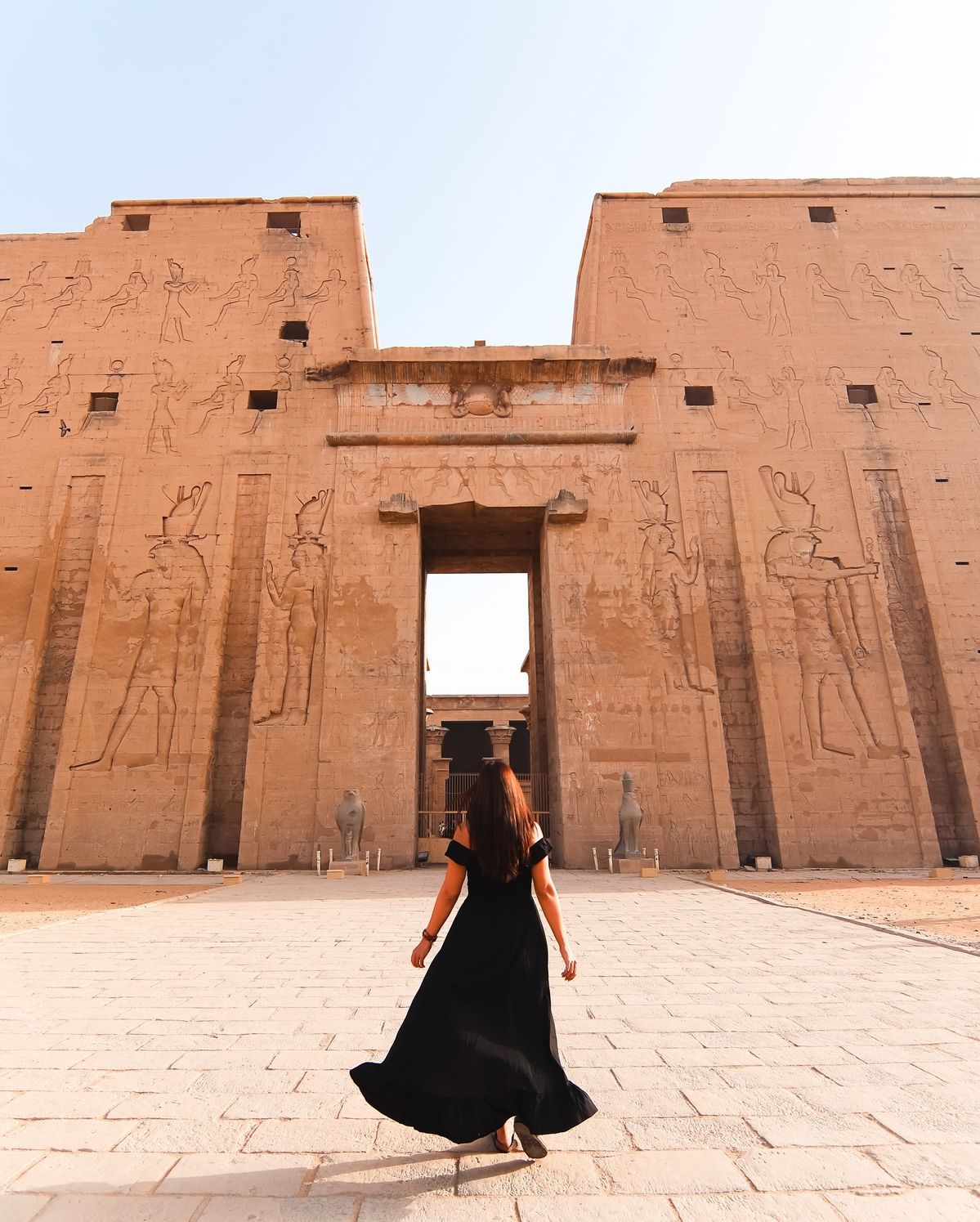
The first major feature visitors encounter is the enormous pylon, or monumental gateway.
The pylon consists of two massive towers connected by a central entrance.
It is one of the most recognizable features of the temple.
The exterior walls are covered with large reliefs showing the king interacting with the gods.
The Ministry of Tourism and Antiquities notes that scenes on the pylon include Ptolemy XII defeating enemies and worshipping deities.
These scenes were highly symbolic.
The king is shown as powerful and victorious, reinforcing the idea that the ruler protects Egypt from chaos and maintains divine order.
This visual message was important because the temple was a sacred space where political authority and religious authority were closely connected.
The Giant Statues of Horus
Standing in front of the pylon are two large granite statues representing Horus as a falcon.
These statues immediately establish the identity of the temple.
The falcon was one of the most recognizable forms of Horus, and the statues served as powerful guardians of the sacred entrance.
The contrast between the enormous pylon and the falcon statues creates one of Edfu’s most impressive views.
Visitors can stand before the entrance and immediately understand the scale of the ancient sanctuary.
The statues also demonstrate how Egyptian artists combined architecture and religious symbolism.
The temple did not merely contain representations of the gods.
Its entire design was built around their presence.
The Great Courtyard
After passing through the pylon, visitors enter a large open courtyard.
The courtyard is surrounded by columns decorated with floral capitals.
This open space formed an important transition between the public entrance and the increasingly sacred areas deeper inside the temple.
The progression through the building was deliberate.
As visitors moved farther into the temple, the spaces became darker, more restricted, and more sacred.
This architectural movement was part of the religious experience.
The temple was not designed as a single open room.
It was a carefully controlled journey toward the sanctuary.
The Hypostyle Halls
Beyond the courtyard are two important hypostyle halls.
A hypostyle hall is a large space supported by numerous columns.
At Edfu, these halls contain extensive reliefs and inscriptions that provide information about religious rituals and temple traditions.
The first hypostyle hall is associated with scenes of the king performing rituals and worshipping the gods.
The second hall contains additional religious scenes, including representations connected with the sacred journey of Horus.
The Ministry of Tourism and Antiquities identifies two hypostyle halls within the temple and notes that the second contains scenes of Horus’s journey in a sacred bark accompanied by Hathor.
These spaces demonstrate how architecture, mythology, and ritual were integrated.
Horus and Hathor
The relationship between Horus and the goddess Hathor is another important part of Edfu’s religious meaning.
Hathor was one of the most important goddesses in ancient Egypt and was associated with love, motherhood, music, joy, femininity, and the sky.
At Edfu, she was connected with Horus through religious festivals and mythology.
The temple inscriptions describe rituals and ceremonies involving the two deities.
One important tradition was the sacred connection between Horus of Edfu and Hathor of Dendera.
According to the UNESCO description of the Ptolemaic temples, Hathor of Dendera and Horus of Edfu were associated with a sacred marriage ceremony known as the Happy Reunion.
This relationship shows that Egyptian temples were connected through shared religious traditions.
Edfu and Dendera therefore provide complementary insights into the religious world of later ancient Egypt.
The Sanctuary – The Most Sacred Area
At the heart of the temple lies the sanctuary.
This was the most sacred part of the complex.
Unlike the outer courtyard and entrance areas, the sanctuary was not a space for everyone.
The inner temple was associated with priests and sacred rituals.
The sanctuary contained a stone shrine, or naos, associated with the divine image of Horus.
The UNESCO description notes that the sanctuary contains a large granite monolithic naos associated with an earlier structure.
The movement from the monumental entrance toward the sanctuary represents a gradual transition from the outer world into the divine realm.
That transition is one of the most important architectural ideas to understand when visiting an ancient Egyptian temple.
Why Is the Temple So Well Preserved?
Edfu Temple is famous for being one of the most complete ancient Egyptian temples.
One important reason is that the temple was buried beneath layers of settlement debris and sand for centuries.
This helped protect many architectural and decorative elements.
The Egyptian Ministry of Tourism and Antiquities explains that the temple remained buried for a long period, which contributed to the survival of its architecture and decoration. Parts of the temple were uncovered and restored by the French archaeologist Auguste Mariette in the nineteenth century.
The UNESCO description similarly notes that the temple was buried beneath sand up to the level of its architraves and was cleared during the nineteenth century.
Today, that preservation allows visitors to experience a much more complete temple layout than is possible at many other archaeological sites.
The Reliefs of Edfu Temple
The reliefs are among the greatest treasures of Edfu.
They cover walls, columns, pylons, doorways, and other architectural surfaces.
Kings are shown presenting offerings to gods.
Deities appear in human, animal, and composite forms.
Religious ceremonies are represented in carefully organized scenes.
Hieroglyphic texts accompany many of the images.
The result is an enormous visual and written record.
These reliefs are important not only because they are beautiful but because they preserve information about ancient Egyptian religion.
The King as Defender of Order
One recurring theme in Egyptian temple art is the king defeating enemies.
The ruler may be shown holding captured enemies by the hair while raising a weapon.
This is not simply a historical record of a specific battle.
It is symbolic.
The king is demonstrating his ability to defeat chaos and protect the land.
At Edfu, scenes on the monumental pylon reinforce this concept.
The ruler appears before the gods as the defender of divine order.
This helps explain why ancient Egyptian temple reliefs frequently combine religion and kingship.
For the Egyptians, maintaining political stability and maintaining cosmic order were deeply connected.
Hieroglyphs – More Than Decoration
The hieroglyphic inscriptions at Edfu are essential for understanding the temple.
Visitors may initially see them as decorative symbols carved into stone.
In reality, they communicate names, titles, religious formulas, rituals, myths, offerings, and descriptions of sacred events.
The inscriptions also help researchers reconstruct how the temple was intended to function.
UNESCO notes that the inscriptions at Edfu provide extensive information about daily liturgies and the religious calendar.
This makes Edfu particularly valuable for Egyptologists.
The walls preserve not only artistic images but also written evidence about religious practice.
The Religious Calendar of Edfu
Ancient Egyptian religion included numerous festivals throughout the year.
Some were connected with the annual agricultural cycle, while others focused on specific gods and temples.
At Edfu, inscriptions preserve information about religious celebrations, including New Year rituals.
UNESCO describes a New Year ceremony in which divine statues were symbolically connected with solar energy and rituals associated with the temple roof.
These festivals demonstrate that the temple was not a static monument.
It was an active religious institution.
Priests performed rituals, sacred objects were carried in processions, and divine images were associated with important ceremonies.
The Sacred Bark of Horus
The ancient Egyptians often transported divine statues in ceremonial boats known as sacred barks.
These boats were not ordinary transportation.
They were symbolic vessels used during religious processions.
At Edfu, scenes show Horus traveling in a sacred bark.
The representation of the bark provides visitors with an opportunity to understand how religious processions may have formed part of temple life.
The walls therefore preserve images of rituals that once filled the temple with movement and ceremony.
Edfu Temple and Ancient Egyptian Architecture
Edfu is also important from an architectural perspective.
The temple demonstrates many characteristic elements of Egyptian religious architecture:
- Monumental pylons
- Open courtyards
- Colonnades
- Hypostyle halls
- Offering rooms
- Ritual chambers
- Sanctuary
- Surrounding walls
- Religious inscriptions
- Monumental statues
The arrangement creates a logical progression from public to sacred spaces.
Visitors first encounter the enormous outer entrance.
Then they move through increasingly enclosed spaces.
Eventually, they reach the sanctuary.
This design reflects the hierarchy of ancient Egyptian sacred architecture.
Why Was Edfu Different From Earlier Temples?
Although the temple follows traditional Egyptian architectural principles, its construction during the Ptolemaic period gives it a special historical character.
The rulers were Greek-speaking monarchs ruling a civilization with thousands of years of Egyptian traditions.
Instead of replacing Egyptian religion, they adopted and promoted it.
This is one reason why Edfu is so valuable for understanding the later history of ancient Egypt.
It shows that Egyptian religious traditions continued long after the great pyramids and the famous New Kingdom pharaohs.
The civilization was changing, but many of its religious ideas remained powerful.
The Temple and the Myth of Horus and Seth
The mythological conflict between Horus and Seth was especially important at Edfu.
Horus represented legitimate kingship and order, while Seth became associated with disorder and conflict in the mythological tradition.
The struggle between the two gods provided a symbolic framework for ideas about rightful rule.
For ancient Egyptian kings, identifying themselves with Horus was a powerful statement.
The king was not simply a political leader.
He was presented as the earthly representative of divine order.
This connection between mythology and kingship is one of the most important lessons that Edfu offers modern visitors.
Archaeology and Restoration at Edfu
The story of Edfu did not end when the temple was abandoned.
Archaeologists have continued studying and conserving the monument.
Modern restoration work has also revealed details that had been hidden beneath later deposits and layers of deterioration.
Recent conservation work has been particularly interesting because restorers have uncovered traces of original colors on carved reliefs and inscriptions.
The Egyptian Ministry of Tourism and Antiquities reported that a joint archaeological mission involving the Supreme Council of Antiquities and the University of Würzburg revealed original painted scenes and inscriptions during work on the temple roof.
This discovery reminds visitors that ancient Egyptian temples were not originally the monochrome stone monuments we often imagine today.
Many surfaces were painted in bright colors.
What Did Edfu Temple Look Like in Ancient Times?
Imagine entering the temple when it was active.
The stone walls would have been brightly colored.
Priests would have performed rituals in restricted areas.
Sacred objects would have been carried through ceremonial spaces.
Offerings would have been presented to the gods.
The names and images of kings would have appeared throughout the complex.
Music, incense, prayers, and ritual movements would have formed part of the religious experience.
Although modern visitors encounter a quiet archaeological monument, the ancient temple was once a living religious institution.
This is an important distinction.
Edfu was not originally built as a monument for tourists.
It was a functioning house of the god Horus.
Edfu Temple and the Nile
The Nile was central to ancient Egyptian civilization.
It provided water, supported agriculture, connected cities, and enabled transportation.
Edfu’s location along the river therefore had both practical and religious significance.
The temple’s relationship with the surrounding landscape was part of a much larger network of Egyptian settlements and sanctuaries.
Traveling to Edfu today by Nile cruise provides a particularly interesting perspective because visitors can still experience the river landscape that connected ancient Upper Egypt.
Visiting Edfu Temple Today
Edfu Temple is open to visitors and remains one of the major archaeological attractions of Upper Egypt.
The official Egyptian Ministry of Tourism and Antiquities currently lists opening times that vary by day, with the site generally opening from early morning until late afternoon. Its current published foreign visitor admission price is EGP 550 for adults and EGP 275 for students.
Because opening hours, ticket prices, and access arrangements can change, it is sensible to verify the latest information before traveling.
Early visits can also be more comfortable, particularly during warmer months.
How to Explore Edfu Temple
A good visit should not focus only on taking photographs.
Take time to look at the architectural sequence.
Begin with the pylon.
Notice the giant figures and reliefs.
Look at the falcon statues.
Walk through the courtyard.
Examine the columns.
Then continue toward the hypostyle halls.
As you move deeper into the temple, notice how the spaces become darker and more restricted.
Finally, consider the sanctuary as the symbolic destination of the entire architectural journey.
This approach makes it much easier to understand the temple as a religious structure rather than simply a collection of ancient stones.
Edfu Temple for History Lovers
Edfu is particularly rewarding for travelers who enjoy history.
The temple connects several different periods and subjects:
Ancient Egyptian religion: Horus, Hathor, Osiris, and the sacred rituals.
Kingship: The pharaoh as the protector of divine order.
Architecture: Pylons, courtyards, columns, halls, and sanctuary.
Art: Reliefs, statues, hieroglyphs, and painted decoration.
Ptolemaic history: Greek-speaking rulers adopting Egyptian traditions.
Archaeology: Excavation, conservation, and modern research.
The temple therefore provides a remarkably complete historical experience.
Edfu Temple as Part of a Nile Journey
One of the best ways to experience Edfu is as part of a Nile itinerary.
A journey between Luxor and Aswan can include several major temples from the later periods of ancient Egyptian history.
Travelers may encounter:
- Karnak Temple
- Luxor Temple
- Edfu Temple
- Kom Ombo Temple
- Philae Temple
Each site tells a different story.
Edfu focuses strongly on Horus.
Kom Ombo is dedicated to Sobek and Horus the Elder.
Dendera is associated with Hathor.
Philae is famous for the cult of Isis.
Together, these temples demonstrate the diversity and continuity of ancient Egyptian religion.
Edfu and Kom Ombo – Two Different Experiences
Travelers often visit Edfu and Kom Ombo on the same Nile journey.
The two temples belong broadly to the Ptolemaic and Roman-era tradition, but they have different religious identities.
Edfu is dedicated primarily to Horus.
Kom Ombo is a unique double sanctuary dedicated to Sobek, the crocodile god, and Horus the Elder. The Egyptian Ministry explains that Kom Ombo’s architectural arrangement reflects its dedication to two deities.
Visiting both allows travelers to compare how Egyptian temple architecture could adapt to different religious traditions.
Why Edfu Temple Matters Today
Edfu is important because it preserves a remarkably detailed picture of ancient Egyptian religion.
The temple shows how mythology influenced architecture.
It demonstrates how kings used religious imagery to reinforce their authority.
Its inscriptions preserve information about rituals and festivals.
Its reliefs reveal how ancient Egyptian artists represented gods and rulers.
Its surviving architectural layout helps modern researchers understand how a major temple functioned.
Perhaps most importantly, Edfu demonstrates the extraordinary continuity of Egyptian religious traditions.
Even during the Ptolemaic period, when Egypt was ruled by a dynasty of foreign origin, the temple was deliberately constructed in an unmistakably Egyptian religious style.
Frequently Asked Questions About Edfu Temple
Who was Horus?
Horus was one of the most important gods of ancient Egypt and was commonly represented as a falcon or a human with a falcon’s head. He was strongly associated with kingship, protection, divine authority, and the sky.
Why was Edfu Temple built?
The temple was built as a major sanctuary dedicated to Horus. Construction of the present temple began under Ptolemy III in 237 BC and continued for approximately 180 years before its completion under Ptolemy XII in 57 BC.
How old is Edfu Temple?
The present temple is more than 2,000 years old. Its construction began in the third century BC and continued through the Ptolemaic period.
What is special about Edfu Temple?
Edfu is exceptionally well preserved and retains many of the major elements of a traditional Egyptian temple, including its monumental pylon, courtyard, hypostyle halls, sanctuary, reliefs, inscriptions, and statues.
How long did it take to build Edfu Temple?
Construction of the main temple took approximately 180 years. Work began in 237 BC and was completed in 57 BC.
Can I visit Edfu Temple from Hurghada?
Yes, but Edfu is considerably farther from Hurghada than Luxor. Travelers may find a multi-day itinerary more comfortable, particularly if they want to combine Edfu with Luxor, Aswan, or a Nile cruise. Best Tours Hurghada can be considered when comparing organized Egypt excursion options.
Is Edfu Temple suitable for families?
Yes. The monumental entrance, giant falcon statues, large courtyard, and colorful reliefs can make the temple especially interesting for children and teenagers who enjoy history. Comfortable footwear, water, and protection from the sun are recommended.
Can you see hieroglyphs at Edfu Temple?
Yes. Hieroglyphic inscriptions cover many parts of the temple. They provide valuable information about Egyptian religion, rituals, festivals, kingship, and the temple’s sacred traditions.
Is Edfu Temple a UNESCO World Heritage Site?
Edfu is included in UNESCO’s Tentative List submission concerning the Ptolemaic and Roman temples of Upper Egypt, rather than being individually inscribed on the World Heritage List.
Final Thoughts – Discovering the World of Horus at Edfu
Edfu Temple is much more than an ancient building dedicated to a falcon-headed god.
It is a remarkable record of Egyptian religious thought, royal authority, architecture, mythology, art, and ritual.
From the enormous pylon to the granite statues of Horus, from the open courtyard to the shadowed sanctuary, the temple takes visitors through a carefully designed sacred journey.
Its walls tell stories of gods and kings.
Its reliefs demonstrate how the pharaoh was connected with divine order.
Its hieroglyphs preserve details about festivals and religious ceremonies.
Its architecture reveals how ancient Egyptians transformed stone into a symbolic representation of the divine world.
Most importantly, Edfu allows modern travelers to understand that ancient Egyptian civilization did not end with the pyramids or the famous New Kingdom pharaohs.
The Ptolemaic rulers continued to build temples according to Egyptian religious traditions, and Edfu became one of the greatest surviving examples of that later period.
Today, walking beneath its monumental pylon and standing before the falcon statues of Horus offers a rare opportunity to experience an ancient sanctuary whose essential structure has survived for more than two thousand years.
For travelers beginning their journey in Hurghada, adding Edfu to a broader Egypt itinerary can provide a fascinating contrast to the beaches and waters of the Red Sea. With careful planning and an itinerary organized through a provider such as Best Tours Hurghada, the journey can connect the modern coastal resort with the temples, myths, and sacred landscapes of Upper Egypt.
Edfu ultimately tells one of the most enduring stories of ancient Egypt: the story of Horus, the falcon god, protector of kingship and defender of divine order.
And inside the great temple built in his honor, that story remains carved into the stone.