
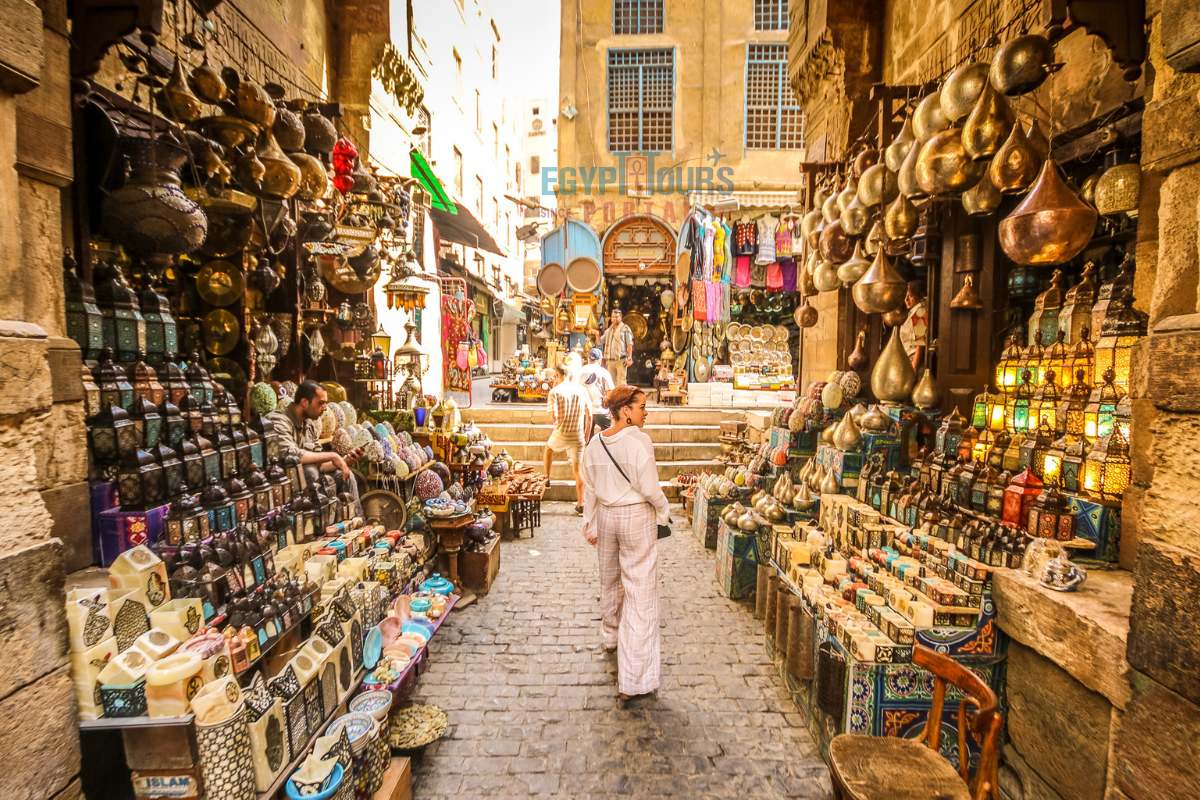
Cairo is a city where different centuries exist side by side. Modern streets, busy markets and contemporary neighborhoods surround some of the most remarkable monuments of the Islamic world. Nowhere is this contrast more fascinating than in Al-Muizz Street, one of the historic arteries of Old Cairo.
Walking through Al-Muizz Street is not simply a sightseeing experience. It is a journey through architecture, religion, commerce and everyday life. Along the historic route, visitors encounter monumental mosques, medieval gates, madrasas, mausoleums, traditional houses, markets and workshops. The street also connects naturally with the famous Khan el-Khalili area, making it possible to combine historic architecture with the atmosphere of one of Cairo’s best-known traditional markets.
The Egyptian Ministry of Tourism and Antiquities describes Al-Muizz Street as one of the world’s largest open-air collections of Islamic monuments. The historic route contains monuments representing several centuries of Egyptian history, from the Fatimid period through the Mamluk and Ottoman eras and into the Muhammad Ali dynasty.
For travelers staying in Hurghada, a visit to Cairo can therefore be much more than a trip to the pyramids. A day that includes Al-Muizz Street, Historic Cairo and Khan el-Khalili reveals another side of Egypt—one shaped by medieval urban life, religious architecture, craftsmanship and centuries of trade.
For travelers planning excursions from Hurghada, Best Tours Hurghada can also be part of a wider Egypt itinerary that combines Cairo’s historic neighborhoods with other major attractions.
Where Is Al-Muizz Street?
Al-Muizz Street is located in the heart of Historic Cairo.
The historic route extends between Bab al-Futuh in the north and Bab Zuwayla in the south, passing through a dense network of historic streets, alleys and markets. Along the way, it connects or passes near important areas including the Khan el-Khalili district and Al-Ghuriya.
The street takes its name from Al-Muizz li-Din Allah, the Fatimid caliph associated with the establishment of Fatimid Cairo in the 10th century. According to the Egyptian Ministry of Tourism and Antiquities, the street was officially known as Al-Muizz from 1937, although it had carried different names during its long history.
Its location is especially significant because Historic Cairo developed around this central urban axis.
UNESCO describes the historic city as an exceptional survival of architectural and urban heritage. The Fatimid nucleus was later expanded and transformed under the Ayyubids, Mamluks and Ottomans, creating the layered city visitors can still experience today.
A Street That Tells the Story of Cairo
One of the most fascinating things about Al-Muizz Street is that its history cannot be reduced to a single dynasty.
Instead, the street became a living record of changing political powers, religious institutions, commercial activities and architectural traditions.
The Fatimids established Cairo as their capital in 969 AD. Later, the Ayyubids expanded the city’s defensive system. The Mamluk period brought an extraordinary concentration of religious, commercial and charitable architecture. Ottoman rulers and local elites later added or renovated buildings while maintaining many elements of the historic urban fabric.
This is why a walk through Al-Muizz Street can feel different from visiting a single monument.
A mosque may stand beside a traditional house. A medieval gate can be followed by a busy market. A historic madrasa may share the same street with a modern workshop or a small shop.
The city has never been frozen completely in time. Instead, historic buildings continue to exist within an active urban environment.
Historic Cairo and UNESCO
Historic Cairo was added to the UNESCO World Heritage List in 1979.
UNESCO recognizes the area for its extraordinary architectural, artistic and urban heritage. The property preserves historical streets, markets, religious buildings, fortifications, traditional houses and other elements that demonstrate more than a millennium of urban development.
UNESCO also emphasizes the importance of Cairo as a political, cultural, intellectual and commercial center. Its position at historic trade routes linking Africa, Asia and Europe contributed to its development and influence.
For visitors, this means that Al-Muizz Street should not be viewed as an isolated attraction.
It forms part of a much larger historic landscape.
Every alley, doorway, market and monument contributes another piece to the story.
Starting the Walk at Bab al-Futuh
One of the most impressive ways to begin exploring Al-Muizz Street is from the northern end near Bab al-Futuh, or the Gate of Conquests.
The present gate was constructed in 1087 during the Fatimid period under the vizier Badr al-Jamali. It formed part of the stone fortifications of Cairo and was designed as a monumental defensive entrance.
The architecture immediately communicates the defensive character of medieval Cairo.
The gate has large rounded towers and a substantial entrance passage. Decorative stone details appear alongside architectural features that served practical military purposes.
Standing in front of Bab al-Futuh provides an excellent introduction to the historic district because it demonstrates that Cairo’s walls were not simply barriers. They were also architectural statements about the power and organization of the city.
From here, the historic route leads south toward the heart of Al-Muizz Street.
Bab al-Nasr – Another Fatimid Gate
Not far from Bab al-Futuh stands another important Fatimid gate: Bab al-Nasr, or the Gate of Victory.
It was also constructed in 1087 under Badr al-Jamali. The gate consists of two square towers with an entrance between them. Its stone facade includes carved shield motifs associated with the defensive character of the fortifications.
Bab al-Nasr and Bab al-Futuh demonstrate the importance of Cairo’s medieval defensive system.
The Fatimid city originally had a series of major gates. Several have disappeared, while others remain as important historical landmarks.
Today, these gates help visitors understand the original boundaries and organization of Fatimid Cairo.
Bab Zuwayla – The Southern Gateway
At the southern end of the historic Al-Muizz route stands Bab Zuwayla.
Constructed in 1092, Bab Zuwayla was another major gate in the Fatimid walls. It has two semicircular towers with the entrance positioned between them.
The gate later became closely connected with the Mamluk architectural landscape.
Two minarets belonging to the nearby Mosque of Sultan al-Mu’ayyad were built on the bases of the gate’s towers in the early 15th century. This created one of the most recognizable architectural combinations in Historic Cairo.
Bab Zuwayla therefore illustrates one of the central characteristics of Old Cairo: buildings from different periods frequently stand directly beside one another.
Mosques Along Al-Muizz Street
Religion played a central role in medieval Cairo, and the architecture along Al-Muizz Street reflects this importance.
Visitors encounter mosques, madrasas, mausoleums, sabils and religious complexes. Many were not designed for only one purpose. They could combine prayer, education, charity, accommodation and burial spaces.
This multifunctional approach is one of the most interesting aspects of Islamic architecture in Historic Cairo.
Instead of thinking of each monument as a separate building, it is often more useful to imagine the entire neighborhood as an interconnected urban environment.
The Qalawun Complex
One of the major monuments associated with Al-Muizz Street is the Sultan Qalawun Complex.
The complex represents the monumental architecture of the Mamluk period and demonstrates how rulers used architecture to establish religious, political and social institutions.
Mamluk Cairo became one of the most important cities of the medieval Islamic world. UNESCO notes that the Mamluk period brought extensive development to the city’s urban fabric and produced major architectural complexes that still define the historic skyline.
Walking past such monuments gives visitors an opportunity to observe details that are easy to miss in photographs.
Stone carving, inscriptions, domes, arches, decorative patterns and carefully designed entrances all contribute to the experience.
Sultan Barquq and Mamluk Architecture
Another major landmark on Al-Muizz Street is the complex of Sultan Barquq.
The Mamluk architectural style is particularly visible in the combination of monumental facades, tall minarets, domes and decorative stonework.
UNESCO highlights Mamluk architecture for its distinctive use of pointed arches, elaborate facades, finely carved architectural elements and domes.
For visitors interested in architecture, this makes Al-Muizz Street particularly rewarding.
You do not need to be an architectural specialist to appreciate the buildings. Simply comparing different entrances, windows, domes and minarets reveals how styles changed over time.
The Sultan al-Ghuri Complex
The Sultan al-Ghuri Complex is another remarkable example of Mamluk architecture.
Constructed in 1503–1504, the complex was designed as an integrated group of religious and social facilities. It included a mosque, madrasa, mausoleum, khanqah, sabil, kuttab and accommodation.
One of its most fascinating characteristics is the relationship between the two sides of the street.
A wooden structure connects the two parts of the complex above the street, creating a striking architectural feature while also providing shelter for a textile and clothing market below.
This is a perfect example of why Al-Muizz Street is more than a collection of monuments.
Architecture and everyday commerce were closely connected.
Wikala al-Ghuri – Commerce and Travel
Another important building is Wikala al-Ghuri.
A wikala was a commercial establishment where merchants could store and trade goods while also finding accommodation.
The official Egyptian monument description explains that Wikala al-Ghuri was built around 1503–1504 and features a rectangular courtyard surrounded by spaces used for warehouses and merchant accommodation.
This gives visitors an opportunity to understand medieval commercial life.
Imagine arriving in Cairo as a merchant with valuable goods. Instead of simply selling products in a modern shop, commercial life involved storage, accommodation, transport and negotiation.
Buildings such as the wikala were designed around these needs.
Traditional Houses and Domestic Architecture
Al-Muizz Street is not only about monumental mosques.
Traditional residential architecture is another important part of Historic Cairo.
Historic houses often reveal how people lived within a dense medieval city. Courtyards, wooden screens, private rooms and carefully controlled openings helped create separation between public and private spaces.
One of the most recognizable features of traditional Islamic Cairo architecture is the mashrabiya, a wooden screen that can regulate light, airflow and privacy.
These details remind visitors that the historic city was not built exclusively for rulers and religious institutions.
It was also a place where families lived, merchants worked and communities developed their daily routines.
Sabil-Kuttabs – Water and Education
Another distinctive building type found along historic Cairo’s streets is the sabil-kuttab.
A sabil traditionally provided public drinking water, while a kuttab functioned as a school.
One example on Al-Muizz Street is the Sabil-Kuttab of Abd al-Rahman Katkhuda, established in 1744. The building contains a sabil room with decorated windows and marble basins, while the upper level served as a kuttab.
This combination reflects the charitable and educational functions incorporated into Cairo’s architecture.
Another example, the Sabil-Kuttab of Nafisa al-Bayda, dates to 1796 and combines a wikala with a sabil-kuttab.
For modern visitors, these buildings provide a glimpse into social institutions that once played an important role in everyday urban life.
The Architecture of Doors, Windows and Facades
One of the easiest ways to enjoy Al-Muizz Street is to slow down and look at the details.
The large monuments naturally attract attention, but smaller architectural elements often tell equally interesting stories.
Look at:
- carved stone doorways
- wooden doors
- geometric patterns
- Arabic inscriptions
- mashrabiya screens
- domes
- minarets
- decorative arches
- marble details
- stone color patterns
- carved wooden ceilings
The Egyptian Ministry of Tourism and Antiquities documents many examples of intricate stone, wood, ceramic and geometric decoration throughout the monuments of Al-Muizz Street.
Photography can therefore become a form of architectural observation.
Instead of photographing only an entire building, take time to capture a doorway, an inscription or a small decorative element.
Al-Muizz Street and Traditional Crafts
The relationship between Al-Muizz Street and traditional craftsmanship is especially important.
Historic Cairo developed around specialized markets and crafts. UNESCO notes that the historic city retains traditional markets and handicraft activities in their historical locations.
As you walk through the area, you may encounter workshops and shops selling products connected with Egyptian craftsmanship.
Depending on the part of the district, visitors may find:
- textiles
- lamps
- metalwork
- leather goods
- jewelry
- wooden products
- decorative objects
- traditional souvenirs
The experience is very different from shopping in a modern mall.
Here, products are often displayed directly beside workshops and busy streets.
Khan el-Khalili – The Natural Companion to Al-Muizz Street
A visit to Al-Muizz Street is often combined with Khan el-Khalili.
The famous bazaar is located within the broader Historic Cairo district and forms part of the same urban environment.
This makes the two areas easy to connect during a walking itinerary.
Al-Muizz Street emphasizes monumental architecture and historic buildings, while Khan el-Khalili brings a stronger focus on commerce, shopping, cafés and the atmosphere of traditional Cairo.
The transition between the two is part of the experience.
You may begin the day surrounded by medieval stone architecture, then gradually enter busier market streets filled with shops, crafts, spices and souvenirs.
What Can You Buy Near Khan el-Khalili?
Khan el-Khalili is known for its variety of traditional products.
Depending on the shop, visitors can find jewelry, decorative objects, textiles, lamps, spices and souvenirs.
However, shopping in a historic market is also about the experience.
The narrow streets, shop displays, conversations between sellers and customers, and smell of food and spices all contribute to the atmosphere.
If you are planning to buy something, take your time.
Compare products, ask about materials and workmanship, and decide what you genuinely want rather than buying the first souvenir you see.
Cafés and Traditional Cairo
One of the pleasures of exploring Historic Cairo is taking a break.
After walking through monuments and markets, sitting in a traditional café can offer a completely different perspective.
Instead of rushing from one attraction to another, you can watch the street around you.
People pass through the market. Shopkeepers organize their goods. Visitors look for souvenirs. Local residents move through the neighborhood as part of their daily routines.
This mixture of tourism and everyday life is one of the defining characteristics of Historic Cairo.
A Walking Experience Rather Than a Checklist
Al-Muizz Street is best experienced slowly.
It is tempting to create a long list of monuments and try to see everything in a few hours. However, the density of historic architecture means that rushing can cause visitors to miss many details.
A slower walk allows time for photography, architecture, shopping and short breaks.
It also makes it easier to notice the relationship between monuments and the surrounding neighborhood.
A doorway may lead into a historic building. A narrow alley may reveal another architectural detail. A small workshop may continue a craft tradition that has been associated with the district for generations.
The street itself becomes the attraction.
What Is the Best Time to Visit Al-Muizz Street?
The best time depends on the experience you want.
Early in the day can be useful for visitors who want to concentrate on monuments and photography. Later in the afternoon, the atmosphere may become more active around markets and commercial areas.
The weather should also be considered, particularly during the hotter months.
Because the route involves walking, comfortable shoes, water and sun protection are important.
It is also wise to check the current opening times and ticket arrangements for individual monuments before visiting, because not every building necessarily follows the same schedule.
The Egyptian Ministry currently lists general visiting hours for several Al-Muizz monuments, but schedules and ticket prices can change.
How Long Should You Spend on Al-Muizz Street?
There is no single ideal duration.
A quick visit can provide an introduction to the area, but a longer itinerary allows visitors to explore monuments, markets and Khan el-Khalili without constantly watching the clock.
For a first visit to Cairo, combining Al-Muizz Street with Khan el-Khalili can easily form a substantial part of a full-day historic Cairo itinerary.
If you are particularly interested in architecture, photography or Islamic history, you may want even more time.
The important thing is to avoid treating the street as a place that can be completely understood in a few photographs.
Visiting Al-Muizz Street From Hurghada
Travelers staying in Hurghada often visit Cairo as a day trip.
The most famous attraction is usually the Giza Plateau, but Cairo offers much more.
Adding Historic Cairo to the itinerary can transform a pyramid-focused excursion into a broader exploration of Egyptian history.
A well-planned itinerary could include the pyramids in one part of the day and Historic Cairo later, depending on the schedule and traffic conditions.
Because Cairo is a large and busy city, travel time between different areas can vary considerably.
For this reason, organized transportation can be particularly useful for visitors who are traveling from Hurghada and want to make the most of limited time.
Al-Muizz Street for First-Time Visitors
First-time visitors may initially find Historic Cairo overwhelming.
The streets can be busy, the architecture is dense, and there are many attractions close together.
The best approach is to accept that you will not see everything.
Choose a manageable route and focus on a few important monuments.
Take time to look upward at minarets and facades. Look closely at doors and inscriptions. Stop occasionally instead of walking continuously.
Most importantly, remember that Historic Cairo is still a living neighborhood.
Visitors should respect residents, religious spaces and local customs.
Dress and Cultural Etiquette
Al-Muizz Street includes numerous mosques and religious monuments.
When entering religious spaces, modest clothing is appropriate. Depending on the site and current regulations, visitors may also be asked to remove their shoes or follow specific instructions.
Photography rules can vary between monuments.
If photography is restricted, visitors should respect the regulations rather than assuming that every historic interior can be photographed.
A respectful approach makes the experience more comfortable for both visitors and local communities.
Why Architecture Lovers Should Visit
For anyone interested in architecture, Al-Muizz Street is almost like an outdoor textbook.
Within a relatively concentrated area, visitors can observe different periods and architectural approaches.
Fatimid architecture can be seen in the historic gates and early mosques. Mamluk architecture appears in monumental religious and funerary complexes. Ottoman-period buildings add further layers to the streetscape.
UNESCO specifically recognizes Historic Cairo as an outstanding ensemble reflecting major developments in Islamic architecture, including Fatimid, Ayyubid and Mamluk periods.
The fascinating part is seeing these styles in context rather than isolated inside a museum.
Why History Lovers Should Visit
History becomes easier to understand when it is connected to physical places.
Instead of simply reading that the Fatimids established Cairo, you can stand beside a Fatimid gate.
Instead of reading about Mamluk architecture, you can walk between monumental Mamluk complexes.
Instead of learning about medieval commerce in a textbook, you can visit a historic wikala and then continue into a living market.
That connection between written history and physical space is what makes Al-Muizz Street so powerful.
Responsible Tourism in Historic Cairo
Historic neighborhoods require care.
The buildings along Al-Muizz Street are not simply decorative backgrounds for photographs. They form part of a fragile heritage landscape.
UNESCO notes that Historic Cairo faces challenges associated with population density, urban growth, traffic, infrastructure, environmental changes and changing building functions. Conservation and rehabilitation therefore remain important.
Visitors can contribute by behaving responsibly.
Do not climb on monuments, touch fragile decorative surfaces unnecessarily, leave litter or enter restricted areas.
When photographing residents or shopkeepers, asking permission is also a considerate practice.
Supporting local artisans and established businesses can help maintain the commercial traditions that remain part of the historic district.
A Different Side of Cairo
Many international visitors first associate Cairo with the pyramids.
The pyramids are undeniably important, but Historic Cairo tells another story.
Here, the focus shifts from ancient pharaonic civilization to the Islamic centuries that shaped the capital’s streets, institutions, markets and architecture.
Al-Muizz Street makes this history particularly accessible because so many layers survive along one connected route.
You can move from a medieval gate to a mosque, from a madrasa to a traditional market, and from a historic courtyard to a modern café.
That combination is what makes the area feel alive.
Al-Muizz Street and Best Tours Hurghada
Travelers staying in Hurghada who want to discover Cairo beyond the pyramids can consider including Best Tours Hurghada when planning their Egypt excursion.
A Cairo itinerary can be structured around different interests. Some travelers want to focus on ancient Egyptian history, while others are more interested in Islamic architecture, traditional markets and local culture.
For those interested in Historic Cairo, Al-Muizz Street can be combined with Khan el-Khalili and other nearby landmarks.
Before booking, it is useful to check the exact itinerary, transportation arrangements, guide services, entrance fees and available time at each location.
That way, the day can be planned according to what matters most to you.
A Suggested Walking Route
For travelers visiting Al-Muizz Street for the first time, a north-to-south route provides a logical way to experience the historic district.
1. Bab al-Futuh
Begin at the northern gate and take time to appreciate its massive stone architecture.
2. Historic Al-Muizz Street
Continue south and observe the mixture of monuments, workshops and everyday street life.
3. Major Mamluk monuments
Explore selected complexes such as the Qalawun and Barquq monuments, depending on opening times and available time.
4. Sultan al-Ghuri area
Pay attention to the architecture around the complex and its connection with the surrounding commercial environment.
5. Khan el-Khalili
Continue toward the market area for shopping, cafés and a more commercial atmosphere.
6. Bab Zuwayla
If your itinerary and time allow, continue toward the southern end and the impressive Fatimid gate.
This route does not need to be completed exactly as described. The best itinerary depends on monument opening times, weather, traffic and personal interests.
Photography Tips for Al-Muizz Street
Al-Muizz Street is ideal for photographers who enjoy architectural details.
Try photographing the same building from different distances.
Start with a wide image showing the relationship between the monument and the street. Then move closer to capture architectural details.
Look for:
- geometric patterns
- carved stone
- wooden screens
- arches
- inscriptions
- minarets
- domes
- market scenes
- doorways
- reflections
- light and shadow
Early morning and late afternoon can produce particularly interesting light.
However, photography should never interfere with religious activities or the privacy of local residents.
Al-Muizz Street After Sunset
Historic Cairo can take on a completely different atmosphere later in the day.
The architecture becomes more dramatic when illuminated, while shops and cafés create a lively street scene.
Depending on the current access arrangements and local conditions, an evening walk can provide a very different visual experience from a daytime visit.
However, visitors should always follow local guidance and remain aware of their surroundings.
Why Al-Muizz Street Belongs on a Cairo Itinerary
Al-Muizz Street combines many elements that make Cairo unique.
It offers architecture without requiring a museum visit. It offers history without separating the past from everyday life. It offers shopping without removing the cultural context of the products.
Most importantly, it demonstrates that Cairo’s history is not confined to a handful of monuments.
It exists in streets, gates, markets, workshops, mosques, houses and public spaces.
Walking through Al-Muizz Street means walking through the urban history of Cairo itself.
Conclusion: Walking Through Medieval Cairo
Al-Muizz Street is one of the most fascinating places to experience Historic Cairo.
From the Fatimid gates of Bab al-Futuh and Bab Zuwayla to Mamluk monuments, traditional buildings, sabil-kuttabs, wikalas and busy craft markets, the street brings together centuries of Egyptian history. The Egyptian Ministry of Tourism and Antiquities identifies 29 monuments along the historic route, representing religious, residential, commercial and defensive functions across several historical periods.
Its connection with Khan el-Khalili makes the experience even richer. Visitors can move from monumental Islamic architecture into narrow market streets filled with crafts, cafés, souvenirs and everyday activity.
For travelers coming from Hurghada, adding Al-Muizz Street to a Cairo itinerary provides an opportunity to see a side of Egypt that is very different from the pyramids.
The pyramids reveal the monumental achievements of ancient Egypt. Al-Muizz Street reveals the centuries of Islamic Cairo that followed.
Together, they create a much broader picture of the country’s extraordinary history.
For travelers planning a Cairo excursion from Hurghada, Best Tours Hurghada can be considered as part of the planning process, particularly for those who want to combine Cairo’s major attractions with a deeper exploration of its historic neighborhoods.
Ultimately, the best way to experience Al-Muizz Street is simple: slow down, look around and allow the city to tell its story one building, one doorway and one street at a time.
Frequently Asked Questions About Al-Muizz Street
What is Al-Muizz Street famous for?
Al-Muizz Street is famous for its concentration of historic Islamic monuments, including mosques, madrasas, mausoleums, gates, traditional buildings and commercial architecture. The Egyptian Ministry of Tourism and Antiquities describes it as one of the world’s largest open-air collections of Islamic monuments.
Where does Al-Muizz Street begin and end?
The historic route extends between Bab al-Futuh in the north and Bab Zuwayla in the south. Along the way, it passes through several historic districts and near the Khan el-Khalili market area.
Is Al-Muizz Street near Khan el-Khalili?
Yes. Khan el-Khalili is located within the broader Historic Cairo area and is closely connected with the Al-Muizz Street experience. Visitors can combine historic monuments with traditional markets, crafts, cafés and shopping.
How old is Al-Muizz Street?
The street is associated with the foundation and development of Fatimid Cairo in the 10th century. However, the buildings visible along the route come from many different periods, including Fatimid, Mamluk and Ottoman eras.
What architectural styles can be seen on Al-Muizz Street?
Visitors can see several layers of Islamic architecture, especially Fatimid and Mamluk examples, alongside later Ottoman-period buildings. Domes, minarets, arches, carved stone, wooden screens and decorative inscriptions are among the features worth observing.
Can Al-Muizz Street be visited on a Cairo trip from Hurghada?
Yes. It can be included in a Cairo itinerary from Hurghada, although the exact schedule depends on transportation, traffic, the attractions included and the amount of time available in Cairo.
Is Al-Muizz Street suitable for photography?
Yes. The street offers many opportunities for architectural and street photography, particularly its gates, facades, minarets, domes, decorative details and market atmosphere. Visitors should respect photography restrictions and ask permission before photographing people.
What should I wear when visiting Al-Muizz Street?
Comfortable clothing and walking shoes are recommended. Because the area contains mosques and other religious monuments, modest clothing is appropriate when entering religious sites.
How much time should I spend there?
A short visit can introduce you to the area, but several hours allow more time for monuments, photography and the nearby Khan el-Khalili market. Travelers with a strong interest in architecture and history may prefer to dedicate a larger part of their Cairo itinerary to Historic Cairo.
Why visit Al-Muizz Street instead of only seeing the pyramids?
The pyramids represent ancient Egyptian civilization, while Al-Muizz Street reveals centuries of Islamic Cairo and medieval urban life. Visiting both provides a broader understanding of Cairo’s long and layered history.