Egypt is a country where completely different travel experiences can exist within the same holiday. One day, you can be relaxing beside the turquoise waters of the Red Sea in Hurghada. The next, you can stand beneath the Great Pyramid of Giza and look at monuments that have survived for more than four millennia.
For many travelers, this contrast is one of the most exciting reasons to combine a Hurghada holiday with a Cairo and Giza excursion. Hurghada offers beaches, warm sea water, snorkeling, boat trips, desert adventures, and a relaxed resort atmosphere. Cairo and Giza introduce a completely different side of Egypt, shaped by ancient civilization, monumental architecture, museums, busy streets, and the Nile.
A trip from Hurghada to Cairo therefore becomes more than a simple excursion. It connects two very different landscapes and experiences: the modern Red Sea resort and the ancient world of the pharaohs.
The journey requires some planning because Hurghada and Cairo are separated by roughly 445–450 km by road. Current transport information shows that road travel can take around five hours or more depending on the route and conditions, while flights between Hurghada and Cairo are much shorter in the air but also require airport transfers and additional logistics.
This guide explains how to combine both destinations, what to see in Cairo and Giza, how to organize the journey, and how to make the most of the contrast between the Red Sea and ancient Egypt.
Why Combine Hurghada and Cairo?
A holiday in Hurghada can be wonderfully relaxing. Many travelers spend their days swimming, snorkeling, taking boat trips, enjoying the beach, or exploring the desert.
However, Egypt is much larger than its Red Sea resorts.
If you stay only in Hurghada, you may experience the country’s natural beauty without seeing some of its most famous archaeological monuments. Cairo and Giza provide an opportunity to add history and culture to a beach-focused holiday.
The combination works particularly well because the experiences are so different.
In Hurghada, the focus is usually on:
- The Red Sea
- Beaches and swimming
- Snorkeling
- Boat excursions
- Islands and coral reefs
- Desert safaris
- Relaxation
- Resort life
In Cairo and Giza, the focus changes to:
- The pyramids
- The Great Sphinx
- Ancient Egyptian history
- Museums
- The Nile
- Historic neighborhoods
- Markets
- Mosques and churches
- Modern Egyptian city life
Cairo itself is one of the world’s major metropolitan areas, while Giza lies immediately within the wider urban region. The official Egyptian tourism authority describes Cairo and Giza as a destination where ancient monuments, historic districts, the Nile, and modern city life meet.
That contrast is precisely what makes the journey interesting.
From the Red Sea to the Nile Valley
The journey from Hurghada to Cairo is also a geographical transition.
Hurghada sits on Egypt’s Red Sea coast. The landscape around the resort is strongly influenced by the sea, desert mountains, dry valleys, and coastal plains.
As you travel toward Cairo, the scenery gradually changes.
The dry desert landscape gives way to the Nile Valley and the densely populated areas surrounding the capital. The Nile has been fundamental to Egyptian civilization for thousands of years, providing water and supporting agriculture in an otherwise predominantly arid country.
Eventually, the open spaces of the Red Sea region are replaced by one of the busiest urban environments in Africa and the Middle East.
Then comes another dramatic change.
In Giza, the modern city meets the desert plateau where the pyramids stand.
This transition is one of the most memorable aspects of the trip. You leave behind the resort atmosphere of Hurghada and suddenly find yourself surrounded by monuments associated with ancient Egyptian civilization.
How Far Is Cairo from Hurghada?
The road distance between Hurghada and Cairo is approximately 445–450 km, depending on the exact starting and ending points. Current transport listings show road journeys taking roughly five hours under typical conditions, while bus journeys can take longer depending on the service and route.
The exact journey time can vary because of:
- Traffic
- Road conditions
- Stops
- Pickup arrangements
- Your hotel’s location
- The final destination in Cairo or Giza
- Time of day
This is why travelers should avoid planning a Cairo excursion around exact minute-by-minute timings.
A realistic schedule gives some flexibility.
If you choose a road-based excursion, an early start is particularly important. A large part of the day can be spent traveling, so the earlier you begin, the more time you can have at the main attractions.
Travel by Bus, Car, or Plane?
There are several ways to travel between Hurghada and Cairo.
Organized road excursion
An organized excursion can be convenient because transport, sightseeing, and guide arrangements can be coordinated in advance.
For travelers staying in Hurghada, this can eliminate much of the logistical work. Instead of arranging every transfer independently, the excursion can be planned around the main attractions.
This is one reason some visitors choose a specialist excursion company such as Best Tours Hurghada when adding Cairo and Giza to their Red Sea holiday.
Private car or transfer
A private vehicle offers greater flexibility.
You can potentially adjust departure times, spend longer at particular locations, and create a more personalized itinerary.
The main consideration is cost, which is normally higher than sharing transport.
Bus
Buses are another option. Current transport information indicates that bus services operate between Hurghada and Cairo, with journey times varying considerably by service.
For independent travelers, buses may be useful, but they require more planning once you arrive in Cairo.
You will still need to organize transportation between the bus station and the archaeological sites.
Flight
Flying reduces the time spent physically traveling between the two cities. Current transport listings show flights from Hurghada to Cairo taking around an hour and twenty minutes in the air, although the complete journey is much longer once airport transfers, check-in, security, and waiting time are included.
For a very short visit, flying can therefore be attractive, but it is important to calculate the complete door-to-door journey rather than looking only at flight time.
What Should You See in Giza?
For most first-time visitors, Giza is the centerpiece of the excursion.
The Giza Plateau contains much more than three pyramids. The archaeological landscape includes pyramids, smaller pyramids, tombs, temples, causeways, and other structures connected with the ancient necropolis.
The Great Pyramid of Khufu
The Great Pyramid is the largest and oldest of the three principal pyramids at Giza.
It was built as the tomb of Pharaoh Khufu and remains the only surviving monument of the Seven Wonders of the Ancient World. The official Egyptian tourism authority dates its construction to more than 4,500 years ago.
Seeing photographs of the Great Pyramid is very different from standing beside it.
Its enormous scale becomes much easier to appreciate when you are close to the monument.
Visitors can also explore certain interior areas when access is available under the current ticketing arrangements. However, the experience involves narrow passages and physical exertion, so travelers should consider their comfort and mobility before choosing an interior visit.
The Pyramid of Khafre
Khafre’s pyramid is often recognized by the surviving casing stones near its upper section.
Its position on slightly higher ground can also make it appear almost as tall as the Great Pyramid when viewed from certain locations.
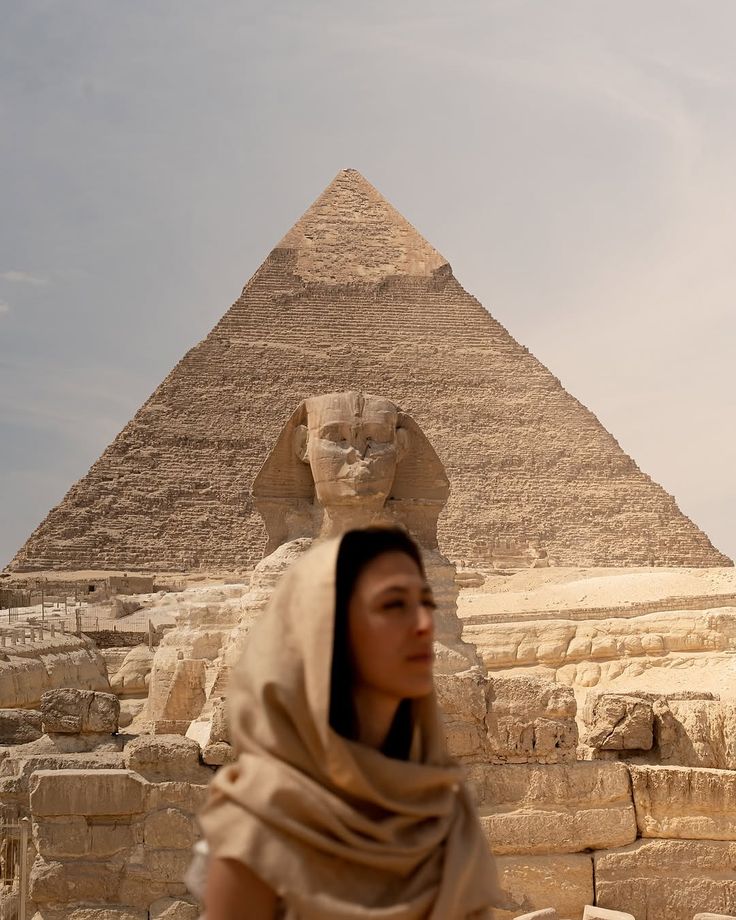
Khafre’s pyramid is particularly important because the Great Sphinx is associated with his pyramid complex.
The Pyramid of Menkaure
Menkaure’s pyramid is smaller than the other two main pyramids.
Its scale provides an interesting contrast and reminds visitors that the Giza Plateau was not designed around a single monument. Instead, it was a complex funerary landscape containing several pyramids and associated structures.
The Great Sphinx
No Cairo and Giza excursion would feel complete without seeing the Great Sphinx.
The monumental sculpture combines a human head with the body of a lion and was carved directly from the limestone bedrock. Egypt’s official tourism information places it beside the Valley Temple associated with Khafre’s complex.
The Sphinx is fascinating not only because of its appearance but also because of the questions surrounding its history and symbolism.
The monument is generally connected with the reign of Khafre, while later Egyptian history gave the Sphinx additional religious significance.
One of the most important later developments was the association of the Sphinx with the sun god Horemakhet.
When visiting, it is useful to separate established archaeological evidence from modern theories. The Sphinx has inspired many alternative interpretations, but not every popular claim has equal archaeological support.
The Grand Egyptian Museum
Depending on the itinerary and current access arrangements, travelers may also want to include the Grand Egyptian Museum, located near the Giza Plateau.
The museum was designed to present an extensive collection dedicated to ancient Egyptian civilization. The official tourism authority states that the museum holds more than 50,000 artifacts and includes major collections, galleries, and the Tutankhamun galleries.
One particularly useful feature for travelers combining Cairo and Giza is its location near the pyramids.
The museum can help provide historical context before or after seeing the monuments themselves.
Instead of looking at a pyramid simply as a gigantic stone structure, visitors can begin to understand the civilization that created it: its religious beliefs, royal traditions, artistic conventions, writing systems, burial practices, and technological abilities.
How long should you spend at the museum?
That depends on your interests.
If ancient Egyptian history is your main passion, you could easily spend several hours exploring the collections.
For a tightly scheduled day trip from Hurghada, however, you may have to choose between a shorter museum visit and more time at the archaeological sites.
Trying to see everything in one day can make the experience unnecessarily rushed.
Cairo Beyond the Pyramids
Cairo is not simply an extension of the Giza Plateau.
The capital has its own identity, and adding a small part of Cairo to your itinerary can make the trip more varied.
Possible additions include:
- Historic Cairo
- Khan el-Khalili
- Al-Muizz Street
- The Citadel
- Historic mosques
- Coptic Cairo
- The Nile
- Downtown Cairo
- Egyptian museums
- Local restaurants and cafés
The official tourism authority describes Cairo as a city where medieval neighborhoods, modern districts, the Nile, cultural attractions, and ancient Giza exist within the same metropolitan area.
However, you should be realistic.
If your excursion includes the pyramids, Sphinx, museum, and several Cairo attractions, the day can become very long.
A focused itinerary is often more enjoyable than trying to check every attraction off a list.
The Egyptian Museum in Downtown Cairo
The historic Egyptian Museum in central Cairo remains an important destination for travelers interested in ancient Egypt.
According to the Egyptian tourism authority, the museum was designed by French architect Marcel Dourgnon and opened in 1902. Its collection covers periods from Predynastic Egypt through the Graeco-Roman era.
This makes it different from simply visiting the pyramids.
At Giza, you experience monumental architecture in its original landscape.
Inside a museum, you can examine smaller objects closely.
Statues, jewelry, coffins, tools, inscriptions, and everyday objects can provide a more personal understanding of ancient Egyptian life.
Should You Visit Cairo in One Day?
A one-day Cairo excursion from Hurghada is possible, but it requires realistic expectations.
The biggest challenge is not the number of attractions. It is the travel distance.
If you travel by road, several hours are spent reaching Cairo and several more returning to Hurghada. That leaves limited time for sightseeing.
Therefore, a one-day excursion works best when you decide in advance what matters most.
For a first visit, a practical priority might be:
- Giza Plateau
- Great Sphinx
- One museum
- One additional Cairo attraction if time permits
Trying to add Giza, multiple museums, Historic Cairo, the Nile, shopping, and several restaurants to the same day can create a very rushed schedule.
A Sample One-Day Cairo and Giza Itinerary
A typical organized itinerary can vary considerably, but the general structure could look like this:
Early morning – Departure from Hurghada
Start early from your hotel.
Bring water, comfortable clothing, snacks, and anything you need for a long day.
Late morning – Arrival in Giza
Begin with the pyramids.
Spend time viewing the Great Pyramid, Khafre’s Pyramid, and Menkaure’s Pyramid.
Allow yourself time to walk, take photographs, and appreciate the landscape rather than rushing immediately from one monument to another.
Midday – Great Sphinx
Continue toward the Sphinx and associated temple area.
This is an ideal moment to learn more about the relationship between the Sphinx and Khafre’s pyramid complex.
Afternoon – Museum
If your itinerary includes the Grand Egyptian Museum or another Cairo museum, continue there after Giza.
A museum visit can add context to the monuments you have already seen.
Late afternoon – Cairo
If time permits, add a short visit to a historic neighborhood, market, or another selected attraction.
Evening – Return to Hurghada
The return journey can be long, particularly after a full day of sightseeing.
This is another reason to avoid filling every available minute with additional activities.
How to Combine a Cairo Trip with a Longer Hurghada Holiday
The best way to combine the destinations is to think of the holiday as two different experiences.
First part: Relax in Hurghada
Spend the first days enjoying the Red Sea.
You could include:
- A snorkeling trip
- A boat excursion
- An island day
- A beach day
- A desert safari
- A sunset experience
- Free time at your hotel
Middle or later part: Visit Cairo
Choose one day for Cairo and Giza.
This creates a strong contrast between relaxation and sightseeing.
Final days: Return to the Red Sea
After a demanding historical excursion, returning to Hurghada gives you time to slow down again.
You can spend the remaining days swimming, relaxing, enjoying a boat trip, or simply staying by the pool.
This balance is especially useful for travelers who do not want their entire holiday to feel like a continuous sightseeing tour.
Hurghada and Cairo Offer Two Different Sides of Egypt
The contrast between the two destinations goes beyond geography.
Hurghada: the Red Sea lifestyle
Hurghada is strongly associated with:
- Sea views
- Beaches
- Resorts
- Snorkeling
- Coral reefs
- Boat trips
- Water activities
- Desert excursions
- Relaxed evenings
The pace can be slow.
You may spend an entire morning beside the water without needing to follow a strict sightseeing schedule.
Cairo: history and urban energy
Cairo is different.
There are busy roads, large neighborhoods, markets, museums, historic buildings, restaurants, and millions of people moving through the metropolitan area.
The atmosphere is energetic and constantly changing.
That difference can make the transition from Hurghada to Cairo surprisingly memorable.
What Should You Wear?
For a Cairo and Giza excursion, comfortable clothing is the priority.
Choose clothing suitable for walking and changing temperatures.
Good options include:
- Comfortable walking shoes
- Lightweight trousers or longer shorts
- Breathable shirts
- Sunglasses
- A hat
- Sun protection
- A light layer for air-conditioned spaces
If you plan to visit religious sites, more conservative clothing may be appropriate.
A scarf or light covering can also be useful.
What Should You Bring?
A practical Cairo day-trip bag might include:
- Passport or required identification
- Water
- Sunscreen
- Sunglasses
- Hat
- Phone
- Portable charger
- Comfortable shoes
- Some cash
- Camera
- Any necessary personal medication
- Small snacks
Keep the bag reasonably light.
You will probably spend many hours walking and moving between locations.
How to Make the Journey More Comfortable
The distance between Hurghada and Cairo means comfort matters.
Try to sleep well before the excursion.
If you are traveling by road, use the journey as an opportunity to rest.
Avoid planning an exhausting late-night activity immediately before the Cairo excursion.
Likewise, if you return to Hurghada late at night, give yourself time to recover before booking another demanding excursion.
This is particularly important for families and older travelers.
Should Families Visit Cairo from Hurghada?
Yes, families can enjoy the experience, but expectations should be realistic.
Children may find the pyramids fascinating because they can see enormous monuments rather than simply reading about them in a book.
However, the long journey can be tiring.
Families should consider:
- Child age
- Heat
- Walking distance
- Breaks
- Food
- Toilet stops
- Transport comfort
- Total excursion length
A private or carefully organized excursion may provide more flexibility for families than a rigid schedule.
Cairo for Photography Lovers
The combination of Hurghada and Cairo also offers extraordinary photographic variety.
In Hurghada, your photographs may focus on:
- Blue water
- Coral reefs
- Boats
- Beaches
- Desert mountains
- Sunsets
In Cairo and Giza, the visual language changes completely.
You can photograph:
- Pyramids
- The Sphinx
- Desert landscapes
- Ancient stone details
- Museum objects
- The Nile
- Historic architecture
- Markets
- Cairo’s skyline
The Giza Plateau is particularly interesting because the ancient monuments exist beside a modern urban environment.
That contrast can become part of the photograph itself.
Responsible Tourism at Ancient Sites
Visiting archaeological sites also comes with responsibility.
Travelers should avoid climbing monuments where prohibited, touching fragile surfaces, removing stones or artifacts, and leaving litter.
Photography should respect site rules and other visitors.
Ancient monuments are not simply backgrounds for photographs. They are part of Egypt’s cultural heritage and require careful preservation.
The official tourism authority emphasizes the importance of Egypt’s archaeological heritage, including the Giza, Saqqara, and Dahshur necropolises.
Should You Book an Organized Excursion?
There is no single correct choice for every traveler.
Independent travelers may prefer arranging transport, tickets, and guides themselves.
Others may prefer an organized excursion because the journey from Hurghada is long and the logistics can become complicated.
When comparing excursions, look beyond the headline price.
Check:
- Transportation type
- Pickup location
- Approximate departure time
- Return arrangements
- Attractions included
- Entrance tickets
- Guide language
- Meal arrangements
- Group size
- Private versus shared transport
- Additional charges
- Current museum arrangements
A clear itinerary makes it easier to understand what you are actually buying.
For travelers who want to organize a Cairo and Giza day trip from their Hurghada base, Best Tours Hurghada can be one option to consider when comparing available excursion arrangements.
Common Mistakes to Avoid
Trying to see everything
Cairo is enormous.
You cannot realistically experience every important attraction during one day from Hurghada.
Choose priorities.
Ignoring travel time
The journey itself takes a significant part of the day.
Plan accordingly.
Wearing uncomfortable shoes
Giza involves walking and uneven surfaces.
Comfort matters much more than fashion.
Forgetting sun protection
The combination of desert surroundings and outdoor sightseeing can mean strong sun exposure.
Planning another exhausting excursion immediately afterward
Give yourself some recovery time.
Choosing an excursion based only on price
A cheaper excursion may have a different transport arrangement, group size, itinerary, or inclusions.
Compare the entire package rather than one number.
Is Cairo Worth Adding to a Hurghada Holiday?
The answer depends on what you want from your Egypt trip.
If your goal is simply to relax beside the Red Sea, you may prefer to spend the entire holiday in Hurghada.
But if you want to experience more of Egypt’s historical heritage, Cairo and Giza add an entirely different dimension.
The pyramids, Sphinx, museums, Nile, historic neighborhoods, and modern city provide experiences that cannot be recreated at a Red Sea resort.
At the same time, Hurghada provides something Cairo cannot: a relaxed coastal holiday centered around the Red Sea.
That is why the two destinations complement each other so well.
Frequently Asked Questions
How far is Cairo from Hurghada?
The road distance is roughly 445–450 km, although the exact distance depends on the locations involved. Current transport information shows that road journeys commonly take around five hours or longer, depending on traffic, stops, and the specific service.
Can I visit Cairo from Hurghada in one day?
Yes, a one-day excursion is possible, particularly when the itinerary is carefully organized. However, the long journey means you should focus on a limited number of major attractions rather than trying to see the whole city.
What are the main attractions in Giza?
The main attractions include the Great Pyramid of Khufu, the pyramids of Khafre and Menkaure, the Great Sphinx, and the wider archaeological landscape of the Giza Plateau. The plateau contains additional tombs, temples, and structures beyond the three famous pyramids.
Is the Grand Egyptian Museum near the pyramids?
Yes. The Grand Egyptian Museum is located near the Giza Plateau and was designed as a major center for ancient Egyptian heritage. Its collections include more than 50,000 artifacts, with extensive galleries dedicated to ancient Egypt.
Is a Cairo trip suitable for families?
It can be, especially when the itinerary includes comfortable transportation, regular breaks, and realistic sightseeing expectations. Families should remember that the journey from Hurghada is long and that Giza involves considerable outdoor walking.
Should I visit Cairo before or after my Hurghada beach holiday?
Either arrangement can work. Some travelers prefer to begin with history and finish with relaxing days in Hurghada, while others enjoy relaxing first and adding Cairo later; the best choice depends on your schedule and energy levels.
What should I bring on a Cairo excursion from Hurghada?
Comfortable shoes, water, sun protection, sunglasses, a hat, identification, a phone or camera, and a portable charger are useful. A small amount of cash can also be helpful for personal purchases and optional expenses.
Can I combine Cairo with Saqqara or Memphis?
It may be possible, particularly with a private or carefully planned itinerary. However, adding more archaeological sites increases the amount of time required, so travelers should decide whether they prefer depth at Giza and Cairo or a broader overview of ancient Egypt.
Final Thoughts
A journey from Hurghada to Cairo is one of the clearest ways to experience the incredible diversity of Egypt.
You begin beside the Red Sea, surrounded by beaches, boats, coral reefs, and resort life. Then you travel across the desert toward the Nile Valley and eventually arrive at a completely different world: the pyramids, the Sphinx, museums, historic neighborhoods, and the enormous energy of Cairo.
The journey is long, but that is also part of its character.
It connects two sides of Egypt that seem completely different at first glance. Hurghada offers relaxation and the natural beauty of the Red Sea, while Cairo and Giza reveal the depth of a civilization whose monuments still define the country’s image thousands of years later.
For travelers who want more than a beach holiday, combining Hurghada and Cairo can create a much richer Egyptian experience.
The key is planning realistically. Choose your priorities, allow enough time for transportation, wear comfortable clothing, and avoid trying to see everything in one day.
With the right balance, you can enjoy the best of both worlds: the sea in Hurghada and the pyramids of Giza in the same Egyptian adventure.