When travelers think about Luxor, they often imagine the magnificent temples of Karnak, the Valley of the Kings, or the impressive Temple of Hatshepsut. Yet, before reaching many of these famous monuments on the West Bank of the Nile, visitors encounter two enormous stone figures that have watched over the landscape for thousands of years: the Colossi of Memnon.
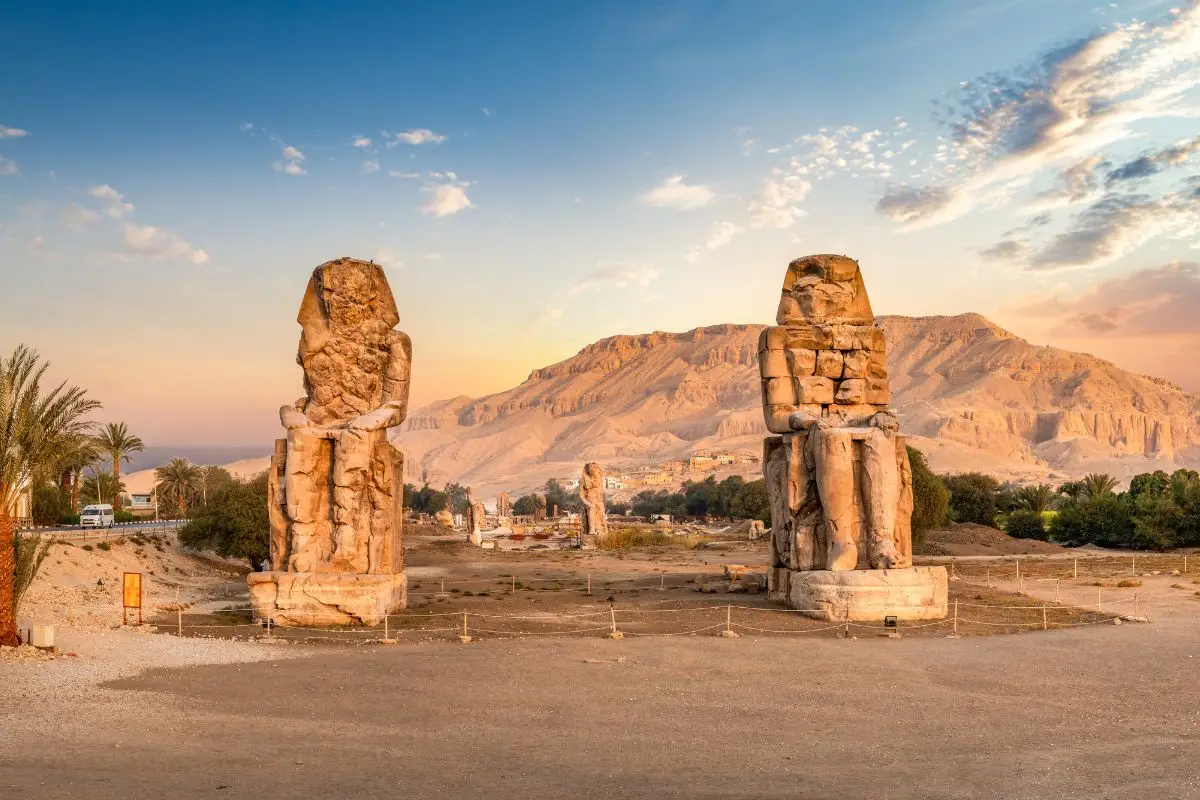
The Colossi of Memnon are among the most recognizable monuments in Luxor. The two monumental seated statues represent Pharaoh Amenhotep III and once stood in front of his enormous mortuary temple on the western bank of ancient Thebes. Today, much of that temple has disappeared, leaving the two statues standing prominently in the open landscape. Archaeological excavations, however, continue to reveal fragments of the enormous complex that once surrounded them.
For many visitors, the Colossi of Memnon are a short stop on a Luxor sightseeing tour. They are easy to visit and usually require less time than the Valley of the Kings or the major temples. However, understanding their history transforms this brief stop into a fascinating introduction to the history of the West Bank.
The statues are connected to the reign of Amenhotep III, the power of the New Kingdom, ancient Egyptian royal symbolism, Greek and Roman legends, and the continuing archaeological discoveries taking place around the monument.
So, what are the Colossi of Memnon? Why were they built? Why are they called “Memnon” if they actually represent Amenhotep III? And why are they such an important part of a sightseeing route through Luxor?
Where Are the Colossi of Memnon?
The Colossi of Memnon are located on the West Bank of the Nile in Luxor, in the area of ancient Thebes.
The Nile divides modern Luxor into two major sightseeing areas. The East Bank is home to famous monuments such as Karnak Temple and Luxor Temple. The West Bank is particularly associated with royal tombs, mortuary temples, and ancient necropolises.
The West Bank includes some of Egypt’s most important archaeological sites, including:
- The Colossi of Memnon
- The Valley of the Kings
- The Temple of Hatshepsut
- The Ramesseum
- Medinet Habu
- The Valley of the Queens
- Deir el-Medina
Ancient Thebes and its necropolis were added to the UNESCO World Heritage List in 1979. The Egyptian Ministry of Tourism and Antiquities identifies the Colossi of Memnon, the Ramesseum, the Temple of Hatshepsut, the Valley of the Kings, and other monuments as important parts of this exceptional archaeological landscape.
This location is important because the Colossi are not an isolated attraction. They belong to a much larger historical landscape.
Who Was Amenhotep III?
The story of the Colossi of Memnon begins with Amenhotep III, one of the major rulers of Egypt’s 18th Dynasty.
His reign belongs to the New Kingdom, a period when ancient Egypt was a powerful state with extensive political influence and remarkable artistic and architectural achievements.
Amenhotep III ruled for several decades, and his reign is particularly associated with monumental building projects. Numerous statues and temples were created during this period.
The Metropolitan Museum of Art describes Amenhotep III as a ruler whose long reign was characterized by wealth and flourishing artistic production. His surviving representations show a distinctive royal style that became an important part of New Kingdom art.
The Colossi of Memnon are among the most impressive examples of this monumental royal tradition.
The Mortuary Temple of Amenhotep III
To understand the original purpose of the Colossi, it is important to imagine the landscape as it looked more than 3,000 years ago.
The two statues were not originally designed as independent monuments. They stood in front of the enormous mortuary temple of Amenhotep III, commonly known as the Temple of Millions of Years.
The temple was located on the West Bank of the Nile and was connected with the religious cult of the deceased king.
The Metropolitan Museum of Art explains that the two monumental seated statues represented the king and stood at the entrance pylon of Amenhotep III’s vast mortuary temple in western Thebes.
Today, much of the temple has disappeared. However, archaeological research continues to uncover evidence of its original scale and complexity.
This makes the Colossi particularly interesting. The statues are not simply two surviving sculptures. They are also clues to a much larger monument that once dominated this part of ancient Thebes.
Why Were the Colossi Built?
The enormous size of the Colossi was deliberate.
Ancient Egyptian royal art often used monumental scale to communicate the importance and status of the pharaoh. A colossal statue was not simply decoration. It could express royal authority, religious significance, and the enduring memory of the ruler.
The two figures show Amenhotep III seated on a throne.
Their calm and symmetrical posture creates an impression of stability and permanence. Instead of showing the king in a dynamic scene, the statues present him as an enduring royal presence.
Their original location also mattered.
Standing at the entrance to the mortuary temple, the Colossi formed part of the monumental approach to the complex. Visitors approaching the temple would have encountered enormous representations of the king before entering the sacred space.
What Did the Temple Look Like?
It is difficult for modern visitors to imagine the original appearance of Amenhotep III’s mortuary temple because only parts of the complex survive.
The temple was enormous and contained numerous statues, architectural elements, religious spaces, and decorated structures.
Archaeological excavations have revealed evidence of statues representing the king, sphinxes, the goddess Sekhmet, decorated walls, columns, and ceremonial scenes. The Egyptian Ministry of Tourism and Antiquities continues to report discoveries from the archaeological and conservation project at the site.
One recent discovery reported by the Egyptian Ministry was a large fragment of a monumental statue of the god Horus found inside the mortuary temple. The project illustrates how archaeological work continues to reveal new information about the original complex.
Therefore, the open landscape behind the Colossi should not be mistaken for an area that was always empty.
It was once occupied by a monumental religious complex.
Why Did the Temple Disappear?
Like many ancient Egyptian monuments, the mortuary temple of Amenhotep III experienced destruction and gradual loss over the centuries.
Natural forces played a role, while later human activity also changed the site. Parts of ancient temples were sometimes reused in later construction projects.
As a result, the original temple gradually disappeared.
The Colossi survived as two of the most visible remains of the complex.
Their survival is particularly significant because they allow visitors today to understand, at least visually, the enormous scale of the original project.
Archaeological excavations are helping researchers reconstruct more of the temple’s history and layout.
Why Are They Called the Colossi of Memnon?
One of the most interesting facts about these statues is that they do not actually represent Memnon.
The statues represent Amenhotep III.
The name “Memnon” developed much later.
During the Greek and Roman periods, ancient travelers associated the statues with Memnon, a legendary figure from Greek mythology. Over time, the name became established and eventually turned into the familiar modern name “Colossi of Memnon.”
This is an excellent example of how the identity of an ancient monument can change over time.
The original Egyptian purpose of the statues was connected with Amenhotep III and his mortuary temple. The name Memnon belongs to a later historical tradition.
The Legend of the Singing Memnon
The Colossi of Memnon are also famous because of an ancient story about a mysterious sound.
In antiquity, one of the statues was said to produce a sound at sunrise.
The phenomenon attracted the attention of ancient travelers and writers. The statue became famous as the “singing Memnon,” and the story contributed to the popularity of the monument throughout the Greek and Roman world.
The phenomenon has been associated with physical conditions affecting damaged stone, including changes in temperature and humidity.
Later repairs apparently ended the phenomenon.
Today, the story of the singing Memnon remains one of the most fascinating legends connected with the monument. It also demonstrates how the meaning of ancient Egyptian monuments continued to evolve long after the civilization that built them had disappeared.
Were the Colossi Really Guardians?
The phrase “Guardians of the West Bank” is an attractive description, but it should be understood symbolically.
The Colossi were not military guards.
They did not protect the temple in the modern sense of the word.
Instead, their monumental presence communicated the importance of Amenhotep III and the sacred complex behind them.
Because they stood at the entrance to the temple, it is easy to understand why modern descriptions sometimes refer to them as symbolic guardians.
Their real function was connected with royal representation, religious architecture, and the monumental presentation of the king.
The Colossi and the History of Ancient Thebes
The Colossi become even more fascinating when viewed within the history of ancient Thebes.
Thebes was one of the most important cities of ancient Egypt, particularly during the Middle Kingdom and New Kingdom.
The Egyptian Ministry of Tourism and Antiquities describes ancient Thebes as a major historical center and notes that many of the monuments visible today were constructed during the New Kingdom.
The Nile created an important division between the city’s eastern and western areas.
The East Bank became associated with major temples and urban life, while the West Bank developed into a landscape of royal tombs and mortuary temples.
The Colossi of Memnon belong directly to this western landscape.
They therefore provide an excellent introduction to the history of the West Bank.
The Colossi Along the West Bank Sightseeing Route
One reason the Colossi of Memnon are so popular is their convenient location.
They can easily be included in a full-day West Bank sightseeing itinerary.
A typical route may include several major attractions.
1. The Colossi of Memnon
The Colossi are often one of the first stops.
They provide a dramatic introduction to the West Bank and require relatively little time compared with larger temple complexes.
Visitors can take photographs, observe the statues, and learn about Amenhotep III and the lost mortuary temple.
2. The Temple of Hatshepsut
The route can then continue to the impressive Temple of Hatshepsut at Deir el-Bahari.
Its terraces and architectural design create a striking contrast with the isolated appearance of the Colossi.
3. The Valley of the Kings
The Valley of the Kings is another essential part of many Luxor itineraries.
This famous valley contains numerous royal tombs from the New Kingdom, including the tomb of Tutankhamun.
4. The Ramesseum
The Ramesseum was the mortuary temple of Ramesses II.
Its surviving ruins provide another perspective on the monumental architecture of the New Kingdom.
5. Medinet Habu
Medinet Habu, associated with Ramesses III, is another important monument on the West Bank.
Together, these sites create a much broader picture of ancient Thebes.
Why Start With the Colossi of Memnon?
The Colossi are an excellent starting point because they introduce visitors to the idea of the West Bank as a monumental royal landscape.
Once you understand that the two statues once stood in front of a huge temple, other sites become easier to interpret.
The Valley of the Kings is no longer simply a collection of tombs.
The Temple of Hatshepsut is no longer just an impressive building.
The Ramesseum becomes part of a broader tradition of royal mortuary architecture.
In this way, the Colossi help create a historical framework for the rest of the excursion.
Visiting the Colossi from Hurghada
For travelers staying in Hurghada, a trip to Luxor offers an opportunity to combine a Red Sea holiday with ancient Egyptian history.
The journey from Hurghada to Luxor takes several hours, depending on the route, traffic, and tour arrangements. Because of this, travelers should plan the day carefully.
Before booking a Luxor excursion, it is useful to check:
- hotel pickup time,
- transportation arrangements,
- total journey time,
- West Bank attractions included,
- entrance tickets,
- guide language,
- group size,
- meal arrangements,
- time spent at each monument,
- expected return time.
A clear itinerary helps travelers understand what the day will involve.
For English-speaking travelers staying in Hurghada, Best Tours Hurghada can be a natural option to consider when planning organized excursions that combine the Red Sea with historical destinations such as Luxor.
What Should You Bring to Luxor?
A day on the West Bank usually involves walking outdoors, so preparation can make a significant difference.
Useful items include:
- comfortable walking shoes,
- lightweight clothing,
- sunglasses,
- a hat or other sun protection,
- sunscreen,
- drinking water,
- a camera or smartphone,
- a small bag for personal items.
The climate in Luxor can be considerably warmer than travelers expect, particularly during the hotter months.
It is therefore helpful to plan breaks and avoid spending unnecessary time in direct sunlight.
Photography at the Colossi of Memnon
The Colossi provide excellent photographic opportunities.
The most recognizable photograph shows both statues together. However, there are many other ways to capture the monument.
Try photographing:
- both statues from a distance,
- one statue in close-up,
- the faces,
- the thrones,
- surviving details,
- the surrounding landscape,
- the mountains of the West Bank,
- the contrast between the statues and the open desert.
A person standing at an appropriate distance can also help demonstrate the enormous scale of the statues.
However, photography should always respect the archaeological site.
Visitors should not climb on monuments, cross restricted areas, or touch fragile surfaces simply to obtain a better photograph.
Are the Colossi Suitable for Families?
Yes.
The monumental scale of the statues can be especially engaging for children.
Instead of beginning with complicated historical dates, parents can start with a simple question:
“Why do you think the ancient Egyptians built statues this huge?”
This can open a conversation about pharaohs, temples, religion, and ancient Egyptian engineering.
Children can then learn that the statues represent Amenhotep III and once stood in front of a huge temple.
This makes the visit more interactive and easier to remember.
Colossi of Memnon and Other Luxor Monuments
One of the most interesting aspects of visiting Luxor is comparing different types of ancient Egyptian architecture.
The Colossi represent monumental royal sculpture.
The Temple of Hatshepsut demonstrates a different architectural concept.
The Valley of the Kings takes visitors underground into royal burial spaces.
The Ramesseum and Medinet Habu reveal the monumental traditions of later rulers.
Together, these sites show how Egyptian architecture, religion, and royal representation developed over centuries.
Archaeology Is Still Revealing New Secrets
The story of the Colossi of Memnon is not finished.
Archaeologists continue to investigate the remains of Amenhotep III’s mortuary temple.
The Egyptian-German archaeological mission working at the site has reported discoveries including colossal statue fragments, sphinxes, representations of the goddess Sekhmet, decorated walls, columns, and ceremonial scenes.
Another reported discovery was a large fragment of a granite statue of Horus inside the temple’s colonnade hall. The discovery forms part of the conservation project associated with the Colossi of Memnon and the Temple of Millions of Years.
These discoveries are important because they help researchers reconstruct a temple that has largely disappeared from the modern landscape.
For visitors, this adds another layer of interest.
You are not simply looking at a finished archaeological site.
You are standing in a place where research and discovery are still taking place.
Responsible Tourism at the Colossi
The West Bank of Luxor contains some of Egypt’s most valuable archaeological heritage.
Visitors can help protect it by following a few simple principles.
Do not climb on ancient monuments.
Do not remove stones or fragments.
Do not touch fragile surfaces unnecessarily.
Respect barriers and restricted areas.
Follow the instructions of guides and site staff.
Avoid leaving rubbish behind.
These actions may seem small, but they matter when millions of visitors explore ancient monuments over many years.
Responsible tourism helps ensure that the Colossi and the wider archaeological landscape remain accessible for future generations.
Colossi of Memnon vs. the Pyramids of Giza
The Colossi of Memnon and the Pyramids of Giza are both iconic Egyptian monuments, but they belong to very different periods and served different purposes.
The Pyramids of Giza were built during the Old Kingdom.
The Colossi of Memnon date to the New Kingdom and are associated with Amenhotep III.
The architectural functions were also different.
The pyramids were monumental royal burial complexes. The Colossi were part of a mortuary temple complex and represented the king in monumental form.
Visiting both destinations therefore gives travelers a fascinating opportunity to see how Egyptian royal architecture changed over many centuries.
Interesting Facts About the Colossi of Memnon
They represent Amenhotep III
Despite their famous name, the statues represent Pharaoh Amenhotep III, not the mythological Memnon. They were part of his enormous mortuary temple on the West Bank.
They were once part of a much larger complex
The two statues originally stood at the entrance to the Temple of Millions of Years of Amenhotep III. Archaeological work continues to uncover additional elements of the temple.
The name Memnon came later
The association with Memnon developed during the Greek and Roman periods and became firmly connected with the monument through ancient traditions.
The “singing” legend made them famous
One of the statues was believed in antiquity to produce a sound around sunrise. This unusual phenomenon contributed to the fame of the monument.
They belong to the ancient Theban landscape
The Colossi form part of the archaeological area of ancient Thebes and its necropolis, which has been a UNESCO World Heritage Site since 1979.
Archaeologists are still studying the site
New discoveries continue to reveal statues, architectural fragments, and other evidence of the original temple complex.
Frequently Asked Questions About the Colossi of Memnon
Who built the Colossi of Memnon?
The statues were commissioned during the reign of Pharaoh Amenhotep III of the 18th Dynasty. They were created as monumental representations of the king and placed in front of his mortuary temple.
Do the Colossi of Memnon actually represent Memnon?
No. The statues represent Amenhotep III. The name “Memnon” comes from a later Greek and Roman identification with the legendary figure Memnon.
Where are the Colossi of Memnon located?
They are located on the West Bank of the Nile in Luxor, within the archaeological landscape of ancient Thebes.
What was their original function?
The Colossi were monumental royal statues standing at the entrance to Amenhotep III’s mortuary temple. Their purpose was connected with royal representation, temple architecture, and the religious cult of the king.
Can I visit the Colossi during a Luxor trip from Hurghada?
Yes. The Colossi are commonly included in West Bank sightseeing programs and can be combined with attractions such as the Valley of the Kings and the Temple of Hatshepsut.
How long should I spend at the Colossi?
The monument itself can be viewed relatively quickly, but it is worth taking enough time to understand its history rather than treating it only as a photo stop.
Why is the West Bank important?
The West Bank contains an exceptional concentration of royal tombs, mortuary temples, and archaeological remains from ancient Thebes. It is one of the most important historical areas in Luxor.
Are the Colossi good for photography?
Yes. Their enormous scale, open surroundings, and distinctive silhouettes make them an excellent photographic subject.
The Colossi of Memnon – A Gateway to the History of Luxor
The Colossi of Memnon may look like two enormous statues standing beside the road, but their story is much greater than their appearance suggests.
They represent Pharaoh Amenhotep III and were once part of one of the largest mortuary temple complexes on the West Bank of ancient Thebes. Their surviving presence gives modern travelers a glimpse into a monumental landscape that has largely disappeared.
Their later name connects them with the legendary Memnon. The story of the singing statue shows how the monument continued to inspire curiosity long after the end of ancient Egyptian civilization.
Today, the Colossi remain an important stop on the West Bank sightseeing route.
From here, travelers can continue toward the Temple of Hatshepsut, the Valley of the Kings, the Ramesseum, or Medinet Habu. Each monument adds another chapter to the story of ancient Thebes.
For travelers coming from Hurghada, visiting the Colossi of Memnon is also a chance to experience a completely different side of Egypt. The Red Sea offers beaches, coral reefs, islands, and desert adventures, while Luxor opens a window into the world of pharaohs, temples, royal tombs, and ancient religious traditions.
That combination is one of the reasons Luxor remains such an important destination for travelers exploring Egypt.
The next time you stand before the two enormous figures on the West Bank, look beyond the statues themselves.
Imagine the temple that once stood behind them.
Imagine the columns, statues, priests, ceremonies, and visitors who once passed through this monumental entrance.
Then look at the archaeological discoveries still emerging from the ground.
The Colossi of Memnon are not simply remnants of the past.
They are a reminder that the history of ancient Egypt is still being discovered, studied, and understood today.