
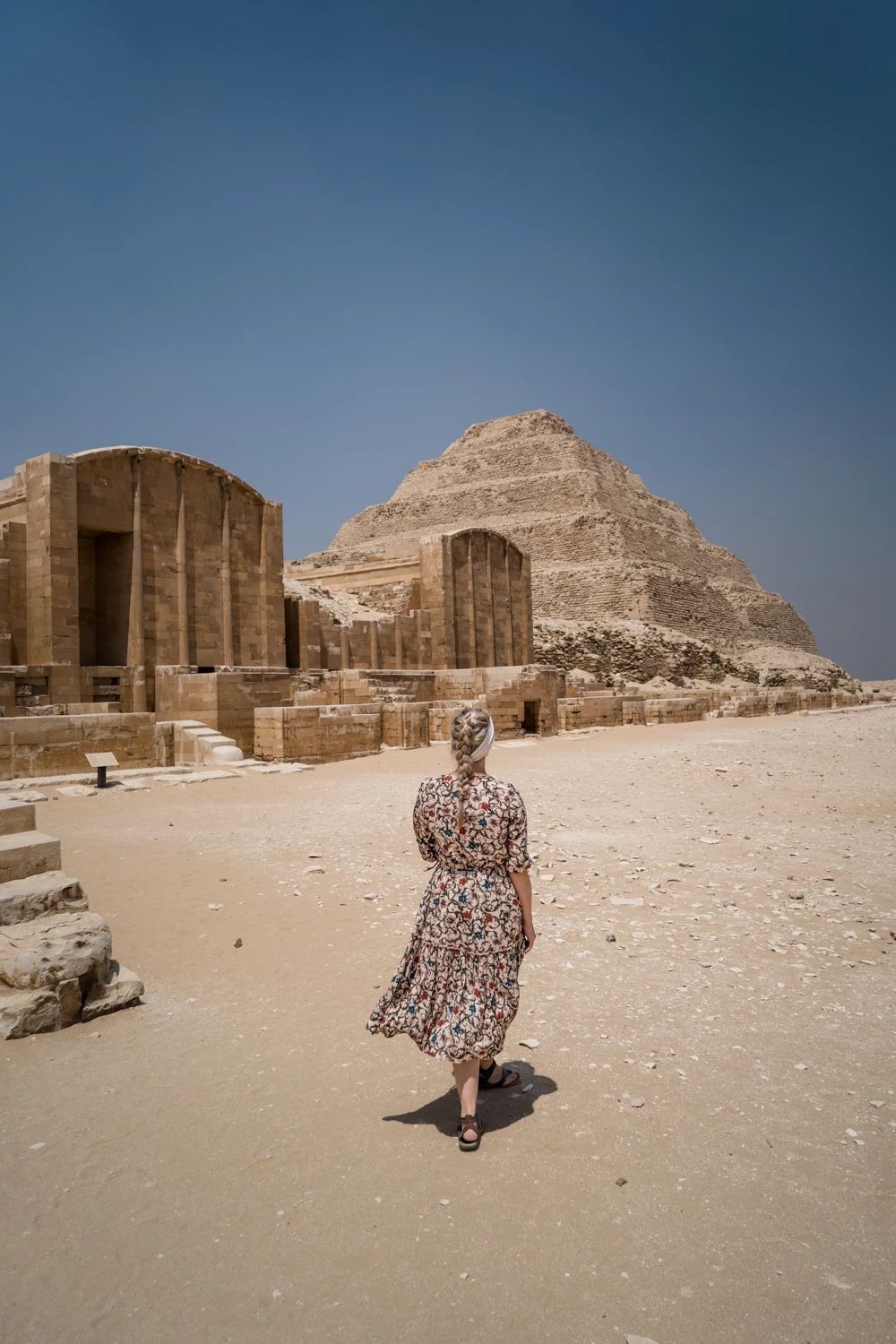
When travelers think about ancient Egypt, the Pyramids of Giza are usually the first monuments that come to mind. The Great Pyramid, the Sphinx, and the vast Giza Plateau have become symbols of Egyptian civilization around the world. Yet the story of ancient Egypt is much larger than the famous monuments of Giza.
A visit to Saqqara and Memphis reveals an important part of that wider story.
Located south of modern Cairo, these two ancient sites help explain how Egyptian civilization developed from its earliest royal monuments into the monumental world travelers recognize today. Saqqara contains the famous Step Pyramid of Djoser, important royal pyramids, decorated private tombs, the Serapeum, and archaeological remains covering thousands of years. Memphis, meanwhile, was one of ancient Egypt’s most important cities and served as a major political and religious center for much of the country’s history.
That is why adding Saqqara and Memphis to a Cairo and Giza excursion can change the way you understand the pyramids. Instead of seeing Giza as an isolated wonder, you begin to see it as one part of a much larger landscape of royal power, religious beliefs, architecture, burial traditions, craftsmanship, and urban life.
For travelers starting from Hurghada, this combination can turn a standard Cairo excursion into a deeper journey through ancient Egyptian history.
Why Look Beyond the Pyramids of Giza?
The Pyramids of Giza are extraordinary, but they represent only one chapter of Egyptian history.
The monuments of Giza belong to the Fourth Dynasty and are among the most famous achievements of the Old Kingdom. However, the development of pyramid architecture began earlier, and Saqqara provides some of the clearest evidence of this architectural evolution.
At Saqqara, visitors can see the Step Pyramid of Djoser, generally dated to the beginning of the Third Dynasty. The Egyptian Ministry of Tourism and Antiquities describes Saqqara as one of the most important cemeteries of Memphis and an archaeological site where monuments from many periods of Egyptian history can be found.
This makes Saqqara particularly interesting for travelers who want to understand how the pyramid tradition developed.
Instead of arriving at Giza and seeing only the finished form of the pyramid, you can first explore an earlier stage of monumental architecture.
That historical sequence adds context.
Saqqara: An Open-Air Museum of Egyptian History
Saqqara is much more than the Step Pyramid.
The site functioned as one of the principal cemeteries of ancient Memphis for thousands of years. Kings, nobles, officials, priests, and other individuals were buried in the area during different periods.
According to Egypt’s Ministry of Tourism and Antiquities, burials at Saqqara extend from the earliest dynasties through the Old, Middle, and New Kingdoms and into later periods. The site also contains evidence from the Coptic era.
This long chronology is one of Saqqara’s greatest strengths.
A traveler walking through the site is not simply looking at one monument from one period. Instead, the landscape represents centuries of changing architectural styles, religious ideas, burial practices, and artistic traditions.
UNESCO includes Saqqara within the broader World Heritage property known as Memphis and its Necropolis – the Pyramid Fields from Giza to Dahshur, inscribed on the World Heritage List in 1979.
The Step Pyramid of Djoser
The Step Pyramid is the monument that immediately attracts attention at Saqqara.
Built for King Djoser, it represents a major moment in the development of Egyptian monumental architecture. Rather than having the smooth triangular appearance associated with the later pyramids of Giza, the structure rises in a series of stepped levels.
The result is visually different from the Great Pyramid, but its importance goes much deeper than its appearance.
UNESCO describes the Step Pyramid complex as containing the first monumental stone building and the first pyramid built in Egypt.
This makes Saqqara an essential stop for anyone interested in the history of pyramid construction.
The monument also demonstrates that pyramid building was not a single sudden invention. Egyptian architects experimented with form, scale, materials, ceremonial spaces, and architectural relationships over time.
Imhotep and the Development of Stone Architecture
The Step Pyramid is traditionally associated with Imhotep, one of the best-known figures connected with ancient Egyptian architecture and intellectual history.
The Egyptian Ministry of Tourism and Antiquities describes Imhotep as the architect of Djoser’s pyramidal tomb and highlights his role in the large-scale use of stone for an integrated architectural complex. The Imhotep Museum at Saqqara was created in his memory and contains objects discovered at the archaeological site.
For modern visitors, this connection makes the Step Pyramid more interesting.
You are not simply looking at an enormous ancient structure. You are looking at a monument associated with an important stage in the development of monumental stone architecture.
The surrounding complex is also important because ancient Egyptian funerary architecture was not limited to the pyramid itself. Temples, courtyards, ceremonial spaces, walls, and processional routes formed part of the larger design.
Saqqara and the Evolution of the Pyramid
One of the best ways to understand Saqqara is to think of it as part of a long architectural experiment.
Egyptian royal tombs evolved considerably over time. Earlier rulers were associated with mastabas, rectangular structures with flat roofs and sloping sides. Later, the pyramid form became dominant for royal burials.
The pyramid itself also changed.
The Step Pyramid represents one stage in that development. Later pyramids became more geometrically smooth, eventually leading to the great monuments of the Giza Plateau.
UNESCO emphasizes that the Memphis necropolis preserves evidence for the development of royal tombs from mastabas toward pyramids.
Seeing this development in person makes the history easier to understand than reading about it in a book.
The Pyramid of Unas and the Pyramid Texts
Saqqara also contains the pyramid of King Unas, a Fifth Dynasty ruler.
Although it is much smaller than the Great Pyramid of Giza, it has enormous historical significance because its burial chamber contains some of the earliest known Pyramid Texts.
The Egyptian Ministry of Tourism and Antiquities explains that these texts were inscribed on the walls of the burial chamber and were intended to assist the deceased king on his journey to the afterlife.
This is an important reminder that Egyptian pyramids were not simply engineering projects.
They were religious monuments connected to beliefs about death, resurrection, the gods, and the journey into the afterlife.
When you visit Saqqara, details such as inscriptions and symbols can therefore be just as important as the size of the monuments.
The Tombs of the Nobles
Another reason to visit Saqqara is the collection of private tombs.
Royal pyramids often dominate photographs, but private tombs can provide a different perspective on ancient Egyptian life.
Decorated tombs may contain scenes connected with agriculture, food production, craftsmanship, animals, celebrations, offerings, and daily activities.
These images help historians understand aspects of Egyptian society that monumental royal architecture alone cannot show.
Instead of focusing only on kings and pyramids, visitors begin to see farmers, craftsmen, administrators, priests, and other members of society.
That makes the ancient world feel more human.
The Tomb of Horemheb
Saqqara also preserves evidence from the New Kingdom.
One notable example is the tomb of Horemheb. Before becoming pharaoh, Horemheb was a powerful military official during the reign of Tutankhamun. He began a tomb at Saqqara before later receiving a royal burial in the Valley of the Kings after becoming king.
His Saqqara tomb is therefore interesting because it reflects a period when the royal center of burial had shifted south toward Thebes.
The tomb also demonstrates how private and elite funerary architecture changed over time.
This is another reason Saqqara should not be treated simply as the location of one pyramid.
It is a historical landscape containing multiple chapters of Egyptian civilization.
The Serapeum of Saqqara
One of Saqqara’s most unusual monuments is the Serapeum.
The Serapeum served as the burial place of the sacred Apis bulls associated with Ptah, the important god of Memphis.
According to the Egyptian Ministry of Tourism and Antiquities, the Serapeum consists of underground galleries where mummified Apis bulls were placed in elaborate burials. The complex was used from the New Kingdom through the Ptolemaic period.
This site offers a fascinating perspective on ancient Egyptian religion.
Animals could have important sacred roles within Egyptian religious traditions. The Apis bull was particularly associated with the cult of Ptah at Memphis.
The Serapeum also demonstrates how religious traditions continued and developed over many centuries.
Memphis: The Ancient City Behind the Necropolis
After exploring Saqqara, visiting Memphis adds another important piece to the story.
Saqqara was a major necropolis associated with Memphis. Memphis itself was the ancient city where political authority, religion, administration, craftsmanship, and everyday life came together.
The Egyptian Ministry of Tourism and Antiquities states that Memphis was an important capital during the Early Dynastic Period and Old Kingdom and remained one of the country’s major cities for more than three thousand years. The city was strongly associated with the worship of Ptah.
UNESCO similarly describes Memphis as an ancient capital positioned strategically near the Nile and important trade routes.
Understanding this relationship helps visitors connect the two sites.
Memphis was the city. Saqqara was one of its major cemeteries.
That simple distinction makes the landscape much easier to understand.
Why Was Memphis So Important?
Memphis occupied an important geographical position.
It stood near the boundary between Upper and Lower Egypt and close to the Nile Valley and Delta. This made it a strategic location for administration, communication, trade, and political control.
The Egyptian Ministry explains that after the unification of Egypt, Memphis became a new capital and remained one of the country’s most important and populous cities for a very long period.
Its importance was not purely political.
Memphis was also a major religious center.
The city was strongly associated with Ptah, a god connected with creation and craftsmanship. Temples, workshops, administrative buildings, and other structures formed part of the ancient urban environment.
Although much of ancient Memphis has disappeared beneath later development and agricultural landscapes, archaeological discoveries continue to reveal information about the city.
The Colossal Statue of Ramesses II
One of the most recognizable surviving monuments at the Memphis open-air museum is the colossal statue of Ramesses II.
The statue demonstrates the scale and sophistication of royal sculpture during the New Kingdom.
Visitors can observe the details of the face, royal headdress, body, and inscriptions while considering how such enormous stone sculptures were designed, transported, carved, and displayed.
The experience is different from standing beside a pyramid.
A pyramid emphasizes monumental geometry.
A royal statue emphasizes the representation of the ruler.
Together, the two types of monuments reveal different aspects of ancient Egyptian power.
Memphis and the God Ptah
Ptah was central to the religious identity of Memphis.
He was associated with creation and craftsmanship and was particularly important to artisans and skilled workers.
This connection helps explain why Memphis was also a center of craftsmanship.
Stone carving, metalworking, sculpture, architecture, and other specialized skills were essential to the construction and decoration of temples and tombs.
When you visit Memphis after Saqqara, the connection becomes easier to appreciate.
You have already seen tombs, pyramids, inscriptions, and sculpture at Saqqara. Memphis provides the urban and religious context behind many of these traditions.
Saqqara, Memphis and Giza: One Historical Landscape
Travelers often think of Giza, Saqqara, and Memphis as completely separate attractions.
Historically, however, they belong to the same broader landscape.
UNESCO’s World Heritage property extends across the pyramid fields and necropolis associated with ancient Memphis, including Giza, Saqqara, and Dahshur.
This is important because it changes how you plan your sightseeing.
Instead of asking whether you should visit “the pyramids” or “Saqqara,” it can be more useful to think about what each location contributes.
Giza introduces the famous pyramids and Sphinx.
Saqqara reveals earlier pyramid development, tombs, inscriptions, and religious traditions.
Memphis provides the urban and religious context of the ancient capital.
Together, they create a much broader picture.
Why Saqqara Adds Depth to a Cairo Excursion
A Cairo and Giza excursion can easily become a checklist of famous monuments.
You see the pyramids, take photographs, visit the Sphinx, and perhaps explore a museum before returning to the hotel.
Saqqara changes the pace and depth of the experience.
Instead of seeing only the most famous monuments, you begin asking different questions:
How did pyramid architecture develop?
Why were tombs decorated?
What did Egyptians believe about the afterlife?
How important were priests and temples?
How did the capital function?
How did religious traditions change over thousands of years?
These questions transform sightseeing into historical exploration.
What Can You Learn at Saqqara That Giza Does Not Show?
Giza is essential for understanding the peak of Old Kingdom pyramid construction.
Saqqara provides a broader chronological perspective.
At Saqqara, travelers can see:
- The Step Pyramid of Djoser
- Royal pyramid complexes
- Pyramid Texts
- Noble tombs
- New Kingdom tombs
- The Serapeum
- The Imhotep Museum
- Evidence from later historical periods
The Ministry of Tourism and Antiquities describes Saqqara as a site spanning a remarkably long period of Egyptian history, including monuments from the earliest dynasties through later periods.
That diversity is what makes it so valuable.
A Different Experience for History Lovers
Travelers who already know the basic story of the pyramids may find Saqqara particularly rewarding.
Once you move beyond the famous names, the site becomes more detailed.
You start noticing architectural changes, inscriptions, tomb decoration, religious symbols, and differences between royal and private monuments.
A knowledgeable guide can make an especially large difference here.
At Giza, the enormous size of the monuments immediately communicates their importance. At Saqqara, many details are smaller and require explanation.
A guide can help explain why a particular tomb matters, what an inscription represents, or how a monument fits into the wider history of Memphis.
Saqqara for Photographers
Saqqara also offers a different visual experience from Giza.
The Step Pyramid creates strong geometric compositions, while surrounding desert landscapes provide space and perspective.
Tombs and architectural details offer opportunities for close-up photography.
At Memphis, statues and museum displays provide another type of subject.
However, photography rules can vary between monuments and museums. Visitors should follow local instructions and avoid using flash where prohibited.
More importantly, photography should not replace observation.
Take time to look at the details before reaching for the camera.
How Long Should You Spend There?
The ideal duration depends on how many monuments you want to visit.
A quick visit can introduce travelers to the Step Pyramid and a few major areas.
A longer visit allows time for tombs, the Serapeum, the Imhotep Museum, and additional archaeological areas.
The official Ministry of Tourism and Antiquities currently lists separate access options for several parts of Saqqara, including the main site, Djoser’s pyramid complex, noble tombs, the Serapeum, and the Imhotep Museum. Visitors should check current ticketing and opening information before traveling because details can change.
Combining Saqqara and Memphis With Giza
For many travelers, the three locations work naturally together.
A possible sightseeing sequence is:
Morning: Giza Plateau and the Pyramids
Late morning: Sphinx and surrounding area
Afternoon: Saqqara
Later afternoon: Memphis
The exact order depends on traffic, opening times, weather, and the tour itinerary.
Some travelers may prefer to begin at Saqqara and finish at Giza. Others may want to see the most famous pyramids first.
The important point is to avoid creating an exhausting schedule simply to visit every possible monument.
Quality time at fewer sites can be more rewarding than rushing through many locations.
Traveling From Hurghada to Cairo
For visitors staying in Hurghada, Cairo is far enough away that planning matters.
A Cairo excursion from Hurghada generally requires an early departure, followed by a full day of sightseeing before the return journey.
Because of this, travelers should decide in advance which sites matter most to them.
If the main goal is to see the Great Pyramid and Sphinx, a shorter Giza-focused program may be enough.
If you want a deeper archaeological experience, look for an itinerary that includes Saqqara and Memphis as well.
When comparing excursions, check the transportation, total duration, entrance fees, guide services, meals, and the exact list of attractions.
Best Tours Hurghada can be considered when planning a Cairo itinerary that goes beyond the standard pyramid visit and includes additional historical sites.
Saqqara or Giza: Are They the Same Experience?
No.
Although both are associated with pyramids, the experience is quite different.
Giza is dominated by enormous monuments that have become global symbols of ancient Egypt.
Saqqara feels more like an archaeological landscape.
You encounter different monuments, tombs, inscriptions, and layers of history. The Step Pyramid also has a completely different architectural character from the smooth-sided pyramids of Giza.
Visiting both is therefore not repetitive.
Instead, each site answers different historical questions.
Best Time to Visit
Egypt’s climate means that the time of day can make a significant difference.
Earlier visits are often more comfortable than spending the entire day outdoors during the strongest heat.
Sun protection is important throughout the year. Bring water, sunglasses, a hat, and comfortable footwear.
The archaeological areas can involve walking on uneven surfaces, so practical shoes are preferable.
If you are visiting from Hurghada on a long day trip, remember that the journey itself can be tiring. A realistic itinerary should leave enough time for meals, breaks, and transportation.
What Should You Bring?
For a Cairo, Saqqara, and Memphis excursion, consider taking:
- Comfortable walking shoes
- Water
- Sunscreen
- Sunglasses
- A hat
- Light, breathable clothing
- A camera or smartphone
- Portable battery
- Small snacks if permitted
- Any necessary personal medication
- A light layer for air-conditioned transportation
It is also useful to keep your belongings organized because you may move between several sites during the day.
Responsible Tourism at Archaeological Sites
Ancient monuments are fragile.
Visitors can help protect them through simple behavior.
Do not touch carvings or painted surfaces unless specifically permitted.
Do not climb monuments.
Do not remove stones, fragments, pottery, or other archaeological material.
Follow barriers and signs.
At museums, follow photography and flash restrictions.
The Egyptian Ministry of Tourism and Antiquities also provides visitor rules for the Imhotep Museum, including instructions not to touch exhibits and to respect museum regulations.
Responsible tourism is not only about protecting monuments for future visitors. It also helps preserve the information that archaeologists and historians use to understand ancient Egypt.
Why Memphis and Saqqara Make Cairo More Meaningful
The most important benefit of visiting Saqqara and Memphis is context.
The pyramids of Giza are spectacular because of their scale and survival.
But ancient Egypt was not built around three pyramids alone.
There were capitals, temples, cemeteries, workshops, administrative centers, religious institutions, royal courts, agricultural communities, and enormous networks connecting the Nile Valley.
Memphis was part of that living world.
Saqqara was part of its sacred landscape.
Giza was another monumental expression of royal power.
When you see all three, the ancient landscape begins to make much more sense.
Frequently Asked Questions
What is Saqqara famous for?
Saqqara is best known for the Step Pyramid of Djoser, but the site contains much more. It includes royal pyramids, decorated private tombs, the Serapeum, New Kingdom tombs, and archaeological remains from several periods of Egyptian history.
Why is Memphis important in ancient Egyptian history?
Memphis was one of ancient Egypt’s most important cities and served as a capital during the Early Dynastic Period and Old Kingdom. It remained an important political and religious center for much of Egyptian history and was strongly associated with the god Ptah.
Is Saqqara older than the Pyramids of Giza?
Saqqara contains monuments that predate the famous pyramids of Giza, including the Step Pyramid of Djoser. It therefore provides important evidence for the development of Egyptian pyramid architecture before the great Fourth Dynasty pyramids.
What is the Step Pyramid of Djoser?
The Step Pyramid was built for King Djoser and is one of the earliest pyramids in Egypt. UNESCO identifies it as the first pyramid built and part of a monumental stone complex at Saqqara.
What are the Pyramid Texts?
The Pyramid Texts are religious inscriptions placed inside royal pyramids. The pyramid of Unas at Saqqara contains one of the earliest known examples, with texts intended to assist the deceased king in the afterlife.
What is the Serapeum at Saqqara?
The Serapeum is an underground complex associated with the burial of sacred Apis bulls connected with the god Ptah. The complex was used over a long period, from the New Kingdom into the Ptolemaic era.
Can I visit Saqqara and Memphis on a Cairo trip?
Yes. Many Cairo itineraries can combine Giza, Saqqara, and Memphis, although the exact schedule depends on the tour operator, transportation, opening hours, and the amount of time available.
Is Saqqara worth visiting if I have already seen Giza?
Saqqara offers a substantially different experience. It provides an opportunity to explore earlier pyramid development, private tombs, religious sites, and a much broader archaeological landscape rather than focusing mainly on the famous monuments of Giza.
How far is Saqqara from Cairo?
Saqqara is located south of Cairo, approximately 40 kilometers southwest of central Cairo according to the Egyptian Ministry of Tourism and Antiquities. Travel time can vary considerably depending on the starting point and traffic.
Final Thoughts
Egypt’s famous pyramids are only the beginning of the story.
Giza shows the extraordinary scale of Old Kingdom royal architecture. Saqqara takes you further back and then forward through thousands of years of history, revealing how burial traditions, architecture, religion, and art developed over time. Memphis adds another essential layer by showing the importance of the ancient city that connected political power, religion, craftsmanship, and the wider Nile Valley.
Together, Giza, Saqqara, and Memphis create a much richer picture of ancient Egypt.
Instead of simply asking how the pyramids were built, you can begin to understand why they were built, how the architectural tradition developed, what Egyptians believed about death and the afterlife, and how royal monuments were connected to a much larger society.
For travelers coming from Hurghada, adding Saqqara and Memphis to a Cairo excursion can therefore turn a famous sightseeing day into a deeper historical journey.
The pyramids may be the headline, but Saqqara and Memphis help tell the story behind them.