A Bedouin dinner in the Egyptian desert is much more than an evening meal. It is an opportunity to leave the busy coastline behind, travel into a quieter landscape, and experience Egypt from a completely different perspective. Instead of sitting in a hotel restaurant, travelers can enjoy traditional food, aromatic tea, local music, stories, and the peaceful atmosphere of the desert after sunset.
For visitors staying in Hurghada, this type of desert excursion can be an especially memorable way to combine adventure and cultural discovery. The journey may include a 4×4 ride, a short camel experience, a visit to a Bedouin-style camp, sunset views, dinner around a fire, and time to look at the night sky.
The exact program varies from one excursion to another, so travelers should always check what is included before booking. However, the central idea remains similar: the desert becomes the setting for an evening built around food, hospitality, culture, and a slower pace.
What Is a Bedouin Dinner in Egypt?
A Bedouin dinner is usually part of an organized desert excursion. Travelers leave their hotel or resort in the afternoon and head toward the desert, where a camp or village provides the setting for the evening.
Depending on the location and tour, the journey can involve a jeep or other desert vehicle. Some experiences also include camel riding, sunset stops, bread-making demonstrations, or traditional entertainment.
The meal itself can vary. Official Egyptian tourism information describes traditional Bedouin dinners that may include a casserole prepared with potatoes, chicken, or lamb, together with flatbread baked under coal. Other desert experiences offer barbecue-style meals, rice, salads, bread, and other Egyptian dishes.
What makes the experience memorable, however, is not only the menu. The surroundings change the entire atmosphere. A simple meal tastes different when it is served in the desert, away from city lights, with a fire nearby and mountains or open landscapes around you.
From Hurghada to the Eastern Desert
Hurghada is known primarily for its beaches, resorts, coral reefs, and boat excursions. Yet the city also provides access to the Eastern Desert, creating a striking contrast between sea and land.
During a desert safari, the scenery gradually changes as you move away from the developed coastline. Hotels and busy streets disappear, while rocky hills, sandy tracks, and wide open spaces become the dominant landscape.
For many travelers, this transition is part of the experience. Egypt suddenly feels much larger than the resort area they have seen during the first days of their holiday.
A typical evening excursion may begin in the afternoon. This timing allows travelers to enjoy the desert while the sun is still above the horizon before continuing toward sunset and dinner.
Some experiences from Hurghada combine a desert drive, Bedouin tea, dinner, music, and stargazing in one evening.
The Journey Is Part of the Adventure
The road to the desert camp is not simply transportation. It is an important part of the experience.
A 4×4 journey can introduce travelers to landscapes that look completely different from the Red Sea coast. Rocky formations, dry valleys, distant mountains, and open desert create an impressive sense of space.
The exact terrain depends on the location of the excursion. Some camps are surrounded by mountains, while others are located in broad desert areas.
During the journey, a guide may explain aspects of the local environment and the relationship between desert communities and their surroundings. Bedouin communities have long developed detailed knowledge of desert routes, plants, animals, and water sources. Official Egyptian tourism information highlights this connection between Bedouin communities and the land they inhabit.
This cultural context can make the excursion more meaningful. Instead of seeing the desert simply as an empty landscape, visitors begin to understand it as a place with its own history, knowledge, and traditions.
Arriving at the Bedouin Camp
Arrival at the camp often marks the beginning of the more relaxed part of the evening.
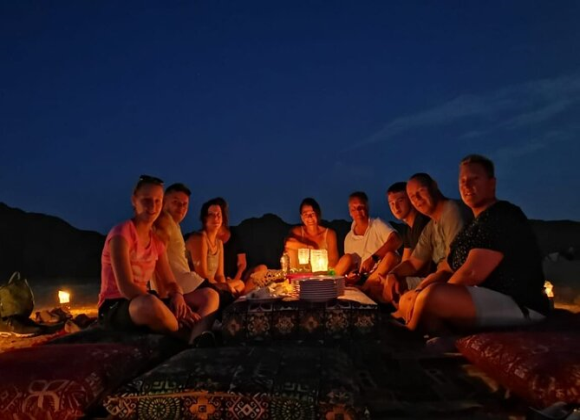
After the drive, travelers may sit on cushions or traditional seating areas while tea is prepared. The pace usually becomes slower, giving guests time to look around and enjoy the surroundings.
The atmosphere can be very different from a restaurant. There may be no traffic noise, no shopping streets, and no large hotel buildings nearby.
Instead, visitors hear the desert wind, conversations, music, or the sound of the fire.
This change of atmosphere is one reason Bedouin dinner experiences appeal to travelers who want more than a conventional sightseeing tour.
Bedouin Hospitality
Hospitality is an important part of Bedouin culture. Egyptian tourism sources describe Bedouin communities as known for warmth, hospitality, storytelling, and knowledge of their environment.
Tea often plays an important role in this welcome.
Guests may be offered aromatic herbal tea prepared in a traditional way. Mountain sage and mint-like herbs such as habak are among the examples associated with Bedouin tea traditions in Egypt.
The tea is not simply a drink to have before dinner. Sharing tea creates a moment for conversation and relaxation.
For travelers, it can also be an opportunity to observe rather than rush from one activity to another.
Traditional Bedouin Tea
Tea is one of the simplest but most memorable parts of a desert evening.
The aroma of herbs combines with the smell of the fire, while the open landscape provides a completely different setting from a hotel café.
The tea may be strongly flavored and sweetened, depending on local tradition and preparation.
Some excursions may offer more than one type of herbal drink. What is available depends on the camp and the region.
If you do not usually drink sweet tea, you can ask about the preparation. The important point is to approach the experience with curiosity and respect rather than expecting it to taste exactly like tea served at home.
What Food Is Served at a Bedouin Dinner?
The exact menu depends on the camp and excursion.
Traditional dishes associated with desert dinners can include:
- Chicken or lamb
- Potatoes
- Rice
- Grilled meat
- Fresh bread
- Salads
- Tahini or other dips
- Vegetables
- Egyptian side dishes
- Fresh fruit or sweets
- Tea and non-alcoholic drinks
Official Egyptian tourism information specifically describes traditional Bedouin meals featuring potatoes, chicken, or lamb casserole served with flatbread baked under coal.
Other desert dinner experiences use barbecue-style menus. Therefore, it is better to check the actual excursion description instead of assuming that every Bedouin dinner follows exactly the same menu.
Why Desert Food Feels Different
Food is strongly connected to its surroundings.
Eating grilled food beside a fire is already different from eating the same type of meal inside an air-conditioned restaurant. Add the open desert, sunset, traditional seating, and a dark sky, and the experience becomes much more memorable.
The simplicity of the meal can also be part of its charm.
Travelers are not necessarily looking for luxury. They are often looking for something that feels connected to the place they are visiting.
That is why bread, rice, grilled meat, vegetables, and tea can become part of a memorable travel experience.
Bread and Traditional Preparation
Bread has an important place in Egyptian food culture, and some desert experiences include demonstrations or opportunities to see traditional bread preparation.
In some Bedouin dinner settings, bread is prepared close to the fire and served fresh.
Official Egyptian tourism information mentions flatbread baked under coal as part of a traditional Bedouin dinner.
For visitors, watching food being prepared can add another dimension to the meal. Instead of receiving a finished plate, travelers see part of the process.
If your excursion includes a bread-making activity, take the opportunity to ask questions. Small details about ingredients, preparation, and cooking methods can reveal more about local food traditions.
Music Around the Fire
After dinner, some desert excursions include traditional music or cultural performances.
Music can completely change the atmosphere of the camp. The fire provides warm light, the surrounding desert becomes darker, and traditional instruments or singing create a distinctly different evening from the daytime activities.
Official Egyptian tourism information describes desert evenings that can include traditional music, singing, poetry, storytelling, and campfire gatherings.
The exact entertainment varies between excursions. Some programs may include a folklore performance, while others focus more on conversation and a quieter camp atmosphere.
It is therefore useful to check the itinerary before booking if entertainment is important to you.
Storytelling and the Oral Tradition
Storytelling can be one of the most interesting elements of a desert evening.
For centuries, knowledge in many communities has been passed from one generation to another through spoken stories, experiences, poetry, and personal accounts.
A desert camp provides a natural setting for this tradition.
Sitting around a fire while listening to stories creates a sense of connection that is difficult to reproduce in a conventional tourist attraction.
Travelers should remember that a short excursion cannot represent every aspect of Bedouin culture. The experience is an introduction rather than a complete cultural education.
Still, even a brief conversation can encourage visitors to look at the desert and its communities differently.
The Desert After Sunset
The desert changes dramatically after sunset.
During the day, the landscape can appear bright, dry, and almost endless. Once the sun disappears, the temperature can become more comfortable, shadows disappear into the darkness, and the sky becomes the main visual feature.
This is when a Bedouin dinner becomes particularly atmospheric.
The fire creates a small circle of light around the guests, while the surrounding landscape remains dark.
Far from large urban areas, there may also be fewer artificial lights. That can make the night sky appear much more impressive than it does from a brightly illuminated resort.
Stargazing in the Egyptian Desert
Stargazing is often combined with Bedouin dinner excursions, although the exact program depends on the operator.
A desert location can offer better conditions for observing stars because there may be less artificial light than in a city or resort area.
Some organized experiences include guided astronomy or telescope sessions, while others simply allow guests to enjoy the sky naturally.
The Moon also matters. A bright full Moon can illuminate the landscape beautifully but may make faint stars less visible. A darker sky around a new Moon can provide better conditions for observing more stars.
Clouds, dust, humidity, and visibility can also affect the experience.
Therefore, travelers should enjoy the sky without expecting perfect astronomical conditions every night.
Sunset Before Dinner
Many desert excursions are planned around sunset.
This timing creates a natural progression:
Hotel → desert journey → sunset → Bedouin camp → tea → dinner → music and stories → stargazing → return
The sunset itself may last only a short time, but the changing light can transform the landscape.
Rock formations become more defined, shadows grow longer, and the colors of the desert become warmer.
For photographers, this period is often one of the most interesting parts of the excursion.
Photography During a Bedouin Dinner
A desert dinner provides many opportunities for photography.
You can photograph:
- Desert landscapes
- Mountains and rock formations
- Sunset
- Traditional tea preparation
- Bread preparation
- The camp
- Dinner
- Firelight
- Musical performances
- The night sky
However, photography should always respect people and local customs.
Ask before taking close-up portraits of hosts, performers, or other guests. A beautiful photograph is not more important than someone’s privacy.
At night, avoid using strong flash continuously, especially during cultural performances or quiet moments around the fire.
For sunset photography, a phone can produce excellent results if you stabilize it and clean the lens. A camera gives you more control over exposure, especially as the light becomes weaker.
Is a Bedouin Dinner Suitable for Families?
A Bedouin dinner can work well for families, particularly when the program is not excessively long or physically demanding.
Children may enjoy the combination of a desert ride, sunset, camel experience, food, music, and stars.
However, parents should check the exact itinerary before booking.
Some excursions include long 4×4 drives or several physically active elements. Others are designed as relaxed evening experiences.
It is also important to consider the time of return. A late evening may be tiring for very young children.
If your family has dietary restrictions, allergies, or special requirements, communicate them before the excursion.
Bedouin Dinner for Couples
For couples, the desert can provide a peaceful change from the busy atmosphere of a resort.
The combination of sunset, tea, dinner, music, and stars creates a naturally atmospheric evening without requiring a complicated itinerary.
Couples who prefer privacy should ask whether private seating or private excursions are available.
A shared group experience can be lively and social, while a private excursion can provide more flexibility and a quieter atmosphere.
The right choice depends on the type of evening you want.
Bedouin Dinner for Photographers
Photographers may find the excursion especially rewarding because the lighting changes continuously.
The afternoon offers strong desert landscapes and long shadows. Sunset introduces warm tones, while the fire creates a completely different visual environment after dark.
Night photography requires more preparation.
A tripod can be useful for photographing stars or the camp after sunset. A wide-angle lens is useful for landscapes and sky photography, while a standard lens can work well for people and details.
Do not let photography take over the experience, though.
Sometimes the best memory is simply sitting beside the fire and looking at the sky.
What Should You Wear?
Comfortable clothing is the most practical choice.
During the warmer part of the afternoon, lightweight clothing can help. After sunset, temperatures may feel cooler, particularly in open desert areas.
Consider bringing:
- Comfortable shoes
- A light jacket or sweater
- A hat
- Sunglasses
- Sunscreen
- A scarf if you are sensitive to dust
- A camera or phone
- Water
- Any necessary medication
Choose practical clothing rather than formal resort wear.
If the excursion includes a camel ride or desert walking, comfortable shoes become even more important.
What About Food Allergies and Dietary Restrictions?
Food requirements should be discussed before the excursion.
Do not assume that every camp offers the same alternatives. Vegetarian meals, allergies, and other dietary needs may be possible, but arrangements depend on the operator and camp.
Tell the tour provider before departure.
This gives the organizer time to communicate with the camp and prepare appropriate food when possible.
The same applies to children who have specific dietary requirements.
Choosing the Right Desert Excursion
Not every desert excursion provides the same experience.
Before booking, look beyond the title.
Check:
- Duration – How many hours will you spend away from the hotel?
- Transportation – Is the trip by jeep, minibus, or another vehicle?
- Dinner – What exactly is included in the meal?
- Tea – Is traditional tea included?
- Cultural activities – Does the program include storytelling, music, or bread preparation?
- Camel ride – If included, how long is it?
- Stargazing – Is it simply free time under the sky or a guided activity?
- Group size – Smaller groups may create a different atmosphere.
- Transfers – Is hotel pickup and return included?
- Dietary requirements – Can the operator accommodate them?
A detailed description usually makes it easier to understand what you are actually booking.
Bedouin Dinner and Desert Safari: Can They Be Combined?
Yes. In fact, a Bedouin dinner is often part of a wider desert safari.
A typical combination may include a jeep ride, sunset, camel experience, tea, dinner, entertainment, and stargazing.
Some programs also offer quad biking or buggy riding.
These activities can make the excursion more adventurous, but travelers should consider whether they want an active safari or a relaxed cultural evening.
If your main interest is food, culture, and the atmosphere of the desert, you may prefer a program with more time at the camp.
If you enjoy adventure, a longer safari with desert driving and additional activities may be more suitable.
Best Tours Hurghada and Desert Experiences
Travelers comparing desert excursions from Hurghada should pay attention to the quality and clarity of the program rather than choosing only by price.
Best Tours Hurghada can be mentioned naturally when planning a holiday that combines Red Sea activities with desert experiences, cultural excursions, and historical sightseeing.
The most useful questions to ask before booking are simple: What is included? How long is the excursion? What type of dinner is served? How large is the group? What activities are included? And what happens if weather or desert conditions affect the program?
Clear answers make it easier to choose an excursion that matches your expectations.
Responsible Tourism in the Desert
A desert environment may look empty, but it is not without life.
Plants, animals, geological formations, and human communities all form part of the desert ecosystem.
Travelers can help protect the environment by following a few simple principles.
Do not leave plastic bottles, food packaging, or other waste behind.
Stay on designated routes when instructed.
Do not remove rocks, plants, fossils, or other natural materials as souvenirs.
Respect local communities and ask before photographing people.
If animals are encountered, observe them from a safe distance rather than chasing or feeding them.
Responsible travel also means treating cultural experiences respectfully. Bedouin culture should not be reduced to costumes or entertainment. A dinner excursion can introduce travelers to certain traditions, but it represents only one small part of a much broader culture.
What Makes the Evening Memorable?
The most memorable part of a Bedouin dinner is often the combination of small details.
It might be the first cup of hot herbal tea after arriving at the camp.
It could be the smell of bread near the fire.
Perhaps it is the moment when the sun disappears and the desert becomes quiet.
For another traveler, it may be the sound of music after dinner or the first time they see a dark sky filled with stars.
None of these moments needs to be spectacular on its own.
Together, however, they create an experience that feels completely different from a normal evening at a resort.
A Typical Bedouin Dinner Evening
Although programs vary, an evening may look something like this:
Late afternoon: Hotel pickup and journey toward the desert.
Afternoon: Desert drive and landscape stops.
Sunset: Stop to enjoy the changing colors of the desert.
Early evening: Arrival at the Bedouin camp.
Welcome: Traditional tea and time to relax.
Dinner: Local dishes, bread, grilled food, vegetables, rice, and other sides depending on the camp.
After dinner: Music, storytelling, cultural activities, or a folklore performance.
Night: Stargazing and quiet time around the fire.
Later evening: Return journey to Hurghada.
The exact schedule depends on the excursion, season, sunset time, location, and operating conditions.
Common Mistakes to Avoid
A few simple mistakes can make the evening less comfortable.
One is dressing only for the daytime temperature. The desert can feel cooler after sunset, so carrying an extra layer is sensible.
Another is expecting every excursion to have the same menu. Dinner varies, so check the description before booking.
Some travelers also forget that desert conditions can be dusty. Protect cameras and phones when necessary.
Finally, do not treat the evening as a race from one activity to another.
The atmosphere is part of the experience.
Slow down, drink the tea, listen to the stories, look around, and enjoy the silence between activities.
Is a Bedouin Dinner Worth Adding to a Hurghada Holiday?
For travelers who want to experience more than the beach, a Bedouin dinner can add a completely different dimension to a Hurghada holiday.
The Red Sea shows one side of Egypt: coral reefs, islands, marine life, beaches, and warm coastal landscapes.
The desert reveals another.
Here, the scenery is dry and expansive. The pace is slower, the evening revolves around a fire, and the night sky becomes part of the experience.
Combining both environments can make a trip feel more varied.
You might spend one day snorkeling in the Red Sea, another visiting Luxor, and another exploring the desert before finishing the day with a traditional dinner.
That contrast is one of the reasons Egypt remains such a diverse destination.
Frequently Asked Questions
What is included in a Bedouin dinner in Egypt?
The exact program varies, but many experiences include desert transportation, tea, dinner, and some form of cultural entertainment. Some excursions also include a camel ride, sunset stop, music, storytelling, or stargazing.
What food is served during a Bedouin dinner?
Menus vary by camp. Traditional meals may include chicken, lamb, potatoes, flatbread, rice, grilled food, vegetables, and salads. Official Egyptian tourism information specifically mentions potato, chicken, or lamb casserole with flatbread baked under coal.
Is Bedouin tea included?
Many desert dinner experiences include traditional herbal tea. Ingredients and preparation vary, but sweetened tea with aromatic herbs is commonly associated with Bedouin hospitality.
Is a Bedouin dinner suitable for children?
It can be suitable for families, especially when the program is relaxed. Parents should check the duration, transportation, evening temperature, and activities before booking.
Can vegetarians join a Bedouin dinner?
This depends on the camp and operator. If you follow a vegetarian or special diet, inform the provider before the excursion rather than waiting until arrival.
Can I take photographs?
Usually yes, but always respect local customs and personal privacy. Ask before photographing people closely, especially hosts and performers.
Is stargazing guaranteed?
No. Desert locations can provide good conditions for observing the night sky, but clouds, dust, humidity, moonlight, and visibility can affect what you see.
Should I bring a jacket?
A light jacket or sweater is useful because the desert can feel cooler after sunset, even when the afternoon was warm.
Can I combine a Bedouin dinner with a desert safari?
Yes. Many excursions combine dinner with jeep or 4×4 rides, camel experiences, sunset stops, and other desert activities. The exact combination depends on the tour operator.
Is a Bedouin dinner the same everywhere in Egypt?
No. Bedouin communities live in different regions, including Sinai and areas connected with the Eastern Desert, and experiences vary by location and operator. A dinner in one region may have a different menu, setting, or cultural program from another.
Final Thoughts
A Bedouin dinner in the Egyptian desert offers something that a traditional restaurant cannot easily reproduce.
It combines food with landscape, hospitality with storytelling, and an evening meal with the quiet atmosphere of the desert.
You may begin the experience by watching the sunset over rocky hills and finish it beside a fire beneath a dark sky. In between, there may be aromatic tea, fresh bread, local dishes, music, stories, and conversations.
The food is important, but it is only one part of the experience.
The real attraction is the setting and the opportunity to slow down for a few hours.
For travelers staying in Hurghada, a desert evening can therefore be an excellent complement to Red Sea excursions. Instead of spending every evening at the resort, you can explore another side of Egypt and experience the contrast between the sea and the desert.
Choose an excursion that clearly explains its program, respects local communities and the environment, and matches your preferred pace. Then leave some room for the unexpected: a beautiful sunset, an interesting story, a cup of tea by the fire, or a sky full of stars.
Those simple moments are often what make a Bedouin dinner one of the most memorable evenings of an Egyptian holiday.