
Ancient Egyptian temples are among the most remarkable monuments ever created. Their enormous columns, monumental gateways, colorful reliefs and mysterious inscriptions continue to fascinate travelers from around the world. Even after thousands of years, these structures still give visitors a powerful impression of the civilization that built them.
However, Egyptian temples were never designed simply to impress the eye. They were important religious centers where priests performed rituals, offerings were presented to the gods and royal ceremonies took place. Their architecture also reflected the beliefs of ancient Egyptians about the universe, the gods, kingship and the eternal balance of life.
This is what makes visiting an ancient Egyptian temple so different from simply looking at an old monument. Every courtyard, column and relief has a story behind it. The deeper visitors move into a temple, the more they can understand how architecture and religion were connected.
From the vast religious complex of Karnak in Luxor to the rock-cut temples of Abu Simbel, Egypt offers an extraordinary variety of sacred architecture. Edfu preserves one of the best examples of a traditional temple design, while Dendera reveals the beauty of later Egyptian religious art. Philae, meanwhile, tells an equally fascinating story about the goddess Isis and the modern effort to save ancient monuments from rising water.
This guide explores the most impressive ancient Egyptian temples, their history, architectural features and religious significance. It also explains how travelers can understand these monuments more easily and how a cultural journey can be combined with a stay in Hurghada.
Why Were Ancient Egyptian Temples Built?
Religion influenced almost every part of ancient Egyptian civilization. The Egyptians believed that powerful gods and goddesses controlled important aspects of life, from the sun and the Nile to fertility, kingship and the journey after death.
Temples were built as sacred places where humans could honor these divine powers.
Priests performed carefully established rituals and presented offerings such as food, flowers, incense and other symbolic gifts. The pharaoh was also closely involved in the religious system. As the ruler of Egypt, he was expected to maintain harmony between the human world and the divine world.
One of the most important ideas was Ma’at, which represented truth, balance, justice and cosmic order.
Ancient Egyptians believed that this order had to be protected. The king therefore had a religious responsibility as well as a political one. Building temples, restoring sacred monuments and honoring the gods were ways of demonstrating that responsibility.
At the same time, temples were powerful symbols of royal authority.
A massive temple complex required enormous resources, skilled workers and careful organization. When a pharaoh added a new hall, pylon or sanctuary, the project could demonstrate both religious devotion and political strength.
This explains why many Egyptian temples were expanded repeatedly. One ruler might begin a monument, another could add a courtyard and a later king might build new columns or gateways.
As a result, some temples became architectural records of several generations of Egyptian history.
How Were Ancient Egyptian Temples Designed?
Although Egyptian temples changed over thousands of years, many followed a recognizable pattern.
The visitor often entered through a monumental gateway before moving into a courtyard. From there, the route continued toward increasingly enclosed and sacred spaces.
This gradual progression was important.
The outer parts of the temple were generally brighter and more open. Deeper inside, the rooms became smaller, darker and more restricted. The sanctuary at the heart of the temple was usually one of the most sacred areas.
This design created a physical journey as well as a symbolic one.
Pylons
The monumental entrance of an Egyptian temple was often formed by a pylon.
A pylon consisted of two massive towers with a central gateway between them. Their walls were commonly decorated with scenes of the pharaoh and the gods.
The images often showed the ruler making offerings or demonstrating his power over Egypt’s enemies.
Because of their size, pylons immediately established the importance of the temple.
Courtyards
After passing through the entrance, visitors could enter a large open courtyard.
Columns were often arranged around these spaces, creating a transition between the exterior and the more enclosed areas of the temple.
The courtyard also allowed sunlight to enter the complex before the visitor continued into darker halls.
Hypostyle halls
One of the most spectacular architectural features of Egyptian temples is the hypostyle hall.
This is a large interior space supported by numerous columns. The columns could be enormous and were often decorated with hieroglyphs, religious scenes and elaborate capitals.
The Great Hypostyle Hall at Karnak is the most famous example.
Its scale gives visitors a clear impression of the engineering and organization required to construct monumental Egyptian architecture.
The sanctuary
The sanctuary was normally located deep within the temple.
It was one of the most sacred areas and could contain a shrine or sacred image associated with the temple’s principal deity.
Unlike the huge spaces at the entrance, the sanctuary was often relatively small and intimate.
The contrast was deliberate. The further one moved into the temple, the closer one came to the sacred center.
Karnak Temple: The Heart of Ancient Thebes
When discussing ancient Egyptian temples, Karnak deserves special attention.
Located in modern Luxor, Karnak is one of the largest religious complexes ever constructed. It was not built by a single pharaoh or during one short period. Instead, generations of rulers contributed to its development.
This long history is one of the reasons Karnak is so fascinating.
Different rulers left their mark through new buildings, statues, columns and inscriptions. Walking through the complex therefore feels like moving through different chapters of Egyptian history.
The Great Hypostyle Hall
The Great Hypostyle Hall is perhaps Karnak’s most recognizable feature.
Its enormous columns dominate the space and create a dramatic forest of stone. Many surfaces are covered with inscriptions and reliefs that once formed part of the temple’s religious and political message.
The scale is difficult to appreciate from photographs.
Standing among the columns makes it easier to understand why ancient Egyptian architecture continues to inspire visitors today.
A center of worship for Amun-Ra
Karnak became particularly important as a center of worship for Amun-Ra, one of the most powerful gods in ancient Egypt.
The growing importance of Amun was closely connected with the rise of Thebes. As the city became an important political center, its religious institutions also gained influence.
Karnak therefore illustrates the close relationship between religion and political power.
It was a place for worship, but it was also a monument to the wealth and authority of ancient Egyptian rulers.
Luxor Temple: Religion, Kingship and Ceremony
Luxor Temple offers a different experience from Karnak.
Although it is also located in Luxor, its architectural arrangement is more concentrated. The temple is especially associated with kingship and religious ceremonies connected with the renewal of royal power.
Its monumental entrance leads visitors through a carefully designed sequence of courtyards, columns and sacred spaces.
The Avenue of Sphinxes
One of the most interesting aspects of Luxor Temple is its historical connection with Karnak.
The two complexes were linked by a ceremonial avenue lined with sphinxes. Religious processions could move along this route during important festivals.
This connection shows that ancient Egyptian temples were part of a larger religious landscape.
They were not isolated buildings. Temples, processional routes, the Nile and surrounding settlements could all form part of a sacred environment.
Statues and reliefs
Large royal statues emphasize the connection between the pharaoh and the divine world.
The reliefs on the temple walls also provide important information about religious ceremonies and royal identity. The pharaoh is frequently shown in the presence of gods, making offerings or participating in sacred events.
For modern visitors, these scenes offer a visual introduction to the beliefs of ancient Egypt.
Abu Simbel: The Monumental Temples of Ramses II
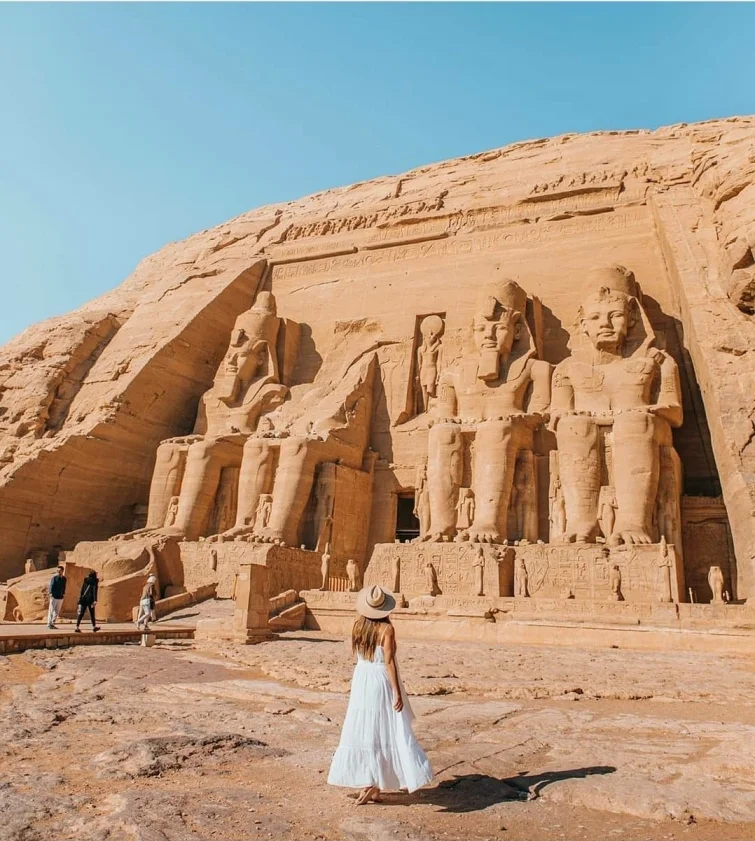
Far south of Luxor, near the modern border with Sudan, stand the extraordinary temples of Abu Simbel.
The larger temple was commissioned by Ramses II, one of the most famous pharaohs of ancient Egypt.
Its façade immediately captures attention because four enormous seated statues of the king dominate the entrance.
Their scale was intentional. The monument communicates power before a visitor even enters the temple.
A temple carved into the rock
Abu Simbel differs from many Egyptian temples because much of the complex was carved directly into the rock.
Inside, visitors find halls and chambers decorated with detailed reliefs. The scenes present the king in religious and military contexts while reinforcing his relationship with the gods.
The smaller temple nearby is associated with Queen Nefertari and the goddess Hathor, creating another important connection between royal power and religious symbolism.
Saving Abu Simbel
The modern history of Abu Simbel is almost as remarkable as its ancient history.
The temples were threatened by the rising waters associated with the construction of the Aswan High Dam during the twentieth century.
An international preservation campaign moved the monuments to a higher location.
Engineers and archaeologists carefully dismantled and reconstructed the temples so they could survive above the new water level.
Today, Abu Simbel represents both ancient Egyptian achievement and modern international cooperation in archaeological preservation.
Temple of Hatshepsut: Where Architecture Meets the Landscape
On the West Bank of Luxor stands the distinctive temple of Hatshepsut.
Hatshepsut was one of the most significant female rulers in ancient Egypt, and her memorial temple reflects the ambition of her reign.
The structure rises in terraces against a dramatic limestone cliff.
Terraces, ramps and symmetry
The temple’s design is immediately different from the massive column-filled spaces of Karnak.
Long terraces and ramps create a strong horizontal pattern, while the cliffs rise vertically behind the monument.
This creates a powerful visual connection between architecture and nature.
Rather than treating the landscape as a background, the designers incorporated it into the monument itself.
Stories from Hatshepsut’s reign
The temple’s reliefs provide insight into the queen’s rule.
One of the most famous themes is the expedition to Punt, a distant region from which Egypt obtained valuable products.
The scenes show ships, people, animals and goods.
They are both artistic compositions and historical records, helping modern visitors understand the interests and ambitions of Hatshepsut’s reign.
Temple of Edfu: A Remarkably Preserved Monument
The Temple of Edfu is dedicated to Horus, one of the most important gods in Egyptian religion.
Located between Luxor and Aswan, it is particularly valuable because much of the temple survives in impressive condition.
The temple was constructed during the Ptolemaic period, long after the great temples of the New Kingdom. Yet its design deliberately followed traditional Egyptian architectural principles.
This makes Edfu an excellent example of how ancient religious traditions continued into later periods.
The Temple of Horus
A monumental pylon marks the entrance.
Beyond it are courtyards, halls, columns and sacred chambers. The walls are covered with reliefs and hieroglyphic inscriptions.
These inscriptions describe religious rituals, myths and ceremonies.
Because so much of the original structure remains, visitors can more easily understand how the different parts of an Egyptian temple were connected.
For anyone interested in ancient Egyptian architecture, Edfu is therefore one of the most rewarding sites to explore.
Kom Ombo: A Temple With Two Religious Traditions
Kom Ombo is one of the most unusual temples along the Nile.
The temple stands beside the river and has a distinctive double design because it was dedicated to two principal deities.
One side was associated with Sobek, the crocodile god, while the other was connected with Horus the Elder.
Why does Kom Ombo have a double design?
The temple’s architecture reflects its dual religious purpose.
Many areas are arranged in parallel, creating two connected but distinct sacred zones.
This unusual plan makes Kom Ombo especially interesting because visitors can see how architecture responded directly to religious beliefs.
The temple also reflects the importance of the Nile and the natural environment.
Crocodiles were part of the ecosystem, and Sobek’s worship connected the animal with ideas of fertility, water and divine power.
Crocodile mummies discovered in the surrounding region provide another fascinating connection between religion and daily life.
Philae Temple: The Sacred World of Isis
Philae is one of Egypt’s most atmospheric temple complexes.
The site was dedicated primarily to Isis, a goddess associated with motherhood, protection and magic.
For ancient Egyptians, the island of Philae was sacred. Its location surrounded by water contributed to its special religious character.
A temple saved from the Nile
The temple complex that visitors see today is not located on its original island.
The construction of the Aswan High Dam created a serious threat to Philae. Rising water could have permanently submerged the monuments.
The complex was therefore moved to nearby Agilkia Island as part of an international preservation project.
Visitors now reach the temple by boat.
The journey across the water creates a memorable introduction to the site and helps emphasize its island setting.
The lasting importance of Isis
The worship of Isis continued for a remarkably long period.
Her story and symbolism remained influential even as Egypt came under different rulers and cultural influences.
Philae therefore represents not only an ancient temple but also the long development of Egyptian religious traditions.
Dendera Temple: The Beauty of Hathor
The Temple of Hathor at Dendera is one of the most beautifully decorated temples in Egypt.
The site has a much older religious history, while the surviving temple was constructed mainly during the Ptolemaic and Roman periods.
It was dedicated to Hathor, a goddess associated with music, joy, motherhood, love and femininity.
The famous Hathor columns
The columns are among the temple’s most recognizable features.
Their capitals contain imagery connected with Hathor, creating a distinctive architectural style.
The decoration continues across the walls and ceilings, where visitors can see an impressive combination of religious symbolism and artistic detail.
The astronomical ceiling
Dendera is also known for its astronomical imagery.
The ceiling decoration reflects ancient Egyptian ideas about the heavens and the relationship between the divine world and the cosmos.
For travelers who enjoy studying architectural details rather than simply photographing famous monuments, Dendera can be especially rewarding.
What Do the Reliefs Inside Egyptian Temples Mean?
One of the most interesting parts of visiting an ancient Egyptian temple is learning how to read its walls.
At first, the combination of hieroglyphs, gods, pharaohs and animals may seem difficult to understand.
However, many scenes follow recurring themes.
The pharaoh is often shown standing before a god. He may present offerings or participate in a religious ceremony.
These images communicate an important idea: the king was responsible for maintaining the relationship between Egypt and the gods.
Words and images worked together
Hieroglyphs were not simply captions added to pictures.
Writing and images formed part of the same visual system.
Inscriptions could identify gods and rulers, describe ceremonies, record royal achievements or communicate religious texts.
The combination of writing and art transformed temple walls into a form of historical and religious communication.
The Gods Behind the Temples
Understanding a few major Egyptian gods can make temple visits much easier.
Amun-Ra
Amun-Ra became one of the most powerful gods in ancient Egypt. His worship was strongly connected with Thebes and Karnak.
Ra
Ra was associated with the sun and played an important role in Egyptian ideas about creation and cosmic order.
Isis
Isis represented motherhood, protection and magic. Philae became one of the most important centers of her worship.
Osiris
Osiris was associated with death, resurrection and the afterlife. His mythology became central to Egyptian beliefs about what happened after death.
Horus
Horus was strongly connected with kingship and protection. He was commonly represented as a falcon or as a human figure with a falcon’s head.
Hathor
Hathor was associated with joy, music, love and motherhood. Dendera was one of the most important centers of her worship.
Sobek
Sobek was associated with crocodiles, water and fertility. His presence is particularly important at Kom Ombo.
How Can Visitors Understand an Egyptian Temple?
You do not need to be an Egyptologist to enjoy these monuments.
A simple approach can make the visit much more meaningful.
Start by looking at the entrance.
Notice the size of the pylon and examine the figures carved into its walls.
Then move toward the courtyard and observe how the space becomes more enclosed.
Pay attention to the columns. Their shape, decoration and capitals can provide clues about the period and religious symbolism of the building.
Next, look closely at the reliefs.
Try to identify the pharaoh and the gods. Notice what the ruler is holding and what he appears to be offering.
Finally, consider the deepest and most restricted areas.
The architecture itself tells a story. The visitor moves from the outside world toward the sacred heart of the temple.
The Nile and the Location of Egyptian Temples
The Nile was the foundation of ancient Egyptian civilization.
It provided water, supported agriculture and connected communities along its banks.
It is therefore not surprising that many important temples were located close to the river.
Traveling through Luxor, Edfu, Kom Ombo and Aswan makes this relationship particularly clear.
Green agricultural fields can appear only a short distance from dry desert landscapes. The contrast is dramatic and helps visitors understand how strongly the Nile shaped life in Egypt.
The river was more than a source of water. It was part of the cultural and religious landscape.
Visiting Ancient Egyptian Temples From Hurghada
For travelers staying in Hurghada, the ancient monuments of Luxor offer an excellent opportunity to experience another side of Egypt.
Hurghada is famous for its beaches, coral reefs, snorkeling and Red Sea excursions. Luxor provides a completely different atmosphere, with temples, ancient tombs and the landscapes of the Nile Valley.
A well-planned Luxor excursion can include several major attractions, depending on the schedule.
Possible stops include:
- Karnak Temple
- Luxor Temple
- Valley of the Kings
- Temple of Hatshepsut
- Colossi of Memnon
The journey itself is part of the experience because the landscape changes as the road moves away from the Red Sea and toward the Nile Valley.
Since a Luxor day trip can be long, travelers should prepare carefully. Comfortable shoes, light clothing, sun protection and sufficient drinking water are especially useful.
When comparing excursions, it is also worth checking the exact itinerary, transportation, inclusions and available time at each site. Travelers looking for cultural excursions from the Red Sea coast can consider providers such as Best Tours Hurghada when planning their trip.
When Is the Best Time to Visit Egyptian Temples?
Egyptian temples can be visited throughout the year, but the weather can influence the experience.
Morning visits are often attractive because temperatures may be more comfortable. The softer light can also create beautiful conditions for photography.
Late afternoon can offer another memorable atmosphere, especially when sunlight creates long shadows across ancient walls and columns.
During hotter periods, however, visitors should plan carefully.
Long walks under direct sunlight can become tiring. A hat, sunscreen, water and comfortable shoes can make a significant difference.
It is also wise to allow enough time for rest rather than trying to see every monument too quickly.
Photography at Ancient Egyptian Temples
Egyptian temples offer an extraordinary range of photographic subjects.
Instead of photographing only the complete monument, look for smaller details.
A decorated column can become a strong architectural composition. A close-up of hieroglyphs can reveal the skill of ancient craftsmen. A statue framed by a temple entrance can create a dramatic image.
The surrounding landscape is also important.
At Hatshepsut’s temple, the cliffs create a natural backdrop. At Karnak, rows of columns provide strong lines and depth. At Luxor Temple, statues and gateways can frame the scene.
The contrast between ancient stone and modern life can also create interesting photographs.
However, visitors should always follow the photography rules of each archaeological site. Some areas may have restrictions, especially inside protected chambers.
Responsible Tourism at Ancient Egyptian Temples
Ancient monuments have survived for thousands of years, but they still need protection.
Visitors play an important role in preserving them.
Do not touch reliefs or inscriptions unless this is specifically permitted. Avoid climbing on monuments and never remove stones, fragments or other archaeological objects.
Follow barriers and signs, even when an area appears accessible.
Photography should also be respectful. If an area prohibits photography or flash, follow the instructions.
Responsible tourism is not complicated.
It simply means treating ancient sites as irreplaceable cultural heritage rather than as ordinary tourist attractions.
By doing so, today’s travelers help ensure that future generations can experience the same monuments.
Ancient Egyptian Temples and the Pyramids
Temples and pyramids are often mentioned together, but they served different purposes.
The pyramids were primarily connected with royal burials, especially during the Old Kingdom.
Temples had broader religious functions.
They were places where priests performed rituals, offerings were presented and the worship of gods was maintained. Some temples were also connected with the cults of deceased kings.
Their architecture reflects these different purposes.
The pyramid focuses on the monumental tomb.
The temple creates a carefully planned sequence that guides visitors toward sacred spaces.
Both reveal the importance of religion and kingship, but they express those ideas in different architectural forms.
Why Do Ancient Egyptian Temples Still Fascinate Visitors?
Their extraordinary age is certainly part of their appeal.
Yet there is something deeper.
These monuments preserve the thoughts and beliefs of people who lived thousands of years ago.
Their walls show how ancient Egyptians imagined their gods. Their inscriptions reveal royal ambitions and religious ceremonies. Their architecture demonstrates remarkable engineering skills.
Most importantly, the temples still feel connected to the people who created them.
A carved relief may show a ceremony that took place thousands of years ago. A column may still carry the name of the ruler who ordered it to be built.
This creates a unique connection between the modern traveler and the ancient world.
A Temple Journey Across Egypt
Travelers who are passionate about ancient Egyptian history can build an entire journey around the country’s major temples.
Begin in Luxor with Karnak and Luxor Temple.
Then explore the West Bank, where the Temple of Hatshepsut stands among the cliffs and the Valley of the Kings preserves royal tombs.
Continue south toward Edfu and Kom Ombo.
From there, travel to Aswan and discover Philae.
If the itinerary allows, continue to Abu Simbel for one of Egypt’s most dramatic archaeological experiences.
Dendera can also be included for travelers who want to explore the decorative style and religious traditions of later Egyptian periods.
Each monument is different.
Together, however, they reveal how Egyptian temple architecture developed and how religious traditions continued to evolve over thousands of years.
Frequently Asked Questions About Ancient Egyptian Temples
What is the most famous ancient Egyptian temple?
Karnak is one of the most famous and extensive temple complexes in Egypt. Its huge columns, monumental gateways and long history make it one of the most important attractions in Luxor.
Which Egyptian temple is the best preserved?
The Temple of Horus at Edfu is among the best-preserved major temples in Egypt. Its surviving halls, columns, reliefs and inscriptions make the original design relatively easy to understand.
What was the purpose of ancient Egyptian temples?
Temples were sacred religious centers where priests performed rituals and presented offerings to the gods. They also expressed royal power and the pharaoh’s responsibility for maintaining divine and cosmic order.
Why are Egyptian temples covered with hieroglyphs?
Hieroglyphs recorded religious texts, royal names, titles, ceremonies and important events. They also formed an essential part of the visual decoration of the temple.
Which Egyptian temple is dedicated to Hathor?
The Temple of Hathor at Dendera is the most famous temple dedicated to Hathor. Its distinctive columns, detailed reliefs and astronomical imagery make it particularly interesting.
Can I visit ancient Egyptian temples from Hurghada?
Yes. Luxor is one of the most popular cultural destinations for travelers staying in Hurghada. Depending on the itinerary, visitors can explore Karnak, Luxor Temple, the Valley of the Kings and other important sites.
How much time is needed to explore Egypt’s main temples?
It depends on the number of locations you want to visit. One day can introduce travelers to several important sites around Luxor, while a longer itinerary is better for exploring Edfu, Kom Ombo, Philae and Abu Simbel.
Are ancient Egyptian temples suitable for families?
Yes, many children find the stories of pharaohs and gods fascinating. Families should nevertheless consider walking distances, temperatures and the length of the excursion when planning a temple visit.
Final Thoughts: Ancient Egyptian Temples Tell Stories in Stone
The ancient Egyptian temples are much more than impressive archaeological monuments.
They are windows into a civilization that developed complex ideas about religion, kingship, death and the universe.
Karnak demonstrates the enormous scale that Egyptian temple architecture could achieve. Luxor Temple reveals the close relationship between religion and royal power. Abu Simbel showcases the ambition of Ramses II, while Hatshepsut’s temple demonstrates how architecture can become part of the surrounding landscape.
Edfu offers an exceptionally well-preserved example of traditional temple design. Kom Ombo reveals how one complex could serve two major deities. Philae tells the story of Isis and the remarkable effort to save her temple from rising waters. Dendera, meanwhile, displays the extraordinary detail and symbolism of later Egyptian religious architecture.
Together, these monuments create a journey through thousands of years of history.
For travelers staying in Hurghada, exploring Luxor provides a fascinating contrast to the Red Sea. After relaxing beside the water or discovering the coral reefs, visitors can travel into the Nile Valley and encounter temples that have survived for millennia.
The key is to look beyond the size of the monuments.
Study the columns. Notice the hieroglyphs. Look at the relationship between the pharaoh and the gods. Observe how light enters the different spaces. Think about why the architects placed each element where it is.
Once you begin looking at temples this way, they become much more than ancient buildings.
They become stories written in stone — stories of gods, kings, beliefs, ceremonies and human ambition that continue to fascinate travelers thousands of years later.