Some countries teach their history through books.
Egypt tells its story through stone, sand, and silence.
Here, history does not sit behind glass alone—it rises from the desert in the shape of pyramids, whispers from temple walls, and sleeps beneath painted tomb ceilings. To travel through Egypt is not simply to move from one place to another; it is to walk through thousands of years of human civilization, step by step.
This is why Egypt history tours are unlike any other journeys in the world. They do not just show you monuments—they unfold a story. And that story begins long before modern cities, borders, or even written alphabets.
Let us travel through Ancient Egypt chronologically, guided by the places that still stand today.
Chapter One: Where Eternity Began – The Pyramids of Giza
The story of Ancient Egypt begins with a belief more powerful than armies or gold: the belief in eternity.
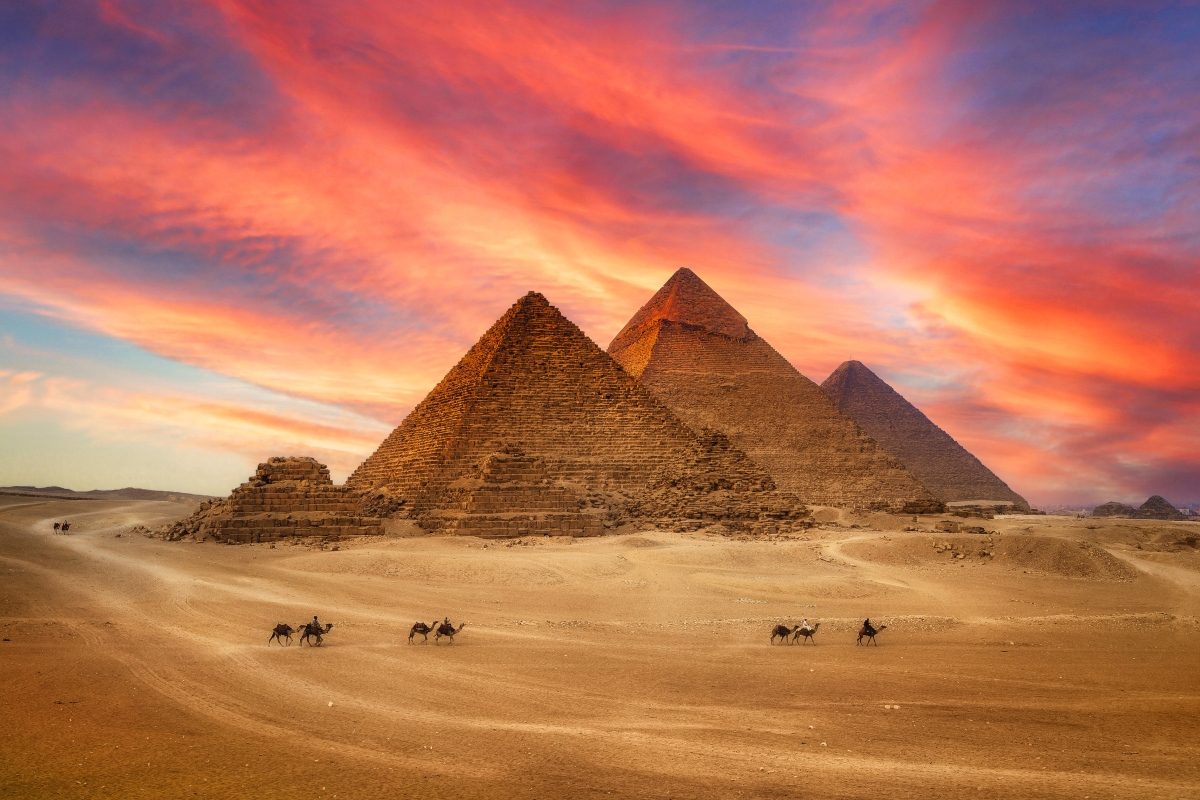
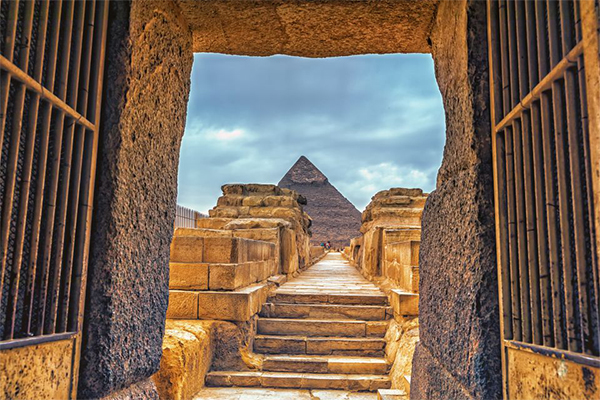
On the western edge of Cairo’s desert plateau rise the pyramids of Giza, monuments so familiar that many forget how radical they were when first built. The Pyramids of Giza were not just royal tombs; they were cosmic machines designed to launch the soul of the king into the afterlife.
Life, Death, and the Afterlife
During Egypt’s Old Kingdom (c. 2686–2181 BCE), the pharaoh was considered divine. His death was not an end but a transformation. Every limestone block, every corridor angle, every burial chamber was aligned with the stars.
Standing before the Great Pyramid of Khufu, visitors on historical tours in Egypt often fall silent—not because of its size alone, but because of the realization that this structure has stood for over 4,500 years.
Nearby, the Great Sphinx gazes east, guarding the necropolis. With the body of a lion and the face of a king, it embodies royal power and divine protection—concepts that shaped Egyptian civilization for millennia.
Here, Ancient Egypt teaches its first lesson: life is temporary, but legacy is eternal.
Chapter Two: Writing, Memory, and Daily Life – Saqqara and the Birth of Stone Architecture
South of Giza lies Saqqara, where Egypt experimented, failed, and succeeded.
The Step Pyramid of Djoser represents the moment Egypt shifted from mudbrick to stone—a technological leap that changed architecture forever. Though less famous than Giza, Saqqara reveals how Ancient Egyptians learned by doing, adapting ideas over generations.
Tombs here are filled with scenes of farming, fishing, baking, and music. These carvings remind us that Ancient Egypt was not only about kings—it was about people, routines, and survival along the Nile.
On Egypt history tours, Saqqara often surprises travelers most. It feels intimate. Human. Relatable.
Chapter Three: Power Shifts South – The Rise of Thebes
As centuries passed, political power moved south. The city of Thebes—modern Luxor—became the heart of Egypt during the Middle and New Kingdoms.
This is where Egypt’s story becomes richer, more complex, and deeply spiritual.
Chapter Four: Gods on Earth – Karnak Temple
If the pyramids symbolize eternity, Karnak symbolizes divine power in motion.
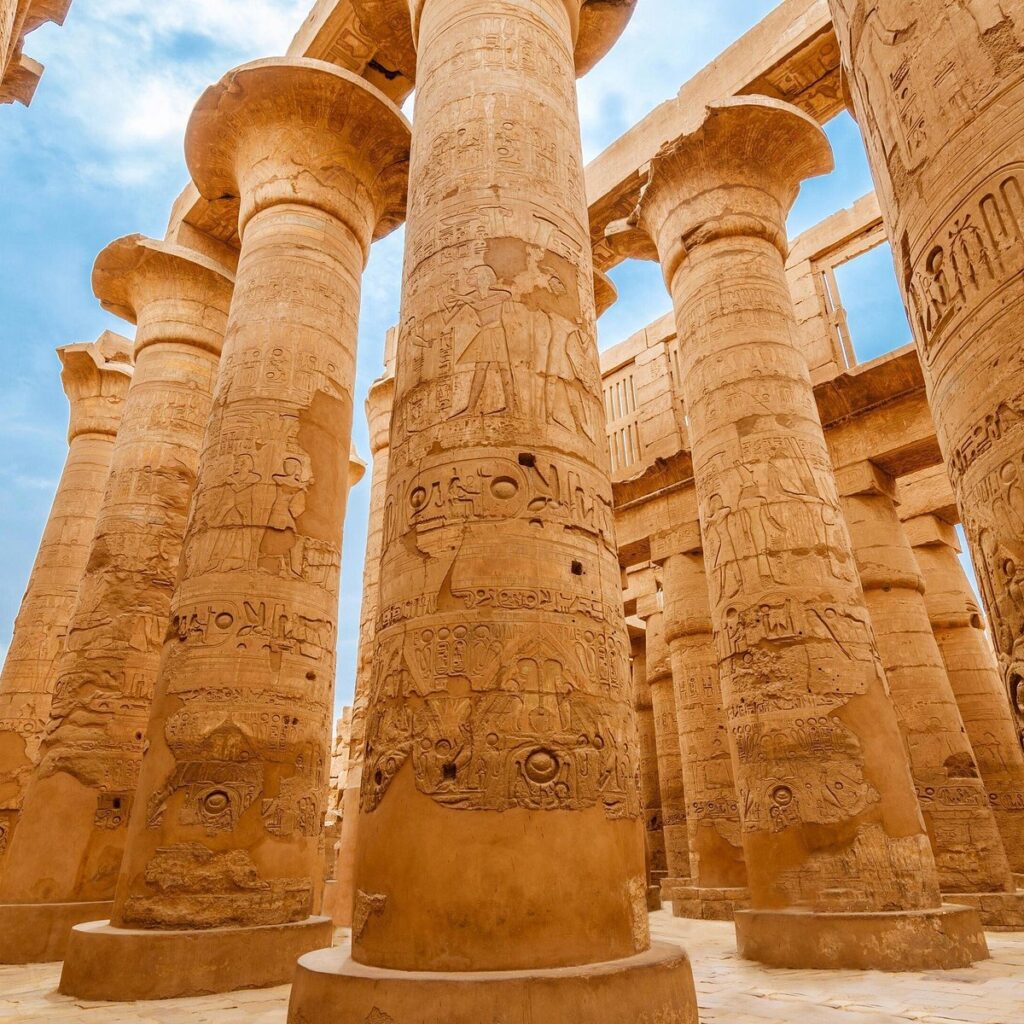
The vast Karnak Temple is not a single temple but a religious city built over 2,000 years. Every pharaoh added something, trying to leave a mark worthy of the gods.
Walking through the Hypostyle Hall—134 towering columns covered in hieroglyphs—feels like entering a forest of stone prayers. These walls record battles, rituals, offerings, and festivals. They were not decoration; they were communication with the divine.
Karnak shows how religion, politics, and architecture merged into one powerful system. To rule Egypt was to serve the gods—and to be remembered by them.
Chapter Five: The Human Side of Kingship – Luxor Temple
While Karnak celebrated the gods, Luxor Temple celebrated kingship itself.
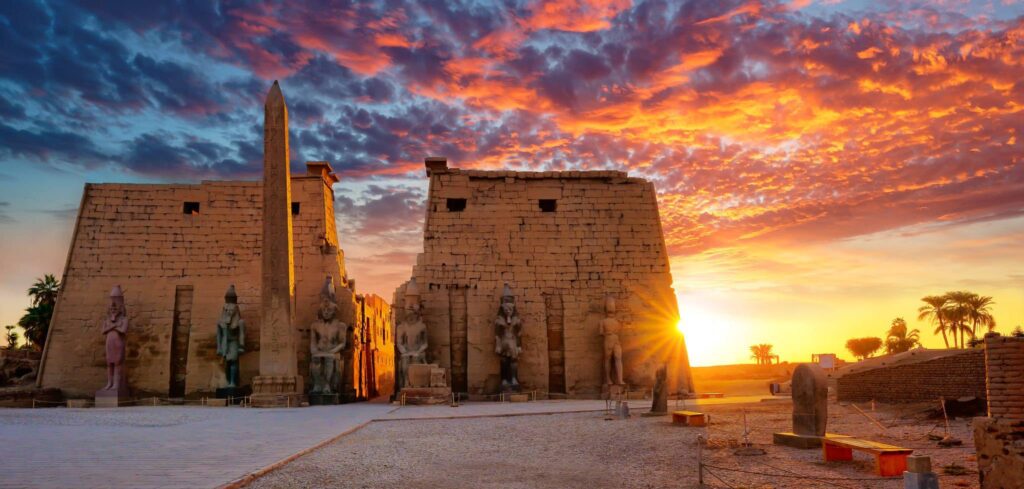
Connected to Karnak by a ceremonial avenue of sphinxes, Luxor Temple was the stage for festivals, coronations, and renewal rituals. Pharaohs came here not to be buried, but to prove they deserved to rule.
What makes Luxor Temple unique is its continuity. Romans, Christians, and Muslims all reused the space, leaving layers of history stacked upon one another. It teaches an important lesson on Egypt history tours: Egypt was never frozen in time—it evolved.
Chapter Six: Death Redefined – The Valley of the Kings
If Giza was about visible eternity, the New Kingdom chose secrecy.
Hidden in desert cliffs lies the Valley of the Kings, where Egypt’s greatest rulers were buried deep underground. Tombs were no longer monuments but journeys—painted guides for the soul’s passage into the afterlife.
Inside the Tombs
Walls glow with vibrant scenes from the Book of the Dead and the Amduat. These texts were maps of the underworld, filled with dangers, gods, and trials.
Tombs like that of Tutankhamun—small but intact—reveal how burial rituals reflected belief, fear, and hope. Gold masks, amulets, and spells all served one purpose: rebirth.
Standing inside these chambers, visitors realize that Ancient Egyptians were not obsessed with death—they were obsessed with continuation.
Chapter Seven: Queens, Power, and Legacy – Hatshepsut’s Temple
Ancient Egypt was ruled by kings—but not only kings.
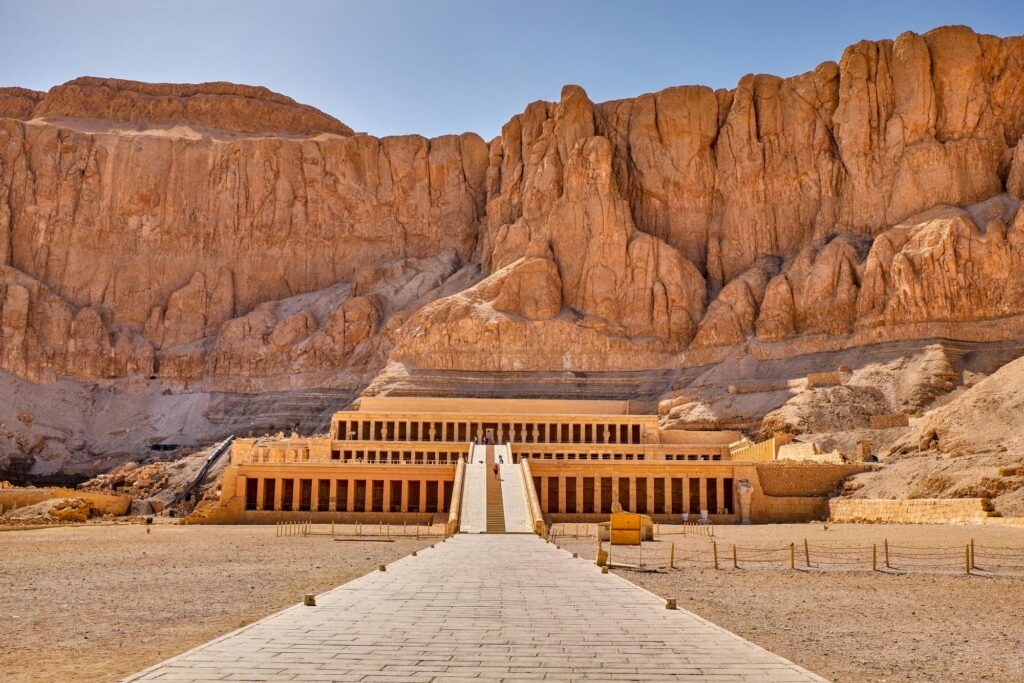
The mortuary temple of Temple of Hatshepsut rises elegantly from the cliffs of Deir el-Bahari. Hatshepsut, one of Egypt’s most successful rulers, governed peacefully and expanded trade.
Her temple tells a political story: reliefs show her divine birth, trade expeditions, and legitimacy. In a male-dominated world, architecture became her argument.
This site challenges assumptions and adds depth to historical tours in Egypt, proving that power took many forms.
Chapter Eight: Knowledge Preserved – Museums as Time Capsules
To truly understand Ancient Egypt, one must see how its artifacts were preserved.
The Egyptian Museum (and its newer counterparts) gathers statues, papyri, jewelry, and mummies under one roof. Here, travelers connect fragments from temples and tombs into a complete narrative.
Museums show how writing developed, how medicine functioned, how art followed strict symbolic rules. They bridge field experience with intellectual understanding—an essential part of Egypt history tours.
Chapter Nine: The Nile – The Silent Protagonist
No site tells Egypt’s story without mentioning the Nile.
Every temple faces it. Every tomb depended on it. The Nile was calendar, highway, food source, and spiritual symbol. On river cruises, travelers experience Egypt the way ancient people did—slowly, rhythmically, guided by water.
The Nile reminds us that civilization here was not accidental. It was engineered around nature.
Why Experiencing These Sites Together Matters
Reading about Ancient Egypt offers facts.
Visiting its sites in sequence offers understanding.
From pyramids to temples, from hidden tombs to museum halls, each place answers a question raised by the last. This is why curated Egypt history tours are so powerful—they transform scattered monuments into a living timeline.
You do not just learn what happened.
You feel why it mattered.
Final Reflection: Egypt as a Living Story
Ancient Egypt is not finished speaking.
Its temples still echo with prayers. Its tombs still protect dreams of eternity. Its stones still carry fingerprints of workers, priests, and kings.
To walk through Egypt is to walk through humanity’s earliest questions:
- What happens after death?
- How do we leave meaning behind?
- How do belief, power, and creativity shape civilization?
And the answers are still there—etched into stone, waiting for those willing to listen.